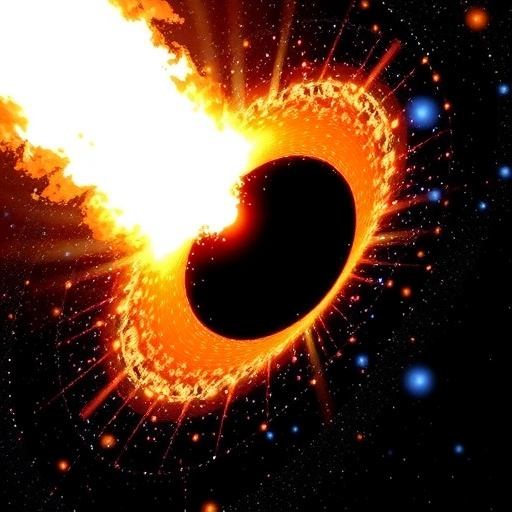
A recent breakthrough in neutrino astrophysics may illuminate one of the universe’s most enduring mysteries—the elusive nature of dark matter—through a tantalizing connection to primordial black holes (PBHs). In a groundbreaking study published today in Physical Review Letters, MIT physicists present a compelling theoretical framework suggesting that the most energetic neutrino ever detected could originate from the explosive final moments of a primordial black hole evaporating near our solar system. This revelation, if confirmed, could mark the first direct observational evidence of Hawking radiation and forge an unexpected path to solving the dark matter conundrum.
Neutrinos, often labeled “ghost particles,” permeate the universe in staggering numbers but rarely interact with matter, making them notoriously difficult to detect. Their ethereal nature contrasts sharply with their abundance, as they are thought to outnumber atomic particles by a billion to one. Recently, the underwater neutrino observatory KM3NeT, situated deep beneath the Mediterranean Sea, observed a neutrino possessing an energy exceeding 100 peta-electron volts—over ten million times the energy produced by the most powerful human-made particle accelerators. The origin of this cosmic powerhouse has bewildered scientists, provoking questions about the physical processes capable of generating such extraordinary particles.
MIT’s theoretical investigation, spearheaded by graduate student Alexandra Klipfel and professor David Kaiser, explores the hypothesis that this neutrino burst emerged from the cataclysmic evaporation of a primordial black hole. Unlike their supermassive stellar counterparts, primordial black holes are thought to be minuscule remnants from the earliest fractions of a second after the Big Bang. These micro black holes, if they exist, could not only endure across cosmic time but might also constitute a significant fraction, or even the entirety, of the mysterious dark matter lurking in galaxies.
The underlying mechanism theorized to produce such neutrino emissions hinges on Hawking radiation, a phenomenon first proposed by Stephen Hawking in the 1970s. According to quantum field theory in curved spacetime, black holes are not entirely black but instead emit radiation due to quantum effects near the event horizon. Over immense timescales, this radiation causes black holes to lose mass, grow hotter, and emit increasingly energetic particles, culminating in a final, violent outburst when the black hole shrinks to atomic scales. This explosive event releases a torrent of ultra-high-energy particles, including neutrinos, that could traverse vast cosmic distances.
Calculations by the MIT team indicate that if primordial black holes are indeed the primary component of dark matter, their distribution throughout the Milky Way means a subset would reach this explosive finale at present times. Statistically, it is plausible that one such explosion occurred within a proximity sufficiently close to our solar system—around 2,000 astronomical units away—to shower Earth with detectable high-energy neutrinos. The researchers estimate approximately an 8% chance of such an event happening within a 14-year span, a likelihood substantial enough to warrant serious scientific consideration.
This hypothesis could also potentially reconcile the puzzling tension between observations made by two leading neutrino observatories: KM3NeT and IceCube. While IceCube, which is embedded deep within Antarctic ice, has detected a small number of high-energy neutrinos over the past decade, none matched the extraordinary energies seen by KM3NeT. If primordial black holes accounted for a continuous background rate of particle emission through their gradual evaporation— punctuated by occasional violent explosions—both observatories’ data could be understood as complementary facets of the same underlying phenomenon.
To delve into the particle emission characteristics, the researchers applied rigorous thermodynamic and quantum calculations to model how PBHs radiate as they shrink. Unlike massive astrophysical black holes, which have temperatures near absolute zero and emit negligible Hawking radiation, microscopic PBHs reach temperatures soaring into the trillions of Kelvin in their final nanoseconds. This thermal runaway causes the emission of enormous quantities of energetic particles, including a sextillion neutrinos clustering around the 100 peta-electron volt scale.
Recognizing the rarity of such explosions, the team further investigated the frequency and spatial distribution of PBH evaporation events in the galactic neighborhood. Their statistical model depends heavily on the assumption that PBHs constitute most of dark matter, influencing the rate of these high-energy bursts sufficiently to explain the detection rates at Earth-based neutrino observatories. These findings open a novel observational window to probe black hole physics and the dark sector of the cosmos simultaneously.
Detecting Hawking radiation directly has long been considered a daunting challenge, with astrophysical black holes too massive and cold to yield measurable signals. The MIT study suggests that primordial black holes provide the “best chance” to finally observe these emissions due to their tiny size and resulting extreme temperatures. The confirmation of such signatures would constitute a historic validation of Hawking’s theory, anchoring a critical pillar of quantum gravity and black hole thermodynamics.
Future advancements hinge on enhanced detection sensitivity and accumulation of more ultra-high-energy neutrino events across multiple observatories worldwide. Collaborative efforts among detectors like KM3NeT and IceCube, along with novel instruments under development, could amass the statistics necessary to identify more PBH evaporation instances. Confirmation of this scenario would revolutionize our understanding of the universe’s composition, linking the enigmatic nature of dark matter with fundamental physics at the intersection of quantum mechanics and general relativity.
Additionally, complementary searches for nearby primordial black holes—involving gravitational lensing, gamma-ray bursts, or other messenger particles—could corroborate the hypothesis from independent vantage points. The confluence of these observational strategies thus serves as the frontier for dark matter research and black hole astrophysics in the decades to come.
While the notion of microscopic black holes exploding nearby may seem exotic, the careful theoretical work by Klipfel and Kaiser underscores how current observations push the boundaries of contemporary physics toward these extraordinary possibilities. As instruments grow more refined and data accumulates, the cosmos may soon reveal whether these ghostly particles carry the fingerprints of primordial black holes, opening a new chapter in unraveling the deepest secrets of space and time.
Subject of Research: Primordial black holes as sources of ultra-high-energy neutrinos and dark matter candidates.
Article Title: “Ultra-High-Energy Neutrinos from Primordial Black Holes”
Web References: Physical Review Letters – DOI 10.1103/vnm4-7wdc
Keywords
Black holes, Primordial black holes, Hawking radiation, Neutrinos, Ultra-high-energy neutrinos, Dark matter, Particle physics, Astroparticle physics, Cosmic neutrinos, Astrophysics, Space sciences, Astronomy
Tags: cosmic particle originsdark matter mysteriesexplosive black hole evaporationghost particles detectionHawking radiation evidencehigh-energy neutrinosMIT physicists researchneutrino astrophysics breakthroughsprimordial black holessolar system anomaliesTheoretical frameworks in astrophysicsunderwater neutrino observatory KM3NeT