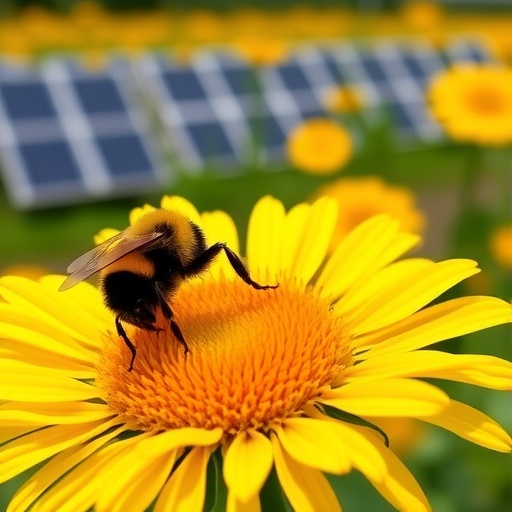
Solar farms are emerging as critical habitats for bumblebee populations in the United Kingdom, according to a groundbreaking study conducted by an interdisciplinary team from Lancaster University, the UK Centre for Ecology & Hydrology, and the University of Reading. As agricultural practices evolve and urbanization alters landscapes, it becomes increasingly vital to explore innovative avenues for biodiversity conservation. This study not only highlights the importance of managing solar farms effectively but also provides a comprehensive look at how these renewable energy installations can serve as refuges for one of the planet’s most vital pollinators.
The importance of bumblebees extends beyond individual species; they play a crucial role in pollinating a wide range of crops and wild plants, contributing significantly to biodiversity and ecosystem health. However, bumblebee populations have been in decline due to habitat loss, pesticide use, and climate change. With the backdrop of these ecological challenges, the new study sheds light on whether solar farms can offer a viable solution to bolster dwindling bumblebee numbers.
One of the pivotal findings from the research is the significant influence of solar farm management practices on bumblebee populations. Specifically, the research team found that solar farms managed with wildflower margins, as opposed to traditional turf grass coverage, could increase bumblebee numbers by a staggering 120%. This represents a doubling of bumblebee populations, underlining the potential of thoughtful management strategies to create abundant foraging resources that are essential for the survival of these insects.
Moreover, the researchers employed a high-resolution modeling technique to predict how the UK’s existing 1,042 solar farms might contribute to sustaining bumblebee populations in the face of changing land-use scenarios over the coming decades. Through this innovative approach, they examined three different socio-economic landscapes informed by established future visions—sustainable, intermediate, and fossil-fuel-driven development. By downscaling these scenarios to a meticulous 10-meter resolution, the team was able to analyze how habitat availability, management strategies, and ecological dynamics can work in tandem to support bumblebee species.
Of particular interest was the discovery that the immediate landscape surrounding solar farms is the determining factor influencing bumblebee densities. The study found that while well-managed solar farms can indeed provide local refuges, their impact is limited to their immediate vicinity. This suggests that while solar farms are beneficial in their own right, their influence does not extend far beyond their borders. As the surrounding landscape composition changes—due to factors like declining agricultural land and urban expansion—the importance of connecting bumblebee habitats becomes increasingly evident.
The implications of this research are profound, especially in light of ongoing discussions about land use and renewable energy production. Dr. Hollie Blaydes, a lead author of the study, emphasized that while solar farms cannot wholly counteract the effects of broader landscape changes, they can still play a meaningful role in mitigating habitat loss. This is significant as countries, including the UK, push for a major shift toward renewable energy as a countermeasure to climate change.
To capitalize on their potential, the study advocates for strategic planning in the placement of new solar farms. Such planning could connect fragmented bumblebee habitats or introduce new resources where they are currently scarce. This calls for a collaboration between energy producers, conservationists, and policymakers to create landscapes that not only support renewable energy but also enhance biodiversity.
In conclusion, this innovative research paints a hopeful picture for the future of bumblebees in a rapidly changing world. While solar farms are not a panacea for the challenges that bumblebee populations face, they offer a promising conservation tool if managed effectively. The findings are a clarion call to use renewable energy sites not just as power generators but as cultivated refuges for biodiversity. As we forge ahead in our commitment to renewable energy, we must not lose sight of the intricate relationships between human progress and ecological sustainability, ensuring that the wings of bees can continue to flutter across our changing landscapes.
Subject of Research: Bumblebee conservation through solar farm management
Article Title: Solar Farms as Vital Refuges for Bumblebee Populations
News Publication Date: October 8, 2025
Web References: N/A
References: N/A
Image Credits: Dr. Hollie Blaydes
Keywords
Biodiversity conservation, solar energy, renewable energy, ecological management, bumblebee habitat affordability.
Tags: bumblebee conservation strategiesconservation solutions for declining bumblebee numbersimpact of agricultural practices on pollinatorsimportance of pollinators in agricultureinterdisciplinary research in ecologyrenewable energy and biodiversityrole of bumblebees in ecosystem healthsolar farm design for pollinator supportsolar farms as wildlife habitatssustainable land management for bee populationsurbanization effects on bumblebee habitatswildflower margins for bumblebee attraction