• HOME
  • NEWS
  • EXPLORE
    • CAREER
      • Companies
      • Jobs
    • EVENTS
    • iGEM
      • News
      • Team
    • PHOTOS
    • VIDEO
    • WIKI
  • BLOG
  • COMMUNITY
    • FACEBOOK
    • INSTAGRAM
    • TWITTER
Friday, April 10, 2026
BIOENGINEER.ORG
No Result
View All Result
  • Login
  • HOME
  • NEWS
  • EXPLORE
    • CAREER
      • Companies
      • Jobs
        • Lecturer
        • PhD Studentship
        • Postdoc
        • Research Assistant
    • EVENTS
    • iGEM
      • News
      • Team
    • PHOTOS
    • VIDEO
    • WIKI
  • BLOG
  • COMMUNITY
    • FACEBOOK
    • INSTAGRAM
    • TWITTER
  • HOME
  • NEWS
  • EXPLORE
    • CAREER
      • Companies
      • Jobs
        • Lecturer
        • PhD Studentship
        • Postdoc
        • Research Assistant
    • EVENTS
    • iGEM
      • News
      • Team
    • PHOTOS
    • VIDEO
    • WIKI
  • BLOG
  • COMMUNITY
    • FACEBOOK
    • INSTAGRAM
    • TWITTER
No Result
View All Result
Bioengineer.org
No Result
View All Result
Home NEWS Science News Chemistry

Correlated rattling atomic chains reduce thermal conductivity of materials

Bioengineer by Bioengineer
January 19, 2023
in Chemistry
Reading Time: 2 mins read
0
Figure 1
Share on FacebookShare on TwitterShare on LinkedinShare on RedditShare on Telegram

A group of researchers has recently unveiled a novel mechanism that leads to further suppression of thermal conductivity in thermoelectric materials, something that will help develop new guidelines for producing high-performance thermoelectric materials.
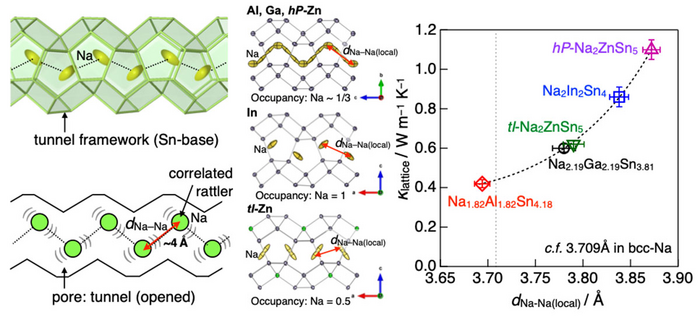
Figure 1

Credit: Takahiro Yamada et al.

A group of researchers has recently unveiled a novel mechanism that leads to further suppression of thermal conductivity in thermoelectric materials, something that will help develop new guidelines for producing high-performance thermoelectric materials.

Details of their research were published in the journal Advanced Materials on December 17, 2022.

Controlling the ease with which heat is transmitted through a material, i.e., thermal conductivity, has a wide range of applications to our everyday lives: from insulating our homes, to improving the performance of electronic devices, as well as enhancing the energy conservation of automobiles and aviation and generating greater power efficiency.

Scientists are increasingly interested in thermal management technology as a means to solve various heat-related problems and to effectively utilize thermal energy.

When the research group placed atomic chains into tunnel spaces within intermetallic compound crystal structures, the atoms strongly correlated with each other in large amplitude vibrations, or “rattling.” Vigorous experiments and theoretical calculations demonstrated that the stronger the correlation between rattling atoms, the greater the decrease in thermal conductivity.

“Since advancements in thermoelectric materials require lower thermal conductivity, our discovery can provide new guidelines for engineering improved thermoelectric materials,” states Takahiro Yamada, professor at Tohoku University’s Institute of Multidisciplinary Research for Advanced Materials (IMRAM) and co-author of the paper.

Also involved in the group was Professor Hisanori Yamane, also from IMRAM, Dr Masahiro Kanno from Tohoku University’s Graduate School of Engineering (at the time of research), Professor Masato Yoshiya from Osaka University’s Graduate School of Engineering, Associate Professor Hiroshi Takatsu and Professor Hiroshi Kageyama from Kyoto University’s Graduate School of Engineering, Chief Senior Research Scientist Dr Takuji Ikeda from the National Institute of Advanced Industrial Science and Technology’s (AIST) Research Institute for Chemical Process Technology, and Senior Research Scientist Dr Hideaki Nagai from AIST’s Research Institute for Energy Conservation.


Journal

Advanced Materials

DOI

10.1002/adma.202207646

Article Title

Correlated rattling of sodium-chains suppressing thermal conduction in thermoelectric stannides

Article Publication Date

17-Dec-2022

Share12Tweet8Share2ShareShareShare2

Related Posts

Breakthrough in Mainz: New Dual-Frequency Paul Trap Achieves Milestone Toward Antihydrogen Creation

Breakthrough in Mainz: New Dual-Frequency Paul Trap Achieves Milestone Toward Antihydrogen Creation

April 10, 2026
blank

Ultra-Low Efficiency Roll-Off and Over 20% Efficiency Achieved in High Color Purity Blue Perovskite QLEDs

April 10, 2026

Bumblebee Bacterium Enables Vitamin B2 Production in Soya Drinks

April 10, 2026

Pharma.AI Spring Kickoff 2026: Advancing the Future of Pharmaceutical Intelligence

April 10, 2026

POPULAR NEWS

  • Boosting Breast Cancer Risk Prediction with Genetics

    47 shares
    Share 19 Tweet 12
  • Popular Anti-Aging Compound Linked to Damage in Corpus Callosum, Study Finds

    44 shares
    Share 18 Tweet 11
  • Imagine a Social Media Feed That Challenges Your Views Instead of Reinforcing Them

    1012 shares
    Share 400 Tweet 250
  • Revolutionary Theory Transforms Quantum Perspective on the Big Bang

    41 shares
    Share 16 Tweet 10

About

We bring you the latest biotechnology news from best research centers and universities around the world. Check our website.

Follow us

Recent News

OHSU Study Uncovers Mechanisms Behind Pancreatic Cancer’s Resistance to Immunotherapy

Antibodies Block Shiga Toxin Kidney Damage Additively

Carbapenem Resistance Mutations Alter Pseudomonas Infection Dynamics

Subscribe to Blog via Email

Enter your email address to subscribe to this blog and receive notifications of new posts by email.

Join 78 other subscribers
  • Contact Us

Bioengineer.org © Copyright 2023 All Rights Reserved.

Welcome Back!

Login to your account below

Forgotten Password?

Retrieve your password

Please enter your username or email address to reset your password.

Log In
No Result
View All Result
  • Homepages
    • Home Page 1
    • Home Page 2
  • News
  • National
  • Business
  • Health
  • Lifestyle
  • Science

Bioengineer.org © Copyright 2023 All Rights Reserved.