Rearing temperatures exert a pronounced and measurable influence on the expression of warning signals in the aposematic seed bug Lygaeus simulans, according to experimental investigations tracking colorimetric shifts across developmental stages. Laboratory trials revealed that exposure to cooler conditions markedly elevates red pigmentation in adult dorsal patterns, effectively masking a recessive yellow phenotype. When individuals carrying a distinct pale mutation were reared from embryonic or post-embryonic stages at twenty-four degrees Celsius, their visual appearance shifted so extensively along chromatic opponent channels that they became visually indistinguishable to the human eye from standard wild-type adults. At warmer rearing conditions of twenty-nine and thirty-two degrees Celsius, the typical phenotypic contrast re-emerged, maintaining bright yellow patches on the pale mutants and vivid red markings on the wild-type insects. These measured visual alterations demonstrate that bright aposematic color signals possess thermal plasticity that operates well beyond early embryogenesis, challenging standard evolutionary assumptions that natural selection strictly enforces uniform warning displays within single insect populations.
Visual warning signals, known collectively as aposematism, serve as a widespread defensive adaptation through which toxic, distasteful, or otherwise unpalatable organisms advertise their unprofitability to visual predators such as birds. Classic evolutionary theory posits that selection should drive these conspicuous markings toward strict uniformity within and between populations, because naive predators learn to avoid unprofitable prey most rapidly and reliably when confronted with a single, unvarying pattern. Despite this expected convergence, broad intraspecific colour variation persists across many aposematic species in nature. Ecological fluctuations, including shifting seasonal cycles, variable ambient temperatures, diverse predator communities, and localized microclimate alterations caused by human habitat disruption, continually shape warning displays. While temperature-dependent pigmentation shifts have been documented in insect systems such as butterflies and dragonflies, these historical examples largely involve thermal melanism, wherein darker cuticular patterns contract as ambient temperatures climb to assist in thermoregulation. Controlled demonstrations showing direct thermal modulation over bright carotenoid- or pteridine-like warning hues remain far less documented.
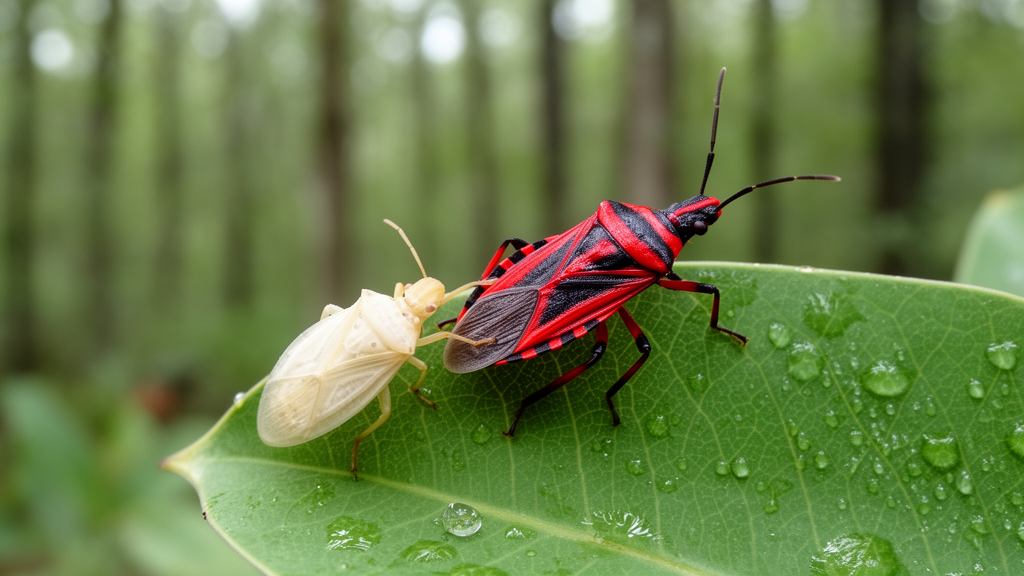
The seed bug Lygaeus simulans, a widespread hemipteran belonging to the family Lygaeidae, occupies Southern and Central Europe across a broad Palearctic distribution. In natural habitats, wild-type adults display a striking, conspicuous pattern consisting of deep black and scarlet red markings across their hemelytra and pronotum, signaling their unpalatability to local insectivorous predators. Within established laboratory colonies derived from wild founders collected in Tuscany, Italy, researchers previously identified a spontaneously occurring pale mutant lineage characterized by yellow-and-black adult markings and grey-green nymphal bodies, contrasting with the vibrant red-and-white coloration seen in wild-type nymphs. Crossing experiments established that this pale mutant phenotype follows strict Mendelian inheritance governed by an autosomal recessive allele. Although anecdotal observations had suggested that pale mutant individuals occasionally developed redder coloration when ambient chamber temperatures dropped, the precise developmental sensitivity, exact chromatic coordinates, physiological correlates, and biochemical mechanisms underlying this chromatic transition had never been systematically measured under controlled laboratory conditions.
To rigorously investigate whether warning signal expression in Lygaeus simulans responds directly to ambient rearing conditions, researchers maintained breeding pairs at an established baseline of twenty-nine degrees Celsius under a constant photoperiod of twenty-two hours of light and two hours of darkness at sixty percent relative humidity to avert reproductive diapause. Freshly deposited one-day-old eggs and actively feeding second-instar nymphs were daily separated and assigned across four tightly regulated climate chambers maintained at twenty-four, twenty-six, twenty-nine, and thirty-two degrees Celsius. This two-stage experimental design permitted researchers to decouple embryonic thermal sensitivity from post-hatching developmental plasticity. The experimental insects remained within their assigned thermal regimes throughout nymphal development until completing their imaginal moult into adulthood. Standardized cohort tracking confirmed that individuals introduced to the temperature regimes as second-instar nymphs displayed colorimetric shifts entirely consistent with those transferred as embryos, confirming that the physiological mechanisms governing warning signal plasticity remain responsive to ambient environmental cues well into late larval development.
Quantifying color variation with objective precision required calibrated multispectral digital photography rather than subjective human scoring. Fully hardened adult bugs were pinned adjacent to a standardized forty-millimetre neutral grey reflectance standard and photographed in a dark room under constant sunray illumination using a modified full-spectrum digital camera fitted with a specialized quartz-compatible lens. Sequential exposures captured both visible spectra at low sensor sensitivity and ultraviolet wavelengths at elevated sensitivity across multiple exposure brackets. The resulting photographic channels were aligned and calibrated using specialized image analysis software to generate standardized human cone-catch values within the three-dimensional CIELAB colour space. Researchers evaluated two distinct aposematic dorsal regions of interest per specimen, deriving precise coordinates across Luminance, the Red-Green opponent channel where higher positive values represent increased red reflectance, and the Yellow-Blue opponent channel where positive values indicate a yellow shift.
Statistical modeling of colorimetric coordinates across three hundred and twenty adult specimens demonstrated powerful main effects and significant interactions between genetic morph and rearing temperature. Luminance values rose significantly with increasing rearing temperatures across all groups, with pale mutants showing a substantially steeper upward trajectory than wild-type bugs. Analysis of the Red-Green opponent channel confirmed that wild-type insects maintained higher baseline redness across all temperatures, yet both morphs experienced a pronounced reduction in red values as rearing temperatures increased from twenty-four to thirty-two degrees. The pale mutant exhibited greater chromatic sensitivity across this thermal gradient; at twenty-four degrees Celsius, elevated red-channel coordinates caused the pale mutant to converge visually with the wild type. Concurrently, Yellow-Blue channel values increased steadily with higher temperatures, particularly among pale mutants, which displayed their most vivid yellow coloration at twenty-nine and thirty-two degrees Celsius. Post-hoc comparisons revealed that chromatic metrics reached a physiological plateau, with no significant colorimetric differences detected between the twenty-nine and thirty-two degree regimes.
The developmental temperature regimes produced marked morphological consequences beyond cuticular pigmentation, directly altering adult body mass and longitudinal dimensions. Measurements gathered from hundreds of newly emerged adults demonstrated that both body weight and body length scaled positively with rearing temperatures. Insects maintained at twenty-four degrees Celsius emerged significantly smaller and lighter than those reared under warmer ambient temperatures, an effect that proved especially severe among wild-type insects. Sex differences were pronounced across all treatments, with adult females consistently displaying greater body mass and longer body length than males across both genetic morphs. Notably, pale mutant bugs maintained at the cooler twenty-four degree treatment retained higher mean adult weights and larger overall body dimensions than their wild-type counterparts, establishing a complex interaction between metabolic development, genetic morph, and environmental thermal constraints during nymphal growth.
Survival tracking across experimental cohorts indicated that low thermal regimes impose substantial physiological costs upon developing seed bugs. Cohorts reared at twenty-four degrees Celsius suffered reduced nymphal survival rates compared to cohorts maintained at warmer temperatures. Furthermore, mature adult bugs maintained continuously under the twenty-four degree regime exhibited total reproductive failure, producing eggs that consistently failed to hatch under laboratory observation. This reproductive cessation mirrors known cold-season dynamics observed in the closely related seed bug Lygaeus equestris, an ecologically similar species known to enter reproductive diapause as ambient temperatures decline to twenty-five degrees Celsius. In contrast, adults reared at thirty-two degrees Celsius successfully copulated and produced viable offspring despite operating near the upper boundary of their natural thermal threshold, indicating that the twenty-four degree threshold represents a stressful physiological limit that coincides with the seasonal onset of autumn in temperate Palearctic environments.
To investigate whether cuticular color polymorphism associates with systemic proteomic remodeling, researchers performed high-resolution SWATH mass spectrometry on whole-body lysates obtained from reproductively mature virgin males and females reared at the twenty-nine degree control temperature. This data-independent acquisition approach quantified seven hundred and nine distinct proteins across replicate samples. Principal Component Analysis revealed that primary variation separated predominantly along the axis of biological sex, accounting for over forty-one percent of total variance, while secondary components cleanly segregated individuals by color morph. Comparative screening identified fifteen proteins exhibiting statistically significant differential expression between wild-type and pale mutant bugs after false discovery rate corrections. These differentially expressed proteins clustered within functional pathways governing carbohydrate conversion, such as glycogen phosphorylase, external chemical perception, including odorant-binding proteins, glandular secretion through salivary proteins, and cellular defense mechanisms responsive to oxidative stress.
Among the differentially expressed proteins detected in proteomic screening, Glutathione S-transferase emerged as a key candidate due to its established multifunctional role in facilitating xenobiotic detoxification and regulating reactive oxygen species in herbivorous insects. Whole-body quantitative spectrometry showed that Glutathione S-transferase levels were significantly upregulated in pale mutants relative to wild-type bugs at twenty-nine degrees Celsius. To determine whether this abundance translated into functional enzymatic activity across differing environmental regimes, researchers measured total Glutathione S-transferase activity in flash-frozen tissues using kinetic spectrophotometric assays tracking substrate conjugation. The enzymatic assays corroborated the proteomic findings at twenty-nine degrees, showing elevated baseline activity in pale mutant females and males. However, temperature exposure altered these dynamics in a sex-dependent manner: while female pale mutants maintained consistently high enzyme activity across both twenty-four and twenty-nine degrees Celsius, wild-type males showed a significant elevation in activity when reared at twenty-four degrees, matching the elevated levels characteristic of pale mutant males.
The co-occurrence of heightened red warning coloration, reduced adult body size, suppressed survival, and altered antioxidant enzyme activity points toward extensive physiological trade-offs governing phenotypic plasticity. In many herbivorous insects, red and yellow warning hues rely on de novo pteridine or ommochrome synthesis, biochemical pathways that consume essential amino acid precursors and demand substantial antioxidant investments. Seed bugs of the genus Lygaeus actively sequester toxic cardenolides from host plants, an adaptive chemical defense that requires a finely tuned oxidative state in vivo. Sequestration and detoxification processes consume reduced glutathione, creating direct competition between antioxidant maintenance and pigmentary investment. Investing limited metabolic resources into producing denser red pigments under cold stress may deplete cellular antioxidant reserves, compounding the developmental costs of sub-optimal temperatures and contributing to reduced body size and lower nymphal viability observed in cold-reared cohorts.
Ecologically, the expression of darker and redder warning displays at cooler temperatures could provide survival benefits that offset developmental and reproductive stresses during seasonal transitions. In temperate European ecosystems, autumn temperature declines coincide with vegetation senescence and reduced overall insect abundance. Avian predators, possessing keen visual systems capable of discriminating subtle variations in warning signal saturation, forage more intensively as alternate prey becomes scarce. A deeper red coloration enhances optical contrast against browning backgrounds, reinforcing learned predator avoidance when predation risk intensifies. However, because field-based survival trials tracking predation rates across natural Lygaeus simulans populations across changing seasons remain to be conducted, the functional significance of this thermal plasticity in natural settings remains an open hypothesis requiring expanded ecological and biochemical validation.
Subject of Research: Temperature-dependent warning coloration and proteomic variation in Lygaeus simulans
Article Title: Temperature‐Dependent Warning Colour Variation in an Aposematic Insect
Article References: Zhao, J., Black, D., Abbs, M. M., Smith, T. K., Shirran, S. L., Synowsky, S. A., Rowland, H. M., Groot, A. T., Shuker, D. M., & Burdfield‐Steel, E. R. (2026). Temperature‐Dependent Warning Colour Variation in an Aposematic Insect. Ecology and Evolution, 16(11), Article e73683. https://doi.org/10.1002/ece3.73683
Image Credits: AI Generated
DOI: 10.1002/ece3.73683
Keywords: Lygaeus simulans, aposematism, warning coloration, thermal plasticity, colour polymorphism, seed bugs, proteomics, SWATH-MS, glutathione S-transferase, oxidative stress, phenotypic plasticity, insect physiology, CIELAB colour space, pigment synthesis, multispectral imaging, ecological trade-offs
News Source: Alan Morgan. (November 12, 2026). Cooler Rearing Temperatures Turn Pale Mutant Seed Bugs Wild Red. Scienmag.