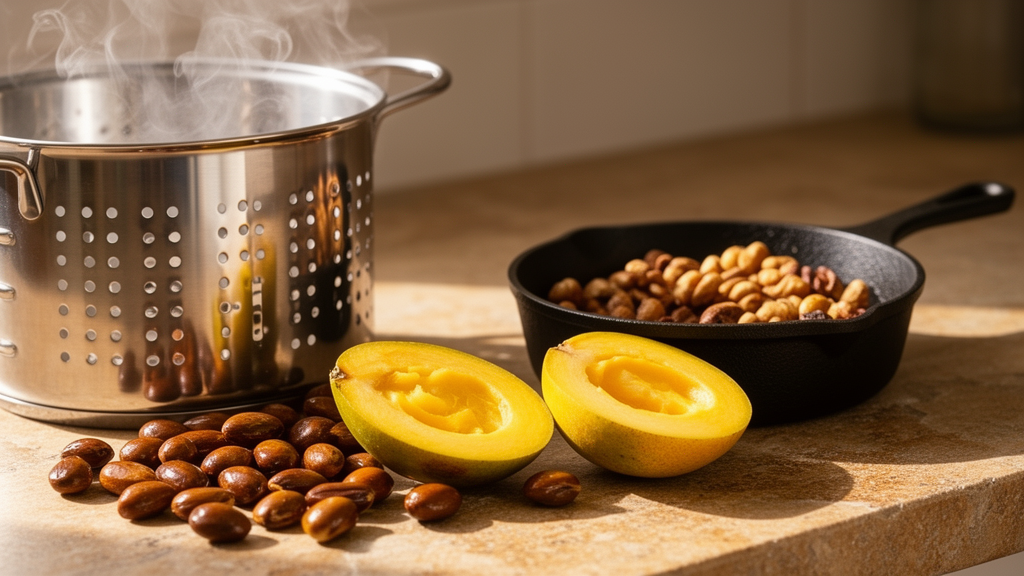
Researchers from the University of Dschang in Cameroon and the National Institute of Food Technology in India have investigated how post-harvest treatments and solvent extraction methods affect the biological properties of Pouteria campechiana nuts. Published in the journal Food, Nutrition and Health in November 2025, the study provides a detailed quantitative analysis of an underutilized crop that is often discarded as waste. The team examined the influence of roasting, boiling, and combined boiling and roasting on the phytochemical content, antioxidant capacity, and in vitro anti-diabetic potential of these nuts. This work addresses a gap in food science by focusing on the nut component of the canistel fruit, which has received less attention than the fruit pulp in previous nutritional studies.
The study utilized a quantitative experimental design to assess the secondary metabolites and biological activities of the nut extracts. The research team collected mature wild Pouteria campechiana fruits from farmers in the Melong town of Cameroon. After removing the pulp, the nuts were separated into four distinct batches to test different culinary treatments. One batch served as a control and was dried at 50 degrees Celsius for 45 hours. A second batch was roasted at 120 degrees Celsius for 15 minutes, while a third was boiled at 95 degrees Celsius for 30 minutes. The fourth batch underwent a double treatment, being boiled first and then roasted. All treated nuts were subsequently dried, crushed, and sieved to a uniform particle size of 500 micrometers before extraction.
To isolate the bioactive compounds, the researchers prepared ethanolic and hydroethanolic extracts from each of the four sample batches. The extraction process followed a specific protocol where 100 grams of nut powder were mixed with 250 milliliters of either 96% ethanol or a 50/50 water-ethanol mixture. The mixtures were shaken vigorously twice a day for 48 hours at a controlled temperature of 24.5 degrees Celsius. After filtration through muslin and filter paper, the residue was re-extracted twice to ensure maximum yield. The resulting extracts were dried and stored at minus 10 degrees Celsius for subsequent phytochemical and biological analyses, ensuring a standardized approach to evaluating the effects of the different treatments.
The phytochemical characterization revealed significant variations in phenolic and flavonoid content depending on the extraction solvent and cooking method. With ethanol extraction, the phenolic content decreased as the intensity of the treatment increased. The untreated sample contained 73.72 mg GAE/g of phenolic compounds, which dropped to 45.51 mg GAE/g in the roasted sample and further to 29.49 mg GAE/g in the boiled-roasted sample. In contrast, hydroethanolic extraction significantly improved the phenolic content in the treated samples. The phenolic content increased from 42.31 mg GAE/g in the raw sample to 57.05 mg GAE/g in the roasted sample. This suggests that the addition of water in the hydroethanolic mixture facilitates the extraction of semi-polar phenolic compounds that are less accessible in pure ethanol, particularly after heat treatment.
Flavonoid levels also responded differently to the treatments and solvents. The flavonoid content in ethanolic extracts ranged from 9.89 mg CE/g in the untreated sample to 17.58 mg CE/g in the boiled sample. For hydroethanolic extracts, the range was from 8.51 mg CE/g in the roasted sample to 16.20 mg CE/g in the boiled sample. The study noted that the type of solvent had a significant effect on the flavonoid content of the roasted sample, with ethanol generally yielding higher concentrations. The researchers explained that boiling induces the diffusion of water molecules into the cells, leading to turgor and lysis, which facilitates the release of flavonoids. However, the polar nature of the hydroethanolic solvent was found to be less compatible with the non-polar structure of many flavonoids, resulting in lower extraction yields for this specific class of compounds.
The antioxidant potential of the extracts was evaluated using two in vitro assays: the ferric reducing antioxidant power (FRAP) and the DPPH radical scavenging activity. The FRAP assay measured the ability of the extracts to reduce ferric iron to ferrous iron, a process linked to the stabilization of transition metals involved in oxidative reactions. The results showed that the reducing potential of ferric iron was highest at a concentration of 200 micrograms per milliliter. The raw canistel nut extract exhibited a reducing capacity close to that of BHT, a synthetic antioxidant widely used in food formulations. This activity was attributed to the high richness of phenolic and flavonoid compounds in the untreated sample, which act as electron donors to stabilize the ferric ion.
In the DPPH radical scavenging assay, the boiled-roasted sample demonstrated the highest reducing capacity among the treated samples. The hydroethanolic extract of the boiled-roasted sample showed a DPPH reduction potential between 20 and 40 percent, while the ethanolic extract ranged from 8 to 20 percent. This finding contrasts with the phenolic content results, where the boiled-roasted sample had the lowest levels. The researchers hypothesized that the double treatment destroys intramolecular bonds in phenolic compounds, causing them to lose their crystalline structure and facilitating the release of protons during redox reactions. This structural modification appears to enhance the antiradical activity despite the lower total phenolic concentration, highlighting the complex relationship between compound structure and biological activity.
The in vitro anti-diabetic potential was assessed by measuring the inhibitory capacity of the extracts on alpha-amylase and amyloglucosidase enzymes, which are crucial for carbohydrate digestion. The ethanolic extract of the boiled-roasted sample was the most active inhibitor of alpha-amylase, with an EC50 value of less than 12.50 micrograms per milliliter. The high activity of the boiled-roasted ethanolic extract was linked to the release of phenolic compounds during the double treatment, which modify the ionization state of amino acids in the active site of the amylase enzyme. This competitive inhibition mechanism suggests that the bioactive compounds in the nuts can effectively limit the breakdown of starch into simpler sugars.
For amyloglucosidase, the inhibitory activities of all extracts were lower, remaining below 40 percent across all concentrations. The ethanolic extract of the boiled-roasted sample, which was highly active against alpha-amylase, showed less activity against amyloglucosidase. This discrepancy was attributed to the low phenolic content in the boiled-roasted sample and the specific molecular interactions required for amyloglucosidase inhibition. The roasted and raw samples showed the highest activity against amyloglucosidase, potentially due to the presence of specific compounds like 1,3-propanediol and catechol. These findings indicate that the inhibitory potential of the nut extracts varies significantly depending on the specific enzyme targeted and the extraction method used.
A Principal Component Analysis was conducted to identify correlations between the samples and the evaluated variables. The analysis revealed that the untreated and boiled-roasted samples contributed significantly to the formation of the first principal component, which was associated with total phenols, DPPH, and FRAP activities. The boiled sample was primarily associated with the second component, linked to hydroethanolic extracts and their DPPH activity. Roasting was responsible for the formation of the third component, which correlated with flavonoid content and amyloglucosidase inhibitory activity. These statistical associations confirm that the culinary treatments and extraction solvents have distinct and measurable effects on the bioactive profile of the nuts, with the double treatment uniquely enhancing certain antioxidant and anti-diabetic properties.
The study concludes that culinary processing and extraction solvent choice are critical factors in determining the biological potential of Pouteria campechiana nuts. While ethanolic extraction yielded higher levels of secondary metabolites, hydroethanolic extracts often demonstrated superior biological activities, particularly in antioxidant assays. The boiled-roasted sample, despite having lower phenolic content, exhibited the highest DPPH radical scavenging activity and the most potent alpha-amylase inhibition. These results provide valuable information for the pharmaceutical and food industries, suggesting that specific processing methods can optimize the recovery of bioactive compounds from underutilized crops.
The researchers acknowledged several limitations in the study, noting that the biological activities were assessed only in vitro. In vivo evaluation of the anti-diabetic, antioxidant, and anti-carcinogenic potential of the extracts is necessary to confirm the observed effects in a biological system. Furthermore, the study did not perform GC-MS profiling to identify the specific secondary metabolites responsible for the observed activities. Future research should focus on optimizing the extraction process and identifying the molecular mechanisms behind the anti-diabetic and antioxidant properties of these nuts. Despite these limitations, the study highlights the potential of canistel nuts as a functional food source that can contribute to the management of stress-related pathologies through dietary intervention.
Subject of Research: Influence of post-harvest treatments and solvent extraction on antioxidants potential, enzymes inhibitions activities and phytochemical content of Pouteria campechiana (Kunth) Baehni nuts (underutilized crops)
Article Title: Influence of post-harvest treatments and solvent extraction on antioxidants potential, enzymes inhibitions activities and phytochemical content of Pouteria campechiana (Kunth) Baehni nuts (underutilized crops)
Article References: Tambo Tene, S., Ndomou, S. C. H., Bemmo, U. L. K., Dangang, D. S. B., Tagne, J. G. T., & Natarajan, V. (2025). Influence of post-harvest treatments and solvent extraction on antioxidants potential, enzymes inhibitions activities and phytochemical content of Pouteria campechiana (Kunth) Baehni nuts (underutilized crops). Food, Nutrition and Health, 2(1), Article 32. https://doi.org/10.1007/s44403-025-00042-z
Image Credits: AI Generated
DOI: 10.1007/s44403-025-00042-z
Keywords: Influence, post-harvest, treatments, solvent, extraction, antioxidants, potential, enzymes, inhibitions, activities, phytochemical, content
News Source: Alan Morgan. (November 10, 2026). Cooking Methods Alter Antioxidant Potential in Underutilized Canistel Nuts. Scienmag.