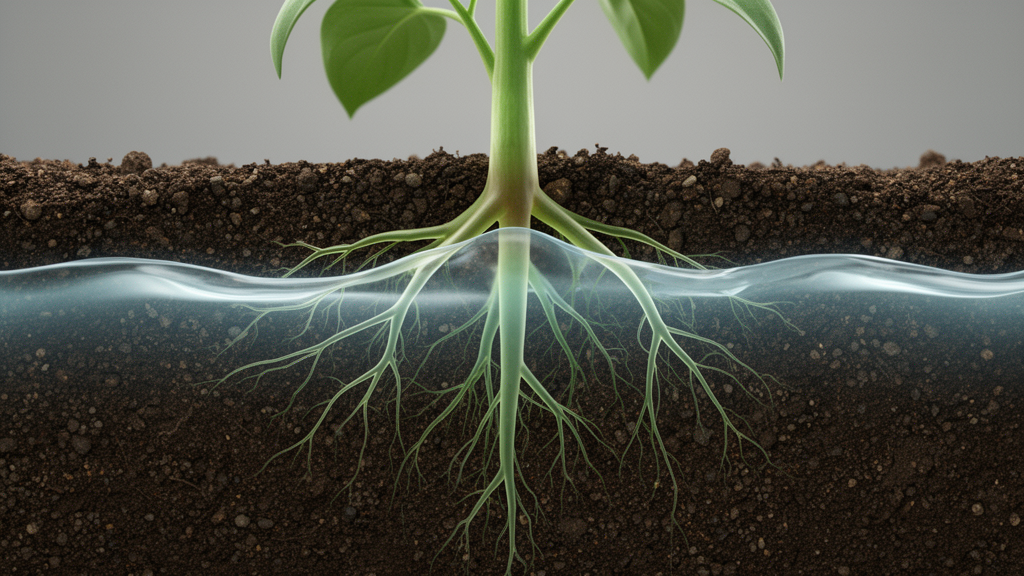
Inferences regarding where vegetation extracts moisture across the subsurface depend critically on an analytical decision that researchers rarely scrutinize: the precise manner in which the soil profile is divided into separate, discrete water sources. According to a scientific analysis published in Nature Plants by Han Fu, Wenxiu Zou, Bingcheng Si, and Asim Biswas, the conventional practice of dividing continuous soil into arbitrary categorical depth intervals can fundamentally alter or even completely reverse research conclusions regarding plant hydration strategies. Rather than forcing root systems into artificial boxes, the authors demonstrate that continuous mathematical representations of root water uptake eliminate arbitrary boundaries, return depth-resolved profiles, and re-establish a direct link between isotope-based inferences, plant root biology, and the physical principles governing soil moisture transport.
Determining the exact depths from which roots extract moisture represents an enduring and deceptively simple question within environmental biology and agronomy. The resulting determinations shape how scientists interpret drought tolerance in wild species and crops, how breeders phenotype root systems for target environments, how agricultural managers schedule irrigation, and how global land-surface models partition evapotranspiration into its constituent flux components. Nevertheless, the prevailing analytical framework used to resolve this depth profile almost universally depends on an unstated assumption: that a plant selectively chooses among a small collection of discrete, isolated water pools positioned directly one above another within the ground.
For more than three decades, environmental researchers have relied on stable isotopes of hydrogen and oxygen as standard tools to trace moisture sources, identify plant water uptake pathways, and understand water movement across the soil-plant-atmosphere continuum. Because soil water exhibits an isotopic signature that varies systematically across depth, analysts can match the isotopic composition of collected xylem water against that soil profile to infer uptake depths without excavating root systems. Over time, this analytical workflow became routine, with Bayesian mixing models originally engineered for animal dietary studies—chief among them the widely adopted MixSIAR software package—emerging as the default computational framework for partitioning plant water sources among predetermined soil compartments.
However, importing an analytical framework directly from animal foraging ecology into soil hydrology introduced a hidden conceptual cost. While dietary components ingested by animals represent genuinely discrete items, such as distinct prey or plant species, a natural soil profile does not exist as separate boxes. Despite this reality, discrete mixing models require researchers to segment the continuous profile into a small collection of sources, typically three to five layers, forcing the user to arbitrarily decide where each boundary lies, such as setting intervals at ten, thirty, or fifty centimeters. A recent critical review highlighted by the authors reveals that altering the total number or the spatial placement of these layer boundaries substantially shifts estimated source contributions, in several cases moving the inferred dominant water source from one portion of the soil profile to an entirely different depth.
The mathematical distortions caused by subjective boundary placement are clearly illustrated by oxygen stable isotope profiles, measured as δ18O representing the per mil deviation of the 18O/16O ratio relative to the Vienna Standard Mean Ocean Water reference standard. When soil water δ18O declines continuously with depth and xylem water isotopic composition is evaluated against it using a discrete Bayesian mixing model, two equally defensible sets of layer boundaries yield contradictory root water uptake density profiles. Under a boundary scheme placed at 0.1 meters and 0.4 meters, soil situated deeper than 0.4 meters appears to supply a major share of total plant water uptake; conversely, under boundaries set at 0.2 meters and 0.5 meters, that identical deep soil zone appears to supply virtually no water. In contrast, applying a continuous formulation without predetermined boundaries estimates uptake density as a smooth function across depth, successfully recovering a single peak near 0.3 meters alongside the full breadth of uptake surrounding it.
Although pedologists identify genuine soil horizons based on physical and developmental characteristics, these morphological horizons rarely match the arbitrary layer boundaries chosen in mixing models, and living root systems do not encounter soil as stepped intervals. Key biological and physical properties—including fine-root length density, unsaturated hydraulic conductivity, matric potential, and volumetric water content—vary continuously across the vertical depth axis, with gradients steepening and relaxing dynamically as soils dry and rewet. Forcing a continuous profile into three or four discrete boxes discards the higher spatial resolution present within isotope data and reduces a graded physiological process into rigid categories. Furthermore, simply increasing the number of discrete layers fails because two isotopic tracers cannot mathematically resolve many discrete sources; neighboring depths frequently carry nearly identical isotopic values, causing each additional layer to sacrifice source identifiability, making estimated proportions less constrained by physical data and increasingly dictated by prior model settings.
The practical consequences of this layer partitioning extend far beyond academic debates over statistical preferences and carry substantial management ramifications. On China’s Loess Plateau, where woody vegetation drives roots many meters deep into thick loess deposits and stable isotope methods are routinely deployed to apportion moisture extraction across those deep depths, grouping identical isotopic profiles under alternative layering schemes yields fundamentally conflicting biological conclusions. Under one grouping approach, the trees appear entirely dependent on shallow soil moisture, whereas an alternate grouping indicates deep soil water is the primary resource sustaining them. These opposing outputs do not represent minor variations around a shared baseline, but instead offer contradictory explanations of how trees survive severe drought, leading to divergent implications for plantation forestry and the valuation of deep groundwater reserves.
Two additional statistical pitfalls compound the instability of discrete mixing frameworks, beginning with the application of Bayesian priors. Bayesian models necessitate that prior assumptions be defined mathematically before experimental data are evaluated, yet default Dirichlet priors commonly provided for multiple discrete sources are not neutral regarding depth. As researchers increase the number of layers, the default prior unevenly weights the profile before a single measured isotope value is processed, an issue exacerbated because most practitioners accept software defaults without sensitivity testing. The second issue involves analytical circularity, where researchers group adjacent soil depths based on isotopic similarity and subsequently use those identical isotopes as source tracers in the mixing model, double-using the data, artificially narrowing the posterior distribution, and exaggerating statistical confidence.
To overcome these systemic limitations, the authors emphasize a continuous mathematical formulation that estimates root water uptake as a probability density function across continuous depth rather than solving for a vector of proportions across arbitrary intervals. Although early implementations over two decades ago demonstrated that Amazonian tree water uptake could be modeled with normal distributions to capture rainfall shifts, modern computational advances provide far greater flexibility. Contemporary continuous Bayesian models utilize beta distributions, mixture distributions, and semi-nonparametric frameworks capable of representing asymmetric and multimodal uptake curves, allowing researchers to characterize peak uptake depth and profile breadth directly while capturing dynamic phenomena like compensatory uptake—where plants draw water disproportionately from deep soil when surface layers dry—as smooth structural changes in a continuous function.
Adopting continuous models offers immediate tangible benefits for plant science, agriculture, and global environmental modeling by treating the continuous uptake profile as a functional phenotype. This continuous profile can be directly correlated with root system architecture, compared across crop genotypes, and utilized in breeding programs to select for resilient water acquisition strategies rather than relying on crude proxies like maximum rooting depth. For agricultural engineers, continuous profiles clarify the exact depths from which crops extract water to optimize irrigation timing, while providing crop and land-surface models with representations of biological water uptake that match the continuous differential equations governing soil water physics.
Moving forward, the authors call on the scientific community to abandon discrete soil layers as an analytical default, formally evaluate Bayesian priors through rigorous sensitivity testing, and reconnect isotope tracing with fundamental soil physics. Because isotopes merely record the historical origin of water molecules rather than the physical mechanisms moving them along hydraulic potential gradients, integrating root and soil hydraulic conductivities with isotopic constraints yields more parsimonious and physically defensible results. While natural experimental complexities—such as extraction artifacts, isotopic fractionation during uptake and transport, and sub-daily fluctuations in xylem water composition—remain persistent physical boundaries in ecohydrology, the authors conclude that partitioning continuous soil into three or four artificial boxes is an unnecessary self-imposed limitation that researchers should replace with continuous models reflecting how plants actually drink.
Subject of Research: Continuous mathematical modeling versus discrete layer partitioning in isotope-based plant root water uptake analysis
Article Title: Plants do not drink in layers
Article References: Fu, H., Zou, W., Si, B., & Biswas, A. (2026). Plants do not drink in layers. Nature Plants. https://doi.org/10.1038/s41477-026-02492-5
Image Credits: AI Generated
DOI: 10.1038/s41477-026-02492-5
Keywords: root water uptake, stable isotopes, Bayesian mixing models, MixSIAR, soil water profile, continuous modeling, xylem water, oxygen isotopes, hydrogen isotopes, compensatory uptake, soil hydrology, Loess Plateau, root architecture, hydraulic conductivity, matric potential, evapotranspiration, irrigation scheduling, phenotyping
News Source: Drew Townsend. (November 20, 2026). Continuous Models Overturn Assumptions That Plants Absorb Water From Discrete Layers. Scienmag.