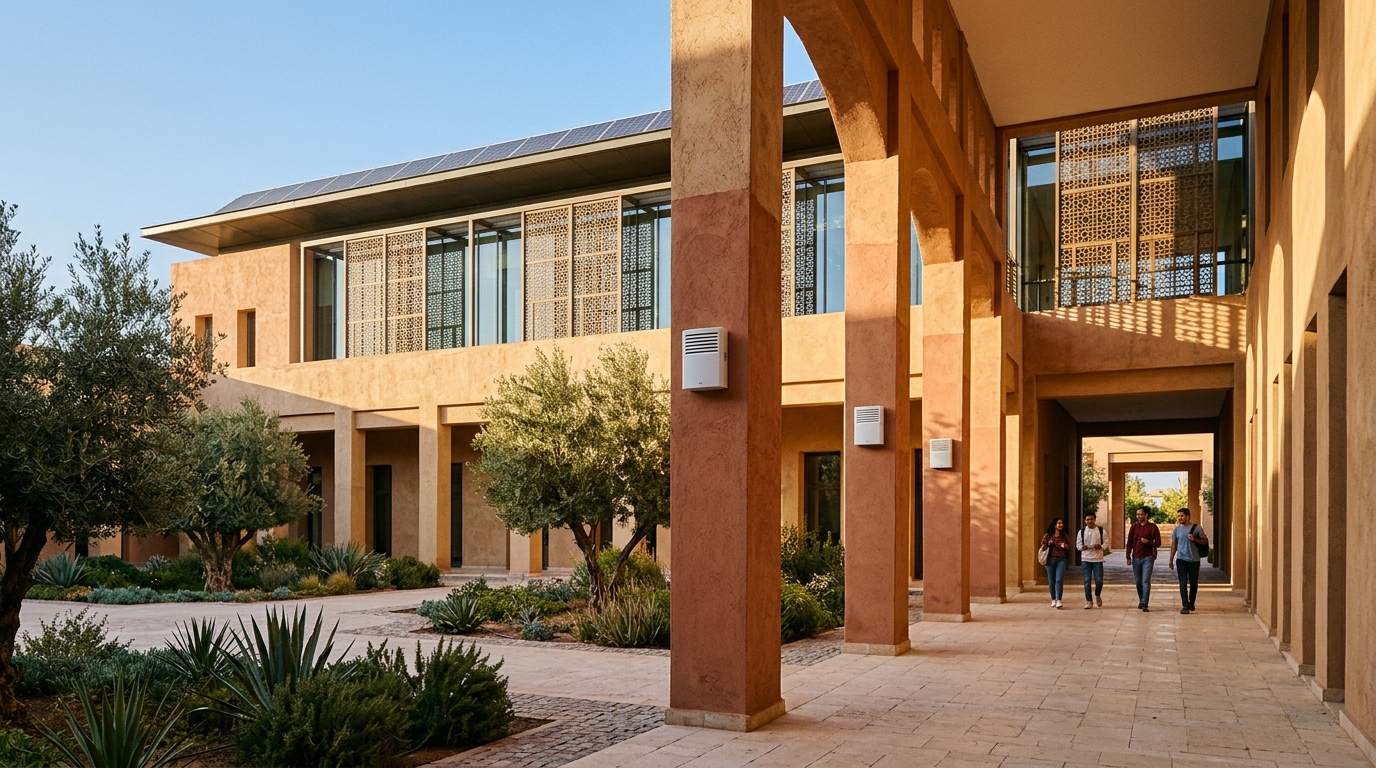
A scenario-based assessment of a newly developed smart university framework for the Private University of Marrakech in Morocco projects an expansion of digitalized campus services from a baseline of 40 percent to 85 percent. The evaluation also estimates that learning management system usage would rise from 55 percent to 90 percent, alongside an estimated 30 percent reduction in normalized administrative processing time across institutional workflows.
Existing models are frequently not sufficiently adapted to higher education institutions in semi-arid zones, where operational resilience, elevated energy demand, severe water scarcity, and indoor thermal comfort represent persistent organizational priorities.
Rather than detailing an active, completed campus implementation, the paper formulates a structured conceptual framework and examines its anticipated outcomes through benchmark-supported scenario modeling. The analytical design contrasts an existing baseline scenario at the Private University of Marrakech, known as UPM, against a projected smart university scenario evaluated across selected operational performance indicators.
The proposed framework combines international institutional benchmarks with a phased implementation roadmap explicitly tailored to the environmental and administrative conditions of UPM. To inform the phased roadmap, the authors incorporated international best practices and lessons drawn from digital transformation initiatives at the National University of Singapore.
A central technical component of the proposed framework is the Smart Campus Data Backbone, an integrated network architecture structured around Internet of Things, edge, fog, and cloud layers. This computing architecture is engineered to coordinate campus environmental monitoring, operational resource management, administrative digitization, learning management platform integration, and data-driven decision-making processes.
Alongside projected operational improvements, the researchers identified significant technical and organizational hurdles that could complicate execution. Key challenges detailed in the assessment include maintaining system interoperability, providing adequate staff training, establishing cybersecurity safeguards, instituting comprehensive data governance frameworks, and managing the strategic prioritization of individual smart components.
The authors conclude that the proposed framework delivers a scalable and practical roadmap to assist UPM Marrakech in transitioning toward a more sustainable, integrated, and data-driven institutional model. They note that the structured implementation process also offers guidance for other university campuses facing comparable ecological, climatic, and resource challenges in semi-arid regions.
Subject of Research: Context-adapted smart university implementation framework for campuses in semi-arid regions
Article Title: Smart sustainable university campuses in semi-arid regions: application of the Smart University implementation process at UPM Marrakech
Article References: Halimi, Y., Kahot, Z., Lafqir, F. E., Hidar, T., & Kabil, S. (2026). Smart sustainable university campuses in semi-arid regions: application of the Smart University implementation process at UPM Marrakech. City, Territory and Architecture. https://doi.org/10.1186/s40410-026-00338-3
Image Credits: AI Generated
DOI: 10.1186/s40410-026-00338-3
Keywords: smart campus, digital transformation, higher education, semi-arid regions, UPM Marrakech, Private University of Marrakech, smart university framework, Smart Campus Data Backbone, IoT-Edge-Fog-Cloud architecture, environmental monitoring, resource management, learning management systems, administrative digitalization, data governance, cybersecurity, interoperability, thermal comfort, water scarcity
News Source: Courtney Benton. (November 29, 2026). Context-Adapted Smart University Framework Projects Major Performance Gains at UPM Marrakech. Scienmag.