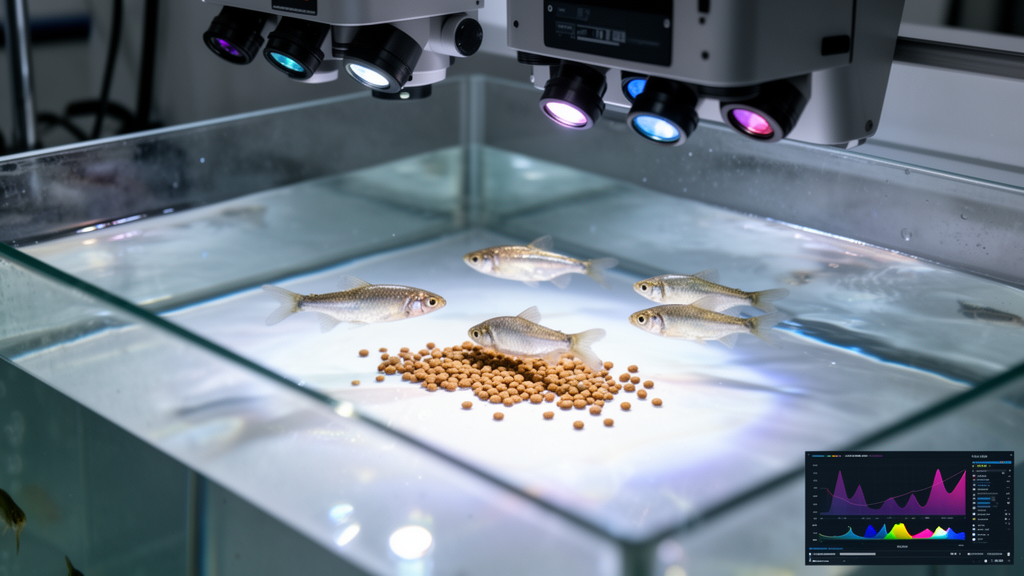
Agricultural engineers and computer scientists have developed an automated computer vision framework named Fish Seg-Tracker that tracks individual fish within crowded schools and measures per-fish feed consumption in indoor aquaculture tanks. Described in research published in Information Processing in Agriculture, the system couples an enhanced real-time detection transformer with a modified video object segmentation network. Rather than relying on traditional bounding boxes that frequently fail during overlapping movements, the methodology propagates pixel-accurate segmentation masks across video frames while registering pellet ingestion events at the individual level. Across laboratory evaluation trials in an indoor recirculating aquaculture facility, the integrated framework attained an overall object detection mean average precision of 94.9 percent, a multi-object tracking accuracy of 76.3 percent, and a feeding event classification accuracy of 92 percent.
Feed management represents a decisive operational factor in commercial aquaculture, dictating biological growth rates, operating expenditures, and water quality stability within culture environments. In conventional farming regimes, feeding strategies remain predominantly dependent on manual operations or automated mechanical dispensers configured with preset schedules, quantities, and distribution positions. Because these established practices rely heavily on subjective human estimations rather than continuous physiological feedback, commercial ponds frequently experience episodes of underfeeding or overfeeding. Insufficient rations restrict fish development and stunt growth cycles, whereas excessive feed dispersal causes economic waste and drives ecological degradation through the decomposition of uneaten organic matter. Establishing a data-driven ration standard requires real-time perception of appetite, which hinges on precisely quantifying feed intake for individual fish to match feeding intensity dynamically.
Previous technological approaches to measuring aquatic feed intake have encountered substantial operational trade-offs between physical invasiveness and optical reliability. Radio-frequency identification tag systems can record tagged individuals entering specific feeding zones, but the required tagging procedure is invasive, labor-intensive, and difficult to scale across commercial cohorts. Conversely, computer vision offers a non-contact alternative that deploys overhead or submerged cameras without disrupting natural animal behaviors. Optical systems have historically utilized two configurations: water surface disturbance monitoring or individual tracking coupled with pellet detection. Surface disturbance methods evaluate collective feeding vigor by computing ripple intensity from overhead video, yet these assessments remain indirect and susceptible to interference from surface aeration, wind, and non-feeding splashes. Direct individual tracking coupled with bounding-box algorithms offers granular consumption metrics, but conventional detectors and box-level trackers routinely suffer from target switching, fragmentation, and false associations when fish schools undergo dense crowding, non-rigid body deformations, and frequent visual occlusions.
To overcome the fundamental constraints of bounding-box tracking, the researchers structured Fish Seg-Tracker around a two-stage computer vision architecture consisting of a specialized detector and an adapted mask-propagation tracker. The upstream detector utilizes a modified real-time detection transformer, known as RT-DETR, configured to simultaneously detect individual fish bodies and minute feed pellets. Standard RT-DETR architectures deploy a ResNet-50 backbone combined with an efficient hybrid encoder consisting of attention-based intra-scale feature interaction modules and cross-scale feature fusion modules. Operating as an end-to-end transformer, the network predicts bounding coordinates directly without requiring non-maximum suppression post-processing, thereby eliminating the suppression errors that typically arise when bounding boxes overlap heavily in densely populated aquatic environments.
To address the substantial scale disparity between large fish bodies and tiny feed pellets, the investigation incorporated two major structural enhancements into the RT-DETR framework. First, the team integrated a Poly Kernel Inception module inspired by PKINet into the feature backbone. This module extracts multi-scale representations by combining small convolutional kernels for fine local details with parallel depthwise separable convolutions that capture wide contextual fields, significantly enriching feature quality across divergent receptive fields. Second, the training protocol integrated a Normalized Wasserstein Distance regression loss alongside conventional bounding-box losses. Because standard intersection-over-union metrics degrade rapidly when evaluating tiny objects with minimal spatial overlap, the Normalized Wasserstein Distance provides scale-invariant distribution modeling that stably calculates positional similarity for tiny, densely clustered feed particles. When retrained on 1,532 annotated images and tested on 323 held-out images, the enhanced RT-DETR achieved a fish precision of 96.5 percent, fish recall of 93.8 percent, pellet precision of 94.8 percent, pellet recall of 92.1 percent, and an overall mean average precision of 94.9 percent, outperforming baseline models such as Faster R-CNN, YOLOv8-s, and standard RT-DETR.
The downstream tracking module adapts Segment Anything Model 2, or SAM2, to sustain long-term individual identities across video streams without requiring human guidance. Although standard SAM2 models deliver robust zero-shot mask propagation across temporal sequences, their native implementation requires interactive manual prompts and retains all past historical frame embeddings in memory, producing linear computational growth that rapidly exhausts GPU resources during continuous video processing. The authors resolved these constraints by automating prompt generation and restructuring memory management. In the automated pipeline, detection bounding boxes from the improved RT-DETR serve as initial prompt inputs. By evaluating intersection-over-union overlaps between incoming detections and masks propagated from preceding frames, any detection falling below a designated threshold is automatically identified as a newly appearing fish instance and registered into the tracking sequence.
To maintain constant video memory consumption during prolonged monitoring, the research team instituted a sliding window attention mechanism that restricts temporal mask propagation to a localized temporal interval rather than querying all preceding frames. Stored masks outside the sliding window—typically configured between 5 and 15 frames—are discarded from active attention calculations, decoupling memory utilization from total video duration. Alongside the sliding window, a dynamic target memory manager regulates individual additions and removals. The system maintains an identity cache with a predefined maximum capacity. When a tracked fish experiences severe occlusion or exits the field of view, the tracker records negative confidence scores; if this negative state persists across consecutive frames, the object’s mask is deregistered from the active identity memory while its feature embedding is cached. Should the individual re-enter the scene within a defined temporal margin, feature matching enables seamless re-identification and resumes continuous trajectory tracking.
Quantifying individual feed consumption relies on a rule-driven behavioral analysis module built on top of the tracking and detection outputs. The analysis operates through three consecutive stages: detecting pellet disappearances, validating candidate feeding subjects, and aggregating verified ingestion events. Candidate feeding events trigger when the local count of detected pellets decreases across consecutive frames within a monitored zone. To determine which fish consumed the missing feed, the system queries the previous tracking masks to localize the fish snout using a discrete curvature algorithm applied to the mask boundary contour. Potential head candidates possessing curvature values above an empirical threshold are filtered, and the true head position is identified by selecting the candidate closest to the mask centroid. Spatial-temporal gating then confirms feeding by verifying that the fish head lies within an effective predation distance of approximately 2.5 to 5 pellet diameters, moves with an approach angle under 45 degrees toward the disappearance anchor, and exceeds a minimum velocity threshold to filter out passive drifting.
Performance validation took place using video recordings collected in an indoor recirculating aquaculture system housing groups of 5 to 20 fish, specifically juvenile Nile tilapia measuring 5 to 10 centimeters in length and large yellow croakers measuring 15 to 20 centimeters. The recording setup examined both full-tank perspectives in rectangular tanks where all animals remained continuously visible and partial-tank views in circular tanks where fish repeatedly entered and exited the camera frame. Across three dedicated feeding evaluation videos comprising 3,000 frames down-sampled to 15 frames per second and evaluated under a three-fold leave-one-video-out protocol across 237 annotated feeding events, the complete framework achieved an event-level assignment accuracy of 92 percent, precision of 0.90, recall of 0.92, and an F1 score of 0.91. For per-fish intake quantification across the three cohorts of ten fish, the model yielded an average mean absolute error of 1.50 pellets per individual, an average mean absolute percentage error between 23.2 and 26.7 percent, and a strong linear correlation between predicted and ground-truth counts with a Pearson correlation coefficient of r = 0.917.
Comparative tracking benchmarks demonstrated the advantages of mask propagation over conventional box-association algorithms. When evaluated on held-out test clips using detector proposals from the improved RT-DETR, Fish Seg-Tracker achieved an identification F1 score of 79.5 and a multi-object tracking accuracy of 76.3 with only 41 identity switches, outperforming ByteTrack, FairMOT, DeepSORT, and CMFTNet. Under an oracle evaluation feeding ground-truth bounding boxes directly into trackers, Fish Seg-Tracker maintained its lead with an identification F1 score of 88.7 and 22 identity switches. External evaluation on the public FishTrack23 benchmark confirmed cross-dataset generalizability, where the method achieved an identification F1 score of 93.1 and multi-object tracking accuracy of 92.4. Despite these tracking strengths, the authors noted operational trade-offs: on an NVIDIA RTX 3090 GPU, the pipeline operated at 5 frames per second with 16 gigabytes of memory consumption, compared to 28 frames per second and 8 gigabytes for RT-DETR coupled with ByteTrack. Furthermore, the authors emphasized that the system represents a controlled proof-of-concept developed under stable indoor lighting and low turbidity, noting that future deployment in commercial open-water ponds will require model compression and algorithmic adaptation to manage turbid water and severe surface reflections.
Subject of Research: Computer vision tracking and individual feed intake estimation in aquaculture tanks
Article Title: Fish Seg-tracker: Mask-propagation based tracking and feed intake estimation in fish schools
Article References: Wang, L., Wu, X., Xie, Y., Yang, C., & Cai, W. (2026). Fish Seg-tracker: Mask-propagation based tracking and feed intake estimation in fish schools. Information Processing in Agriculture. https://doi.org/10.1016/j.inpa.2026.09.001
Image Credits: AI Generated
DOI: 10.1016/j.inpa.2026.09.001
Keywords: Aquaculture, Fish Tracking, Computer Vision, Feed Intake Estimation, Segment Anything Model 2, RT-DETR, Video Object Segmentation, Mask Propagation, Poly Kernel Inception, Normalized Wasserstein Distance, Sliding Window Attention, Precision Feeding, Nile Tilapia, Large Yellow Croaker, Recirculating Aquaculture System, Object Detection, Trajectory Association, Automated Feeding
News Source: Elena Sutton. (November 25, 2026). Computer Vision System Tracks Individual Fish and Quantifies Feeding Intake. Scienmag.