• HOME
  • NEWS
  • EXPLORE
    • CAREER
      • Companies
      • Jobs
    • EVENTS
    • iGEM
      • News
      • Team
    • PHOTOS
    • VIDEO
    • WIKI
  • BLOG
  • COMMUNITY
    • FACEBOOK
    • INSTAGRAM
    • TWITTER
Friday, January 23, 2026
BIOENGINEER.ORG
No Result
View All Result
  • Login
  • HOME
  • NEWS
  • EXPLORE
    • CAREER
      • Companies
      • Jobs
        • Lecturer
        • PhD Studentship
        • Postdoc
        • Research Assistant
    • EVENTS
    • iGEM
      • News
      • Team
    • PHOTOS
    • VIDEO
    • WIKI
  • BLOG
  • COMMUNITY
    • FACEBOOK
    • INSTAGRAM
    • TWITTER
  • HOME
  • NEWS
  • EXPLORE
    • CAREER
      • Companies
      • Jobs
        • Lecturer
        • PhD Studentship
        • Postdoc
        • Research Assistant
    • EVENTS
    • iGEM
      • News
      • Team
    • PHOTOS
    • VIDEO
    • WIKI
  • BLOG
  • COMMUNITY
    • FACEBOOK
    • INSTAGRAM
    • TWITTER
No Result
View All Result
Bioengineer.org
No Result
View All Result
Home NEWS Science News

Compute at the speed of light

Bioengineer by Bioengineer
September 26, 2019
in Science News
Reading Time: 3 mins read
0
IMAGE
Share on FacebookShare on TwitterShare on LinkedinShare on RedditShare on Telegram

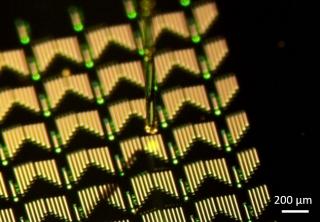
UD research team develops new way to make integrated photonics
IMAGE

Credit: Photo courtesy Tingyi Gu

The signals from a lighthouse to ships at sea is an early example of optical communication, the use of light to transmit information. Today, researchers in the field of integrated photonics are using optical communications principles to build high-tech devices, like lightning-fast computers, which utilize light instead of electricity.

At the University of Delaware, a research team led by Tingyi Gu, assistant professor of electrical and computer engineering, has designed an integrated photonics platform with a one-dimensional metalens — a thin lens that can be designed at the nanoscale to focus light in a specific way — and metasurfaces — tiny surfaces made with nanostructures to manipulate the transmitted or reflected light– that limit the loss of information. The team recently described their device in the journal Nature Communications.

“It’s a new way to achieve integrated photonics compared to the conventional way,” said doctoral student Zi Wang, the first author of the paper.

The team fabricated a tiny metalens on a silicon-based chip programmed with hundreds of tiny air slots, enabling parallel optical signal processing all within the tiny chip. They demonstrated high signal transmission with less than one decibel loss over a 200-nanometer bandwidth. When they layered three of their metasurfaces together, they demonstrated functionalities of Fourier transformation and differentiation — important techniques in the physical sciences that break down functions into constituent parts.

“This is the first paper to use low-loss metasurfaces on the integrated photonics platform,” said Gu. “Our structure is broadband and low loss, which is critical for energy efficient optical communications.”

What’s more, the new device developed at UD is much smaller and lighter than conventional devices of its type. It doesn’t require the manual alignment of lenses, so it is more robust and scalable compared to the traditional free-space optics platforms, which require tremendous patience and time to set up.

This new device could have applications in imaging, sensing and quantum information processing, such as on-chip transformation optics, mathematical operations and spectrometers. With more development, this technology could also be useful in deep learning and neural network applications in computing.

“It’s just much faster than conventional structures,” said Gu. “There are still a lot of technical challenges when you try to actively control them, but this is a new platform we are starting with and working on.”

Parts of the device were fabricated in the University of Delaware Nanofabrication Facility and at AIM Photonics in Rochester, New York.

While working on this project, Gu was inspired by conversations with fellow faculty members Dennis Prather, Engineering Alumni Professor of Electrical and Computer Engineering; Gonzalo Arce, Charles Black Evans Professor of Electrical and Computer Engineering; and Kenneth Barner, Charles Black Evans Professor of Electrical and Computer Engineering.

###

Media Contact
Peter Kerwin
[email protected]

Original Source

https://www.udel.edu/udaily/2019/september/tingyi-gu-integrated-photonics-nature-communications/

Related Journal Article

http://dx.doi.org/10.1038/s41467-019-11578-y

Tags: Computer ScienceElectrical Engineering/ElectronicsTechnology/Engineering/Computer Science
Share12Tweet8Share2ShareShareShare2

Related Posts

Exploring WD40 Proteins in Populus yunnanensis Under Salt Stress

Exploring WD40 Proteins in Populus yunnanensis Under Salt Stress

January 23, 2026
Factors Influencing Climate-Smart Farming in Nigeria

Factors Influencing Climate-Smart Farming in Nigeria

January 23, 2026

New Insights on Carbonyl-Infused Bis-Pyrazoles: Synthesis and Significance

January 23, 2026

EAST: Smart Navigation for Robots in Dynamic Environments

January 23, 2026
Please login to join discussion

POPULAR NEWS

  • Enhancing Spiritual Care Education in Nursing Programs

    156 shares
    Share 62 Tweet 39
  • PTSD, Depression, Anxiety in Childhood Cancer Survivors, Parents

    148 shares
    Share 59 Tweet 37
  • Robotic Ureteral Reconstruction: A Novel Approach

    80 shares
    Share 32 Tweet 20
  • Digital Privacy: Health Data Control in Incarceration

    62 shares
    Share 25 Tweet 16
>

About

We bring you the latest biotechnology news from best research centers and universities around the world. Check our website.

Follow us

Recent News

Exploring WD40 Proteins in Populus yunnanensis Under Salt Stress

Factors Influencing Climate-Smart Farming in Nigeria

New Insights on Carbonyl-Infused Bis-Pyrazoles: Synthesis and Significance

Subscribe to Blog via Email

Enter your email address to subscribe to this blog and receive notifications of new posts by email.

Join 71 other subscribers
  • Contact Us

Bioengineer.org © Copyright 2023 All Rights Reserved.

Welcome Back!

Login to your account below

Forgotten Password?

Retrieve your password

Please enter your username or email address to reset your password.

Log In
No Result
View All Result
  • Homepages
    • Home Page 1
    • Home Page 2
  • News
  • National
  • Business
  • Health
  • Lifestyle
  • Science

Bioengineer.org © Copyright 2023 All Rights Reserved.