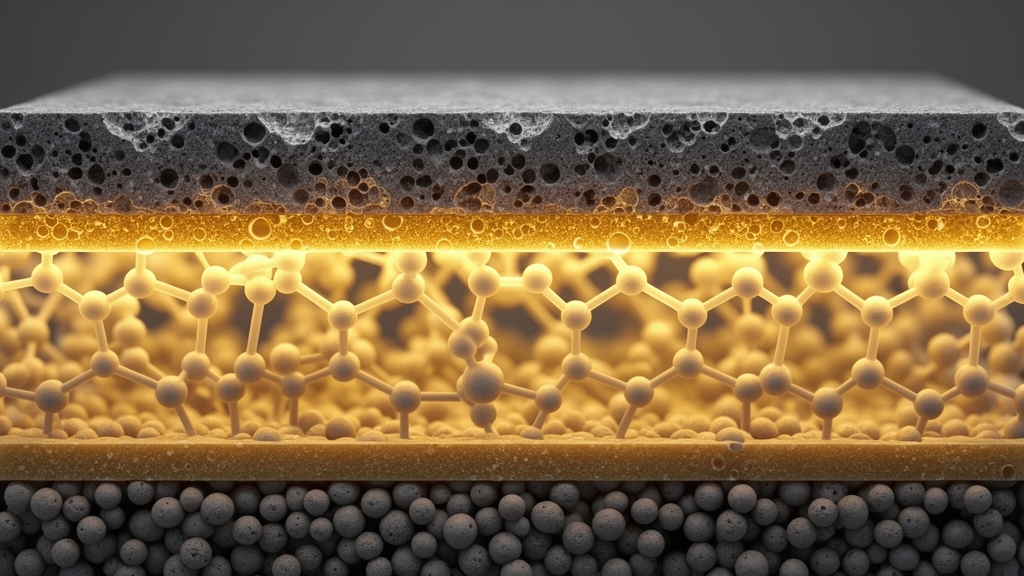
A comprehensive review evaluated how multiscale computational modeling strategies accelerate materials development and optimization for solid oxide fuel cells in sustainable energy systems. Solid oxide fuel cells convert chemical energy into electricity through electrode surface redox reactions without intermediate thermal cycles, achieving electrical efficiencies exceeding sixty percent and combined heat and power efficiencies reaching eighty-five percent. High operating temperatures between six hundred and one thousand degrees Celsius enable internal fuel reforming, allowing flexible operation on biogas, hydrogen, synthetic hydrocarbons, ammonia, and natural gas. This fuel flexibility makes these electrochemical devices adaptable to expanding hydrogen economies and renewable power configurations. However, direct integration with intermittent solar and wind installations subjects cell stacks to dynamic loads and thermal cycling, accelerating performance decay. Because traditional trial-and-error synthesis requires extensive laboratory time and precursors, researchers are implementing integrated theoretical modeling pipelines spanning quantum mechanical calculations to continuum device simulations to predict catalytic activity, transport kinetics, and durability.
The standard solid oxide fuel cell architecture consists of porous anode and cathode chambers separated by a dense, oxide-ion-conducting ceramic electrolyte. During operation, the cathode executes an oxygen reduction reaction, transforming gaseous oxygen into mobile oxide anions that migrate across the electrolyte toward the fuel-facing anode. Simultaneously, the anode catalyzes fuel oxidation to release electrons, driving electrical current through an external circuit back to the cathode. Baseline devices commonly employ metallic nickel and yttria-stabilized zirconia cermets at the anode, while perovskites such as lanthanum strontium manganite or mixed-conducting lanthanum strontium cobalt ferrite serve as cathodes. Typical electrolytes comprise yttria-stabilized zirconia, gadolinium-doped ceria, or doped lanthanum gallate ceramics. Advanced designs integrate fuel cells with solid oxide electrolysis cells to form reversible systems driven by wind and solar power. These integrated assemblies store surplus intermittent electricity in chemical form as hydrogen while generating electricity during supply deficits, facilitating electrical grid stabilization.
Anode optimization requires predictive computational screening to mitigate nickel particle sintering, carbon coking from hydrocarbon fuels, sulfur poisoning, and redox cycling mechanical fatigue. Density functional theory calculations systematically quantify species adsorption energies, reporting carbon binding values of negative 6.81 electron volts at face-centered cubic sites and negative 6.89 electron volts at hexagonal close-packed sites on nickel surfaces. Furthermore, density functional calculations demonstrate that the activation barrier for methyl group dehydrogenation decreases from 1.39 electron volts on bare surfaces to 0.74 electron volts at metal-oxide oxygen-vacancy interfaces, revealing how interfacial defects promote carbon deposition pathways. Mesoscale phase-field and lattice Boltzmann simulations evaluate microstructural evolution alongside gaseous transport, tracking nickel particle enlargement from 0.956 to 1.03 micrometers while the active electrocatalytic site fraction declines from 3.305 percent to 2.995 percent. Time-dependent three-dimensional nanotomography models show that contact angles of one hundred twenty degrees match experimental microstructures annealed at eight hundred fifty degrees Celsius.
Cathode oxygen reduction reactions represent the primary kinetic bottleneck in operating solid oxide cells, determining overall polarization losses. While lanthanum strontium manganite acts predominantly as an electronic conductor restricting active oxygen reduction to regions near triple-phase boundaries, mixed conductors like lanthanum strontium cobalt ferrite extend reaction zones across the electrode surface. First-principles calculations show that molecular oxygen adsorbs preferentially onto transition-metal cobalt or iron B-sites, forming superoxide or peroxide intermediates with an isomerization barrier of 0.14 electron volts. Existing surface oxygen vacancies promote oxygen dissociation, displaying calculated activation barriers of 0.30 electron volts on cobalt sites and 0.14 electron volts on iron sites. Density functional theory calculations identify oxygen-vacancy formation energies of 1.73 electron volts in lanthanum strontium manganite compared to 0.06 electron volts in barium strontium cobalt ferrite. In bulk cobaltite and ferrite lattices, vacancy formation energies span 3.0 to 3.5 electron volts, yet drop to 2.0 electron volts at specific coordinated surface sites.
Electrolyte performance requires minimizing oxide-ion migration barriers while preserving phase stability under both oxidizing and reducing operating conditions. In conventional yttria-stabilized zirconia, substituting trivalent yttrium cations for tetravalent zirconium cations creates oxygen vacancies that enable anionic conduction. However, increasing dopant concentrations beyond an optimal threshold increases defect-defect association and vacancy trapping, impeding ion mobility. Combined first-principles calculations and kinetic Monte Carlo simulations confirm that dopant loadings between seven and nine mole percent yttria maximize ionic conductivity, aligning with experimental measurements. Molecular dynamics simulations determine that oxygen diffusion activation energies range between 0.6 and 1.0 electron volts as yttria content increases from six to twenty-five mole percent. Kinetic Monte Carlo models calculate migration activation energies of 0.4 to 0.5 electron volts for stabilized zirconias, whereas doped cerias exhibit lower barriers of 0.2 to 0.3 electron volts. In lanthanum strontium gallium magnesium oxide perovskites, cubic crystalline symmetry yields lower vacancy migration barriers than distorted structures, corroborating an experimental migration enthalpy of 58 kilojoules per mole.
Assembling individual cells into functional stacks requires ferritic stainless steel interconnect plates that separate gases while maintaining electrical continuity. At high temperatures, volatile chromium species evaporate from these metallic plates and deposit across cathode triple-phase boundaries, poisoning catalytic reduction sites. Density functional theory modeling guides the design of protective manganese-cobalt spinel coatings that suppress chromium evaporation while finite element simulations evaluate internal thermo-mechanical stress distributions. Across material interfaces, elevated temperatures trigger cation interdiffusion that precipitates resistive secondary phases. In lanthanum strontium cobalt ferrite and yttria-stabilized zirconia junctions, chemical interdiffusion generates insulating lanthanum zirconate and strontium zirconate layers. Thermodynamic computations establish a negative reaction formation enthalpy of negative 107.3 plus or minus 5.1 kilojoules per mole for lanthanum zirconate, proving its spontaneous formation over constituent binary oxides. The growth of these insulating barrier layers follows parabolic diffusion kinetics governed by Arrhenius temperature dependencies, progressively elevating polarization resistance, impeding oxide-ion transport, and degrading operational cell lifespan.
Capturing the complex physical chemistry of fuel cell materials requires combining complementary computational techniques across disparate spatial and temporal scales. Ground-state density functional theory models quantum mechanical electronic structures and defect energetics using standard approximations such as the Perdew-Burke-Ernzerhof functional. However, standard semilocal functionals suffer from self-interaction errors when describing localized electronic f-states and partially filled d-orbitals in reducible transition-metal oxides. To improve physical fidelity, researchers employ Hubbard-U on-site Coulomb corrections, creating the DFT+U methodology to accurately predict electronic localization and defect-induced lattice relaxation. In cerium oxide systems, the calculated band gap under DFT+U ranges from 2.84 to 3.27 electron volts, closely matching the experimental band gap of approximately 3.2 electron volts, whereas hybrid functionals yield larger values of 3.63 to 4.09 electron volts. Extending quantum calculations to operational environments, ab initio thermodynamics integrates ground-state electronic energies with vibrational contributions and chemical potentials, enabling researchers to construct phase stability diagrams under fluctuating temperatures and oxygen partial pressures.
At larger temporal and structural scales, atomistic molecular dynamics simulations track temperature-dependent ion transport across grain boundaries over nanosecond intervals, utilizing interatomic potentials benchmarked against quantum mechanical datasets. Mesoscale phase-field methods and kinetic Monte Carlo algorithms bridge atomic interactions and macroscopic continuum behaviors, simulating morphological evolution and microstructural degradation. Phase-field models utilize bulk thermodynamic parameters, interfacial mobilities, and gradient-energy coefficients to track structural coarsening in porous electrodes. Three-dimensional phase-field simulations of nickel coarsening in anode cermets validated against ex-situ X-ray nanotomography at eight hundred fifty degrees Celsius demonstrated that setting interfacial contact angles to one hundred twenty degrees accurately replicates experimental pore connectivity. Similarly, kinetic Monte Carlo models combined with focused-ion-beam scanning electron microscopy tomography examine the sintering of lanthanum strontium cobalt iron oxide cathodes. These simulations demonstrate that modeling electrode particles as clumped multispheres provides far more realistic representations of evolving microstructures than traditional single-sphere geometric approximations, providing quantitative descriptors for long-term durability.
Machine learning models accelerate fuel cell materials discovery by establishing quantitative relationships between atomic compositions, calculated quantum descriptors, and measured electrochemical performance. Support Vector Regression algorithms trained on perovskite datasets predict oxygen tracer surface-exchange coefficients with a five-fold cross-validation coefficient of determination of 0.853 and a mean absolute error of 0.365 log units. Incorporating machine-learning-generated descriptors increases the coefficient of determination to 0.898 while decreasing the mean absolute error to 0.260 log units, enabling rapid computational screening across 1.3 million virtual perovskite compositions. Additionally, extreme gradient boosting models predict oxygen-vacancy formation energies, calculating 3.70 electron volts for multicomponent perovskites where quantum calculations yield 2.87 electron volts. At the device level, data-driven microstructural optimization achieved a validated peak power density of 1.43 watts per square centimeter, representing a twenty-nine percent enhancement over standard cells. Meanwhile, multiscale stack models validate thirty-eight thousand hours of degradation data from eighteen-cell stacks within seventy-five minutes, while localized models show anode triple-phase boundary densities decline from 3.11 to 2.4 inverse square micrometers between 973 and 1123 Kelvin.
Despite substantial progress across computational domains, several fundamental challenges continue to hinder fully predictive simulations of solid oxide fuel cell lifespans. Seamlessly coupling parameters across disparate physical scales remains difficult, as transferring surface reaction kinetics and migration barriers from atomistic calculations into continuum computational fluid dynamics models introduces cumulative uncertainties. Furthermore, simplified kinetic formulations often fail to capture simultaneous, coupled degradation processes that occur over forty thousand to eighty thousand operational hours, including nickel coarsening, chromium poisoning, cation segregation, and interfacial secondary-phase growth. The accuracy of atomistic predictions remains constrained by functional selection and empirical potential transferability, while continuum models depend on empirical validation data. Data-driven machine learning workflows are similarly hindered by the scarcity of standardized, open-access training databases that span diverse compositions, dynamic operating temperatures, and fuel gas mixtures. Addressing these bottlenecks requires establishing coordinated multiscale simulation pipelines, developing physics-informed machine learning frameworks, and assembling curated experimental repositories to guide the rational design of durable solid oxide fuel cell materials.
Subject of Research: Multiscale computational modeling and materials development for solid oxide fuel cells
Article Title: Computational modelling-assisted materials development for solid oxide fuel cells toward sustainable energy generation
Article References: Nangan, S., Joseph, A. M., B, S. R., Selvi, S., Verma, D., & Jawaid, M. (2026). Computational modelling-assisted materials development for solid oxide fuel cells toward sustainable energy generation. Chemical Physics Impact, 13, Article 101221. https://doi.org/10.1016/j.chphi.2026.101221
Image Credits: AI Generated
DOI: 10.1016/j.chphi.2026.101221
Keywords: solid oxide fuel cells, computational materials science, density functional theory, multiscale modeling, electrolyte optimization, oxygen reduction reaction, yttria-stabilized zirconia, nickel coarsening, mixed ionic-electronic conductors, phase-field simulations, kinetic Monte Carlo, machine learning in energy, degradation mechanisms, chromium poisoning, interfacial reactions, ab initio thermodynamics, molecular dynamics
News Source: Faith Mcneil. (November 24, 2026). Computational Models Predict Solid Oxide Fuel Cell Degradation and Materials Behavior. Scienmag.