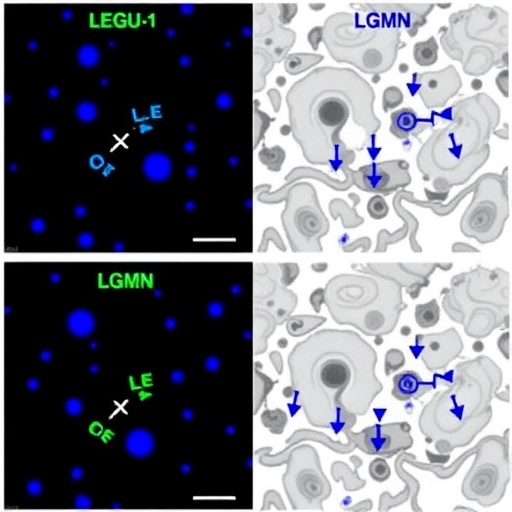
In a groundbreaking bioinformatics study published in the upcoming 2026 edition of Acta Parasitologica, researchers have unveiled key insights into the interactions between certain parasitic enzymes and widely used proton pump inhibitor (PPI) drugs. The investigation centered on the legumain-like cysteine protease 1 (LEGU-1) enzymes from Trichomonas vaginalis and Trichomonas gallinae, two pathogenic protozoans, and compared them with the human legumain (LGMN) enzyme. This innovative study delves into the molecular interplay of these enzymes with the proton pump inhibitors lansoprazole, omeprazole, and esomeprazole, aiming to uncover potential pharmacological implications and new therapeutic avenues.
Legumain proteases are specialized enzymes responsible for pivotal biological processes, including proteolytic cleavage and antigen presentation. Their role in both human physiology and pathogen virulence makes them attractive targets for drug design. This study is the first comprehensive bioinformatics analysis juxtaposing the legumain-like enzymes of Trichomonas species with human legumain to evaluate potential cross-reactivity or selective inhibition by commonly used PPI drugs. Historically, PPIs have been valued primarily for their acid suppression in treating gastroesophageal reflux disease and peptic ulcers. However, their capacity to interact with diverse proteases marks a new frontier in understanding their broader bioactivity.
The researchers harnessed advanced computational tools and molecular docking simulations to predict the binding affinities and interaction dynamics between the LEGU-1 enzymes and the three PPI drugs. These in silico methods, which encompass sequence analysis, structural modeling, and ligand-protein binding energy calculations, offer a powerful lens into biochemical interactions that are often difficult to capture in vitro or in vivo. By meticulously comparing the legumain-like proteins of Trichomonas vaginalis and Trichomonas gallinae with the human legumain sequence, the study delineates nuanced variations potentially impacting drug binding and efficacy.
One of the salient findings is the differential affinity exhibited by the proton pump inhibitors towards the parasite enzymes versus the human counterpart. Lansoprazole, omeprazole, and esomeprazole displayed varied binding strengths, indicating a degree of specificity that could be leveraged for selective targeting of parasitic infections without adversely affecting the host enzyme. The implications of these results extend beyond theoretical bioinformatics, signposting PPIs as potential candidates for therapeutic repurposing against trichomoniasis and related parasitic diseases.
The study further elaborates on the structural motifs and active site residues that mediate drug binding. Despite the evolutionary conservation of legumain proteases, subtle amino acid substitutions in the parasite enzymes appear to modulate their conformations and interaction landscapes. These sequence variations influence hydrogen bonding patterns, hydrophobic interactions, and overall molecular stability when complexed with the PPIs. Such molecular insights pave the way for rational drug design aimed at enhancing specificity and minimizing off-target effects.
Moreover, the comparative approach undertaken by the scientists sheds light on the evolutionary trajectory of legumain enzymes across species. By elucidating how parasitic legumain-like cysteine proteases diverge functionally and structurally from their human homologs, this work enriches the understanding of parasite biology and host-pathogen interactions. This knowledge is instrumental for designing anti-parasitic agents that can circumvent resistance mechanisms and achieve heightened efficacy.
The integration of proton pump inhibitors into anti-parasitic strategies is an emerging paradigm, largely unexplored until now. PPIs, readily available and with favorable safety profiles, represent a promising pool of compounds for repurposing. This study not only broadens the spectrum of molecular targets for PPIs but also highlights the sophistication of in silico screening methods in accelerating drug discovery pipelines against neglected infectious diseases.
By bridging molecular parasitology, enzymology, and pharmacology, the research underscores the importance of interdisciplinary approaches in tackling complex biomedical challenges. The authors meticulously dissect the interactions at an atomic level, providing a valuable blueprint for future experimental validations and clinical translations. Central to this process is understanding the distinct biochemical environments presented by parasite versus human enzymes, which dictate drug interactions and therapeutic windows.
In addition to structural comparisons, the study investigates the thermodynamics of ligand binding, revealing insights into the stability and reversibility of enzyme-drug complexes. Such energetic profiling assists in predicting drug efficacy and potential resistance. Importantly, the findings suggest that certain PPIs may stabilize or destabilize legumain-like enzymes under physiological conditions, opening avenues for fine-tuning drug formulations for targeted anti-parasitic action.
While traditionally PPIs have been used for gastric acid suppression, their mechanistic versatility is increasingly recognized. This study exemplifies the untapped potential of certain enzymatic off-target interactions that could be therapeutically exploited. The bioinformatics analyses offer a rapid, cost-effective initial screening that, when coupled with biochemical assays, could revolutionize the development of multi-functional drugs against protozoan parasites like Trichomonas species.
The ongoing rise in drug resistance among parasitic infections calls for innovative strategies. The cross-disciplinary methodology presented here serves as a model for leveraging existing pharmacophores in novel contexts. By characterizing the interactions between three clinically approved PPIs and parasite legumain-like proteases, the research contributes valuable data that may shorten the trajectory from bench to bedside in treating trichomoniasis and related infections.
Finally, this study lays the foundation for further experimental studies involving enzyme kinetics, crystallographic analyses, and in vitro parasite cultures to validate the computational predictions. It beckons a new era where bioinformatics-driven hypotheses inform the design of next-generation therapeutics, emphasizing the critical role of molecular docking and protein-ligand interaction studies in contemporary parasitology and pharmacology. The clinical implications are particularly exciting as they hint at repurposing well-studied and accessible drugs to combat difficult-to-treat parasitic diseases, thereby addressing significant global health burdens.
Overall, the research by Köseoğlu and colleagues marks a pioneering advance in understanding the molecular physiology of parasite legumain-like enzymes and their interaction with proton pump inhibitors, highlighting translational potential that could redefine treatment paradigms for parasitic infections worldwide.
Subject of Research: Interaction of Trichomonas vaginalis and Trichomonas gallinae legumain-like cysteine proteases with proton pump inhibitor drugs, compared to human legumain enzymes.
Article Title: Comparing the Interactions of Trichomonas vaginalis/gallinae Legumain-Like Cysteine Protease 1 (LEGU-1) and Human Legumain (LGMN) Protein Sequences with Proton Pump Inhibitor Drugs (Lansoprazole, Omeprazole, and Esomeprazole) by Bioinformatics Analyses.
Article References:
Köseoğlu, A.E., Kutnu, M., Özgültekin, B. et al. Comparing the Interactions of Trichomonas vaginalis/gallinae Legumain-Like Cysteine Protease 1 (LEGU-1) and Human Legumain (LGMN) Protein Sequences with Proton Pump Inhibitor Drugs (Lansoprazole, Omeprazole, and Esomeprazole) by Bioinformatics Analyses. Acta Parasit. 71, 8 (2026). https://doi.org/10.1007/s11686-025-01187-9
Image Credits: AI Generated
DOI: https://doi.org/10.1007/s11686-025-01187-9
Tags: bioinformatics in parasitologycross-reactivity of PPIscysteine protease drug designdrug interactions with proteasesLEGU-1 enzyme interactionslegumain-like enzymes studyLGMN protease comparisonmolecular docking simulationsproteolytic cleavage in pathogensproton pump inhibitor pharmacologytherapeutic implications of PPIsTrichomonas vaginalis bioinformatics