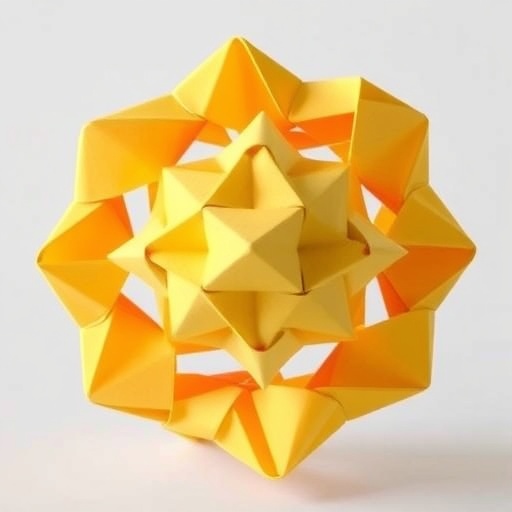
In the realm of aerospace engineering, the evolving nature of satellite technology is crucial, particularly when it comes to energy transmission mechanisms within spacecraft. Traditional electromagnetic waveguides have long employed rigid metal structures for the transfer of energy, presenting significant challenges regarding weight and flexibility, especially in the harsh conditions of space. Fueled by innovation, a team led by Xin Ning from the University of Illinois Urbana-Champaign’s Department of Aerospace Engineering has tapped into the art of origami to rethink the design of these vital components.
The traditional metal waveguides, characterized by their heavy construction and inflexibility, pose limitations for advanced space missions. As these structures often require robust connection flanges to ensure effective energy transmission, they inherently add weight to the payload. Recognizing these constraints, Ning and his graduate students embarked on a journey that sought to leverage the principles of origami to create novel solutions. By designing foldable, flexible waveguides, the team envisioned a system that could be launched in a compact form and subsequently unfolded once deployed in space.
Ning’s collaboration with Sven Bilén, a noted expert in electromagnetics, initiated the exploration into how origami could transform the functionality and applicability of waveguides. The duo posed an intriguing question: Could the folding techniques borrowed from origami provide a means to construct a flexible yet efficient electromagnetic waveguide? This inquiry led Ning and his research team to develop designs that maintained the required rectangular cross-section for comparable performance to traditional constructs. Their approach not only embraced aesthetics but also functional efficiency that space missions demand.
One of the formative inspirations for Ning’s designs was the common brown paper shopping bag. This simple, yet effective structure served as a prototype that simulated how a waveguide could fold while preserving its ability to efficiently transport energy. Graduate researchers Nikhil Ashok and Sangwoo Suk translated this conceptual anchor into a working prototype by designing a foldable tube that resulted in a functional electromagnetic waveguide able to connect seamlessly to existing systems. Their creativity blossomed as they advanced their designs, ultimately arriving at more intricate configurations mimicking bellows.
The fabrication of these innovative models involved tangible materials that could withstand the rigors of space. The team printed their designs onto large sheets of paper, which were then laminated with aluminum foil, allowing them to test functional properties in real-time. The thought process extended toward the potential of utilizing more durable materials, such as compounds found in 3D printing, coupled with high-quality coatings like Kapton. These choices highlight the critical intersection between theoretical design and practical applicability in engineering.
As the team developed their origami-based waveguides, they did so with an emphasis on maintaining commercial relevance. By leveraging existing commercial electromagnetic waveguide designs, the researchers ensured that their work could be directly comparable to legacy systems. This meticulous method of testing and validation allowed them to explore designs that would optimize energy transfer while minimizing losses, a central challenge within electromagnetic transmission.
Throughout their exploratory phase, the team encountered various engineering hurdles, one of which involved the twisting and bending mechanics of their designs. As they worked to achieve the desired 90-degree twist, it became clear that the complexity of the folds needed to be controlled accurately to prevent deployment failures. After much experimentation, Ning’s team identified the nuances of their model which dictated deployment success. Understanding the load dynamics provided insight into the mechanical behaviors of their designs during deployment.
In their trials, the team observed that initial deployment phases exhibited low resistance before encountering sudden points of increased tension. This phenomenon led to the realization that there existed a critical threshold for the stretched material; going beyond it could result in structural failures. Consequently, the team needed to refine their design to reach the optimal deployment length that balanced functionality with structural integrity, ensuring that the panel could handle operational demands without suffering from unnecessary energy loss.
The culmination of their research has resulted in a much-anticipated patent, marking a significant milestone for Ning and his team as they stand at the forefront of aerospace innovation. While their initial focus lies within the sector of spacecraft technology, the implications of their designs reach far beyond. The principles of their origami-inspired waveguides hold promise for diverse applications, including naval systems, electrical engineering, and microwave energy transmission across various communication systems.
By blending art with science, Ning and his team have not only contributed to the advancement of satellite technology but also expanded the boundaries of engineering through the lens of creativity and innovation. Their research underscores the importance of interdisciplinary collaboration in solving complex engineering problems. As they continue to refine their designs, it is evident that the future of aerospace engineering may hinge on imaginative concepts that challenge conventional methodologies.
In an era where space exploration is increasingly intricate, the innovations emanating from the University of Illinois signify a shift towards more adaptable solutions that maintain performance while reducing the precious weight of spacecraft. Ning’s pioneering approach to electromagnetic waveguide design will likely inspire subsequent generations of engineers to explore untapped frontiers in both space technology and beyond.
The published studies documenting their groundbreaking work not only highlight the emerging trends within electromagnetic applications but also emphasize the crucial relationship between engineering design and practical applications in modern technology. Furthermore, the contributions of this team resonate within the larger narrative of how scientific and artistic exploration can yield tangible advancements that benefit society as a whole.
As we look ahead to the future of satellite and communications technology, one can only speculate on the extraordinary possibilities that lie in the intersection of origami and engineering—a testament to human ingenuity and the continual pursuit of knowledge. The journey of Xin Ning and his team serves as a clarion call for a future where creativity and technology coalesce seamlessly in the pursuit of exploration and innovation.
Subject of Research: Origami-based electromagnetic waveguides
Article Title: Shape-morphable origami electromagnetic waveguides
News Publication Date: 1-Dec-2025
Web References: https://www.nature.com/articles/s44172-025-00539-7
References: DOI: 10.1038/s44172-025-00539-7
Image Credits: Not provided
Keywords
Tags: advanced space mission designaerospace engineering innovationschallenges of traditional satellite structurescompact origami space structuresdeployable satellite componentselectromagnetic waveguide alternativesenergy transfer mechanisms in spaceflexible energy transmission in spacecraftlightweight satellite technologyorigami design principles in engineeringorigami-inspired waveguidesUniversity of Illinois aerospace research