A qualitative participatory action research project conducted at a regenerative citizen farm in the Netherlands demonstrates that combining ethnobotanical plant inventories with community economies frameworks can generate practical botanical designs while revealing significant social and physical barriers to community inclusion. Reporting in the journal Agriculture and Human Values, researchers Anna M. Roodhof, Melanie Ziegler, and Lucie Sovová evaluated an operational approach they term community ethnobotany. Food forests—agricultural production systems comprised of edible perennial crops structured to mimic natural forest ecosystems—have frequently been commended in academic literature for ecological benefits. However, scholars have also cautioned that these initiatives often reproduce systemic socio-economic inequalities across the Global North. High entry costs, land scarcity, and reliance on premium retail pricing or uncompensated volunteer labor frequently restrict participation to affluent demographics, typically leaving alternative food initiatives led by university-educated individuals with substantial seed capital while excluding lower-income community members.
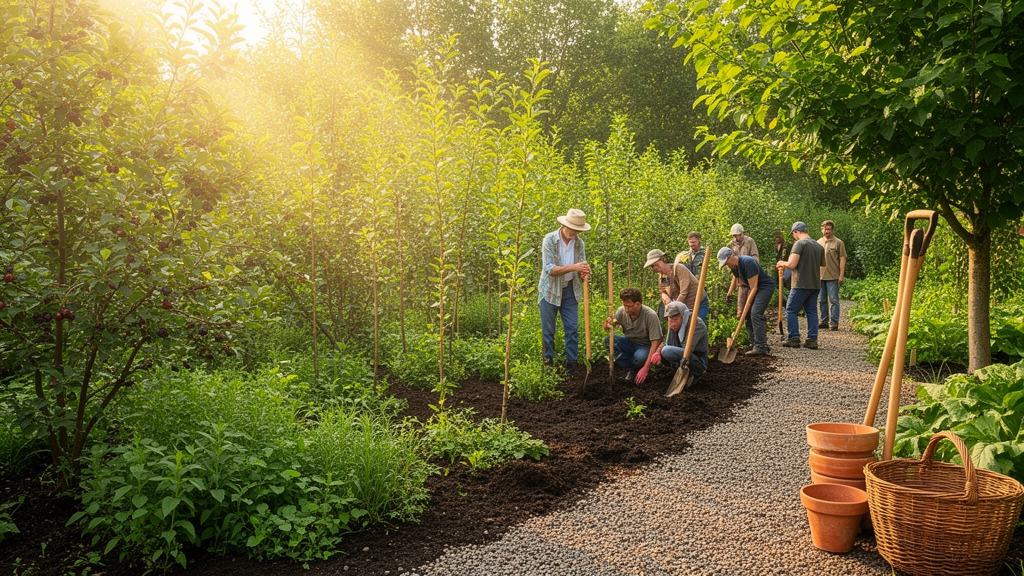
To investigate whether participatory methodologies could counter these exclusionary patterns, the study examined the Regenerative Citizen Farm the Biesterhof, a small-scale mixed enterprise founded in the spring of 2022 in the eastern rural Netherlands. The enterprise operates across twenty-five hectares of arable land leased from Land van Ons, a citizen cooperative comprising approximately three hundred members that collectively purchases agricultural ground to facilitate nature-inclusive farming practices. At the time of the investigation, the Biesterhof was managed by an operational team of six farmers—four women and two men between the ages of twenty-five and forty-five who all hold university degrees and originate from the Global North—supported by seven weekly volunteers. Seeking to avoid replicating the socio-economic insularity seen in conventional alternative food systems, the farmers decided to integrate a two-hectare food forest designed specifically to foster mutual connections with neighboring communities and more-than-human entities.
The methodological framework developed by the researchers operationalized J. K. Gibson-Graham’s community economies framework alongside traditional ethnobotanical inventories to create an actionable research and design process. Community economies scholarship conceptualizes economic networks as sites where interdependent livelihoods among multi-species assemblages are negotiated across four ethical coordinates: participation, necessity, surplus, and commons. Ethnobotanical inventorying was utilized as a complementary descriptive instrument to document the diverse relationships, material uses, and symbolic attachments that people maintain with specific botanical species. The authors noted that classical ethnobotany often risks treating plant communities through an extractivist, utilitarian lens unless situated within political frameworks, while community economies frameworks frequently struggle to operationalize more-than-human actors empirically. By synthesizing both disciplines into community ethnobotany, the researchers sought to analyze local human and ecological needs prior to planting.
The fieldwork was carried out from February to September 2023 by co-author Melanie as part of a Master of Science thesis supervised by Roodhof. The initial institutional idea of conducting a commercial market analysis for prospective food forest yields was shifted toward community building following iterative discussions and regular participant observation during weekly community working days. Melanie conducted semi-structured interviews ranging from thirty to ninety minutes in German and English with all six Biesterhof farmers and twenty-five neighboring community members residing within a fifteen-kilometer radius. The interviewed neighbors formed a demographically diverse group spanning ages from twelve to over eighty, including regional Dutch residents whose lineages trace locally as well as immigrant residents with Iranian, Moroccan, Syrian, and Turkish backgrounds. The interview sessions closed with structured free-listing exercises capturing participants’ emotional, cultural, culinary, and medicinal connections to both cultivated and wild plants.
The analytical evaluation of the farm’s existing operation against the four ethical coordinates demonstrated that decision-making remains concentrated within the primary farming collective. Although the farm team prioritizes social inclusion and values input from conventional neighboring farmers, volunteers, and produce subscribers, the enterprise functions as a private venture whose members bear direct financial vulnerability. The farmers reported relying on outside employment gigs because farm revenues—derived from seasonal vegetable subscriptions running from May through December and hosted on-site events—do not yet generate sufficient monetary surplus to pay fair wages. Financial insecurity severely circumscribed their capacity to offer discounted access to lower-income community members, as evidenced by correspondence from a local pensioner who noted that event meals and produce subscriptions were unaffordable on a state retirement income. Consequently, while the planned food forest was envisioned as an expansive commons supporting multi-species wellbeing, management decisions remain bounded by the economic viability of the core team.
The empirical plant inventory compiled through the interviews and subsequent activities recorded 121 distinct species, including eighty-three perennial species or varieties, six biennials, and thirty-two annual crops. Because food forest canopies typically exclude annual cultivation, the core design catalog prioritized biennial and perennial varieties. The inventory revealed stark qualitative differences in how various demographic groups relate to botanical life. The six farm team members, who were raised largely in suburban environments without agricultural backgrounds, articulated an ideological and systemic orientation toward nature. Their design ideas included multi-layered vegetation such as willows, apples, pears, walnuts, hazelnuts, elderflower, sumac, chamomile, and culinary herbs, while expressing caution regarding thorny species like stinging nettles and thistles that impede barefoot walking, as well as aggressive species like bamboo.
In contrast to the abstract systemic terminology used by the farm managers, participating neighbors with regional Dutch heritage described highly concrete, place-based relationships informed by regional agricultural history. Elderly Dutch respondents recalled the local landscape before the 1970s, describing a period prior to agricultural consolidation when small, diversified family holdings integrated dairy cows, vegetable plots, and mixed orchards of plums, walnuts, and red currants. These participants connected specific woody perennials, such as birch, poplar, ash, and willow trees, to sensory domestic attachments and practical uses like crafting farm posts.
Neighbors of Middle Eastern and North African heritage contributed distinct ethnobotanical perspectives centered on sensory richness, medicinal properties, and culinary preservation. Participants of Moroccan descent detailed home remedies utilizing pennyroyal to treat viral symptoms, alongside wormwood, little mallow, and traditional za’atar seasoning blends combining wild oregano, thyme, calamintha, and savory. Iranian and Syrian interviewees emphasized intense aroma and fruit production, describing specialized food traditions such as processing dried oak acorns into flour using mortars and sieves, as well as harvesting grapevine leaves for rolled meat and vegetarian yalanji dishes. Several respondents noted that vegetables and herbs commercially available in Dutch supermarkets lacked the pungent taste and smell found in their native regions, prompting them to source unique seed lines, import dried seasonings through visiting relatives, or purchase directly from growers to secure flavorful culinary staples such as fenugreek and Syrian zucchini.
To translate the interview findings into physical agroecological plans, the researchers convened a collaborative visioning workshop employing creative arts-based methods. Farmer Nico indicated that using imaginative prompts helped resolve early design hesitations, producing a more tangible spatial layout. However, the workshop exposed significant limitations of participatory action research in overcoming structural inequities: non-Dutch interviewees were entirely absent from the workshop. The authors identified language differences as an obstacle, but noted that physical and geographical barriers were decisive, as the rural farm site is poorly served by public transit and requires private vehicular or bicycle travel that proved insurmountable for city residents from nearby Nijmegen.
The study concludes that while community ethnobotany provides a valuable operational framework for incorporating local human-plant traditions into agroforestry design, the methodology itself cannot automatically resolve underlying structural injustices. Participatory research remains constrained by short project timelines, academic resource dependencies, and the broader macro-economic contradictions of alternative food production, where sustainable grower compensation conflicts directly with consumer affordability. Furthermore, the documented plant preferences remained largely anthropocentric and utilitarian, highlighting that centering human-plant connections does not inherently guarantee egalitarian multi-species agency. The researchers emphasize that future agri-food interventions must deploy multi-sited fieldwork and simultaneously address tangible physical transit and financial access alongside botanical planning if food forestry initiatives are to realize genuinely inclusive community economies.
Subject of Research: Participatory action research applying community ethnobotany to inclusive food forest design at a Dutch citizen farm
Article Title: Combining inventories for ethical action: lessons from using ‘community ethnobotany’ for food forest design
Article References: Roodhof, A. M., Ziegler, M., & Sovová, L. (2026). Combining inventories for ethical action: lessons from using ‘community ethnobotany’ for food forest design. Agriculture and Human Values, 43(4), Article 170. https://doi.org/10.1007/s10460-026-10980-9
Image Credits: AI Generated
DOI: 10.1007/s10460-026-10980-9
Keywords: food forestry, community ethnobotany, participatory action research, regenerative agriculture, community economies, agroforestry, the Biesterhof, human-plant relationships, plant inventories, social inclusion, food justice, perennial crops, co-design workshop, more-than-human relations, local food systems, Netherlands agriculture, short food chains
News Source: Alan Morgan. (November 24, 2026). Community Ethnobotany Informs Food Forest Design but Faces Persistent Participation Barriers. Scienmag.