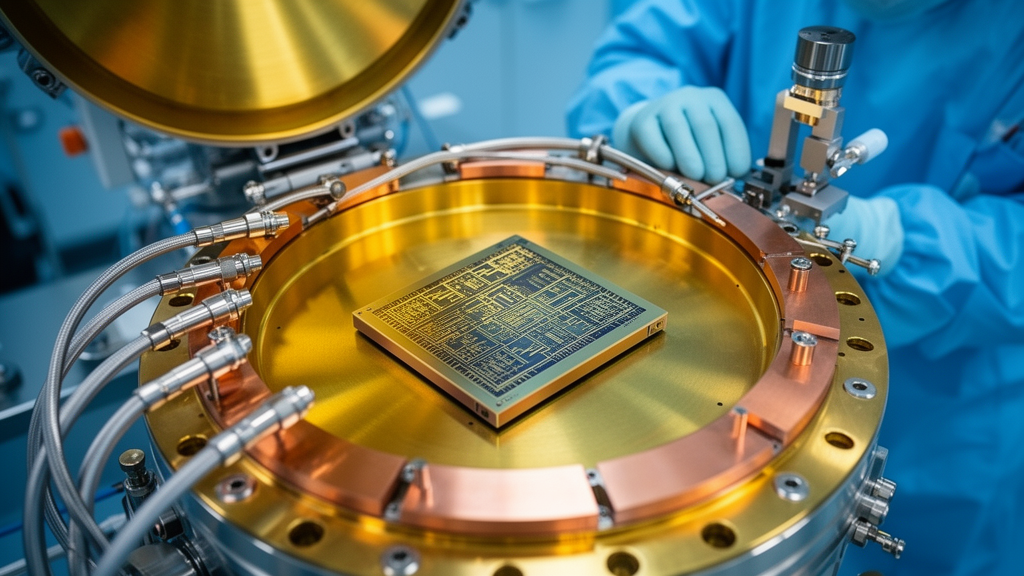
Matthew Duschenes and his colleagues have developed new mathematical formulas that describe the statistical fingerprints of noisy quantum systems, revealing that certain measurement setups produce distributions with multiple peaks rather than the single peak previously assumed. This theoretical work, published in the journal Physical Review A and designated an Editors’ Suggestion by the American Physical Society, offers a more realistic picture of how noise affects quantum computations. The study was conducted by Duschenes, a former PhD student of the late Ray Laflamme, along with his advisors Juan Carrasquilla and Roger Melko, and represents one of the last scientific papers to bear Laflamme’s name. The research focuses on the interplay between imposed randomness in quantum protocols and the inherent noise caused by environmental interactions, a critical area for understanding the limitations and potential of current quantum hardware.
In everyday life, randomness is often external, such as the spin of a roulette wheel, but in the quantum world, properties are characterized by probabilities of observation rather than specific outcomes. Duschenes explains that quantum computing systems involve imposing that the systems evolve randomly due to random protocols that are applied. This imposed randomness is distinct from the noise caused by quantum systems interacting with their environment, which can be visualized as delicate qubits being disturbed by external touches, causing some information to disappear. Understanding the interplay between these two sources of randomness is essential for determining if a quantum device is performing a task that cannot be easily replicated by a classical computer.
The research team approached this problem using combinatorics, the branch of mathematics concerned with counting, arranging, and combining elements, particularly when there are too many possibilities to list individually. Previous studies had relied on approaches rooted in complex analysis, but Duschenes and his collaborators found that a combinatorial method provided a cleaner and more intuitive framework for deriving expressions for measurement statistics. Carrasquilla described this approach as brilliant, noting that it allowed the team to see the state of the system from different angles when the state is random. This method provided a more complete picture of the measurement procedures, akin to viewing an object in three dimensions rather than just from one side, thereby offering a more informative understanding of the underlying quantum processes.
The work produced formulas for the noisy distributions in more realistic settings known as mixed states. These are quantum systems that are partly entangled with an environment that cannot be fully controlled, resulting in the loss of some information. By focusing on mixed states, the researchers moved beyond idealized models to address the imperfections that plague today’s quantum processors. The team tested these formulas against simulations of brickwork quantum circuits, a model where quantum operations are laid out like layers of bricks with noise mixed into each layer. This setup allows for a realistic mimicry of the errors and noise present in current hardware, providing a robust testbed for the new theoretical formulas.
The results of the simulations revealed a significant departure from previous observations. Instead of yielding a single peak for the noisy distributions, the researchers found that some kinds of measurements, specifically those built from mismatched or non-symmetric sets of measurement operators, produced distributions with multiple peaks. This finding indicates a much richer statistical picture than had been previously observed in simpler noise cases. The ability to recreate these distributions through simulation allowed the team to plot them as histograms, varying parameters such as system size, evolution time, and the amount of noise present. This visualization capability provides a clear view of how different conditions affect the statistical outcomes of quantum measurements.
Duschenes noted that the emergence of multiple peaks leads to interesting questions about why these patterns occur and where they might appear in other areas of quantum computing. The study was initially motivated by the desire to simulate these quantum systems using conventional computers, seeking more efficient ways to run simulation codes. This led to a deeper understanding of the measurement procedures in randomly behaving quantum systems and how they affect what can be measured. The team also aimed to understand the effects of noise and errors, seeking to describe mathematically how these systems change over time. By understanding the details of how sources of randomness are affected by noise, researchers can gain a better sense of whether quantum computers will be useful for specific tasks.
The broader implications of this work extend to the ongoing debate surrounding quantum advantage. Quantum computing scientists are striving to achieve a state where a quantum computer solves a real-world problem significantly faster, cheaper, or more accurately than a classical computer. Much of the current discussion rests on assumptions built around simpler, single-peaked noise cases. The more realistic picture of quantum noise distributions developed by Duschenes and his colleagues may offer better clues for measuring and identifying where quantum computers can demonstrate an advantage. This shift from idealized to realistic noise models is crucial for accurately assessing the capabilities of current and future quantum devices.
The research also highlights the importance of understanding the fundamental mathematical details and experimental implications of quantum information. Ray Laflamme, who passed away in 2025, was known for asking poignant questions and understanding the deep connections between theory and experiment. He was fascinated by whether quantum systems could be made useful and robust to their noisy environment, and what implications that would have for the physics governing our world. The work done in this paper is seen as a way to commemorate his contributions as a mentor and scientist, embodying the creativity and ingenuity that characterized his career. Laflamme set a high scientific bar for thoroughness and curiosity, attributes that are reflected in the detailed and rigorous approach taken by his former student.
The study raises future research questions that can be explored by looking at other quantum computation models or algorithms to see if they exhibit these new types of distributions. Instead of simulating brickwork circuits, researchers could investigate different models to understand the prevalence of multi-peaked distributions. This line of inquiry could provide further insights into the nature of noise in quantum systems and its impact on computational tasks.
Duschenes, now a postdoctoral researcher at the University of Guelph, earned his PhD at Perimeter Institute and the University of Waterloo. His advisors, Juan Carrasquilla and Roger Melko, are currently at ETH Zurich in Switzerland and the University of Waterloo, respectively. The paper, which received an Editors’ Suggestion, is recognized for its importance, impact, and intrinsic interest in the field of quantum physics. This designation highlights the significance of the work in advancing the understanding of noisy quantum systems.
By moving away from complex analysis, the team was able to derive expressions for statistics in a more intuitive manner. This approach not only simplified the derivation process but also provided a clearer understanding of the underlying mechanisms. Carrasquilla emphasized that the more general measurement approach provided a more complete picture, allowing for a deeper exploration of the statistical properties of quantum systems.
The findings of this study contribute to the broader goal of making quantum computers useful and robust. The work opens up new questions about randomness, noise, and robustness in more general settings, inviting further exploration by the scientific community.
Subject of Research: Statistical analysis of noise distributions in random quantum systems using combinatorial methods
Article Title: Finding the fingerprints of noisy distributions in random quantum systems
Article References: Finding the fingerprints of noisy distributions in random quantum systems. Original publication (Bibliographic details unavailable.)
Image Credits: AI Generated
DOI: Not provided
Keywords: quantum computing, noisy intermediate-scale quantum, combinatorics, measurement statistics, mixed states, brickwork circuits, quantum advantage, error mitigation, random protocols, environmental noise, Physical Review A, Perimeter Institute, Ray Laflamme, Matthew Duschenes, Juan Carrasquilla, Roger Melko, quantum information, statistical fingerprints, multi-peaked distributions, quantum simulation
News Source: Katie Riggs. (November 14, 2026). Combinatorics reveals multi-peaked noise distributions in quantum circuits. Scienmag.