• HOME
  • NEWS
  • EXPLORE
    • CAREER
      • Companies
      • Jobs
    • EVENTS
    • iGEM
      • News
      • Team
    • PHOTOS
    • VIDEO
    • WIKI
  • BLOG
  • COMMUNITY
    • FACEBOOK
    • INSTAGRAM
    • TWITTER
Saturday, November 7, 2026
BIOENGINEER.ORG
No Result
View All Result
  • Login
  • HOME
  • NEWS
  • EXPLORE
    • CAREER
      • Companies
      • Jobs
        • Lecturer
        • PhD Studentship
        • Postdoc
        • Research Assistant
    • EVENTS
    • iGEM
      • News
      • Team
    • PHOTOS
    • VIDEO
    • WIKI
  • BLOG
  • COMMUNITY
    • FACEBOOK
    • INSTAGRAM
    • TWITTER
No Result
View All Result
Bioengineer.org
No Result
View All Result
Home NEWS Science News Health

Colombian Medical Students View Simulation Tools as Complementary to Clinical Practice

by
November 7, 2026
in Health
Reading Time: 2 mins read
0
Colombian Medical Students View Simulation Tools as Complementary to Clinical Practice

Colombian Medical Students View Simulation Tools as Complementary to Clinical Practice

Share on FacebookShare on TwitterShare on LinkedinShare on RedditShare on Telegram

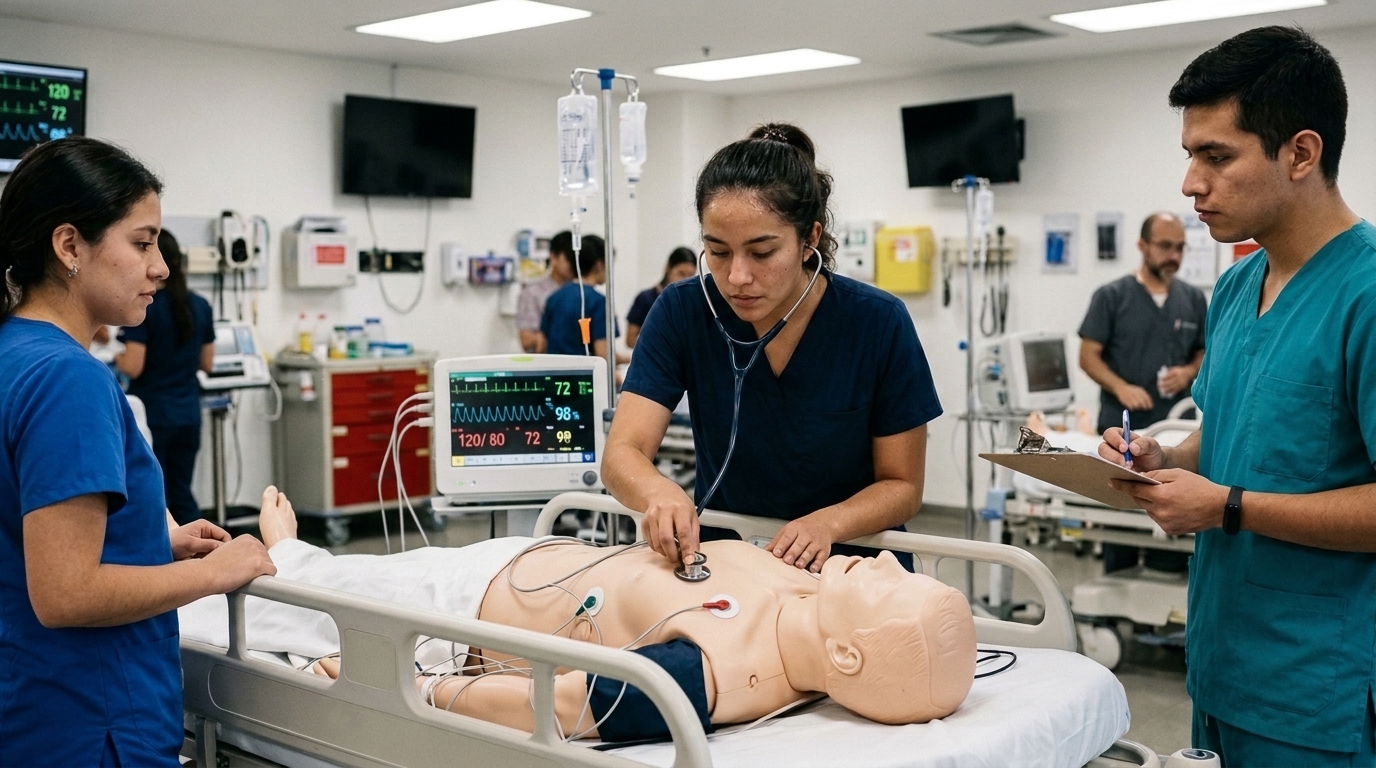
Medical students at a Colombian university view immersive and simulation technologies as a complement to rather than a substitute for clinical practice, according to a qualitative study published in Advances in Simulation. The investigation evaluated how these educational technologies are integrated into medical training, noting that while simulation facilitates safe procedural exercise and exposure to rare clinical conditions, effective implementation in Colombia depends on specific pedagogical, technical, and socioeconomic considerations.

The study was structured across three methodological phases, beginning with a literature review. In the second phase, researchers conducted observations in simulation laboratories involving fifth-, seventh-, and eighth-semester medical students, complementing the sessions with surveys administered to 84 students and semi-structured interviews completed with nine participants. In the final phase, the authors performed a thematic analysis of the data using Atlas.ti software and validated the findings through a focus group.

Participants reported that immersive and simulation technologies strengthen practical competencies by providing immediate feedback and allowing repetitive training routines in controlled settings. Students also observed that simulation tools enable the learning of infrequent pathologies.

However, the study identified critical limitations, including the simplification of clinical scenarios, technical problems, unequal access to resources, and poor development of interpersonal empathy and communication skills. The authors also found that student expectations were influenced by viewing technological modernization as an indicator of academic quality, concluding that successful integration requires ongoing assessment, contextualization, teacher training, equitable access, and coherence with the realities of the health system.

Subject of Research: Medical student perspectives on simulation technologies in Colombia

Article Title: Integration of immersive and simulation technologies in medical education: a qualitative study of student perspectives in a Colombian university

Article References: Galvis-Villamizar, S., García, V. M., & Arias, J. C. (2026). Integration of immersive and simulation technologies in medical education: a qualitative study of student perspectives in a Colombian university. Advances in Simulation. https://doi.org/10.1186/s41077-026-00483-2

Image Credits: AI Generated

DOI: 10.1186/s41077-026-00483-2

Keywords: medical education, simulation technologies, immersive learning, qualitative research, clinical practice, Colombia, student perspectives, health systems, Integration, immersive, simulation, technologies

News Source: Courtney Benton. (November 7, 2026). Colombian Medical Students View Simulation Tools as Complementary to Clinical Practice. Scienmag.


Tags: Clinical PracticeColombiahealth systemsimmersiveImmersive LearningintegrationMedical Educationqualitative researchsimulationsimulation technologiesstudent perspectivestechnologies
Share12Tweet7Share2ShareShareShare1

Related Posts

Adding Chemotherapy to First-Line EGFR-Targeted Therapy Extends Survival in Advanced Lung Cancer, Meta-Analysis Finds

Adding Chemotherapy to First-Line EGFR-Targeted Therapy Extends Survival in Advanced Lung Cancer, Meta-Analysis Finds

November 7, 2026
Tissue factor-targeted antibody-drug conjugate linked to severe ocular surface toxicity in five patients

Tissue factor-targeted antibody-drug conjugate linked to severe ocular surface toxicity in five patients

November 7, 2026

Rule shifts slow reactions in OCD and treatment-resistant depression on card sorting test

November 7, 2026

Non-Profits Launch Bridge Funding for Neurodegenerative Research

November 7, 2026

POPULAR NEWS

  • Spinal cord lesions stretching three segments or more: Spanish cohort maps the causes and the MRI clues that tell them apart

    Spinal cord lesions stretching three segments or more: Spanish cohort maps the causes and the MRI clues that tell them apart

    29 shares
    Share 12 Tweet 7
  • Preservative-free 0.02% tacrolimus eye drops eased vernal keratoconjunctivitis in children

    29 shares
    Share 12 Tweet 7
  • MicroRNAs May Steer Male and Female Development in Gnetum montanum

    29 shares
    Share 12 Tweet 7
  • Erectile dysfunction may precede rare genetic brain disease by years, case series suggests

    29 shares
    Share 12 Tweet 7

About

We bring you the latest biotechnology news from best research centers and universities around the world. Check our website.

Follow us

Recent News

Adding Chemotherapy to First-Line EGFR-Targeted Therapy Extends Survival in Advanced Lung Cancer, Meta-Analysis Finds

Dual AI Architecture Predicts Disaster Cascades to Optimize Regional Emergency Responses

Reinforcement learning picks which pretrained layers to fine-tune for medical image classification

Subscribe to Blog via Email

Enter your email address to subscribe to this blog and receive notifications of new posts by email.

Join 86 other subscribers
  • Contact Us

Bioengineer.org © Copyright 2023 All Rights Reserved.

Welcome Back!

Login to your account below

Forgotten Password?

Retrieve your password

Please enter your username or email address to reset your password.

Log In
No Result
View All Result
  • Homepages
    • Home Page 1
    • Home Page 2
  • News
  • National
  • Business
  • Health
  • Lifestyle
  • Science

Bioengineer.org © Copyright 2023 All Rights Reserved.