• HOME
  • NEWS
  • EXPLORE
    • CAREER
      • Companies
      • Jobs
    • EVENTS
    • iGEM
      • News
      • Team
    • PHOTOS
    • VIDEO
    • WIKI
  • BLOG
  • COMMUNITY
    • FACEBOOK
    • INSTAGRAM
    • TWITTER
Saturday, January 17, 2026
BIOENGINEER.ORG
No Result
View All Result
  • Login
  • HOME
  • NEWS
  • EXPLORE
    • CAREER
      • Companies
      • Jobs
        • Lecturer
        • PhD Studentship
        • Postdoc
        • Research Assistant
    • EVENTS
    • iGEM
      • News
      • Team
    • PHOTOS
    • VIDEO
    • WIKI
  • BLOG
  • COMMUNITY
    • FACEBOOK
    • INSTAGRAM
    • TWITTER
  • HOME
  • NEWS
  • EXPLORE
    • CAREER
      • Companies
      • Jobs
        • Lecturer
        • PhD Studentship
        • Postdoc
        • Research Assistant
    • EVENTS
    • iGEM
      • News
      • Team
    • PHOTOS
    • VIDEO
    • WIKI
  • BLOG
  • COMMUNITY
    • FACEBOOK
    • INSTAGRAM
    • TWITTER
No Result
View All Result
Bioengineer.org
No Result
View All Result
Home NEWS Science News

Collaborative virtual reality environments for the home office

Bioengineer by Bioengineer
July 8, 2020
in Science News
Reading Time: 2 mins read
0
IMAGE
Share on FacebookShare on TwitterShare on LinkedinShare on RedditShare on Telegram

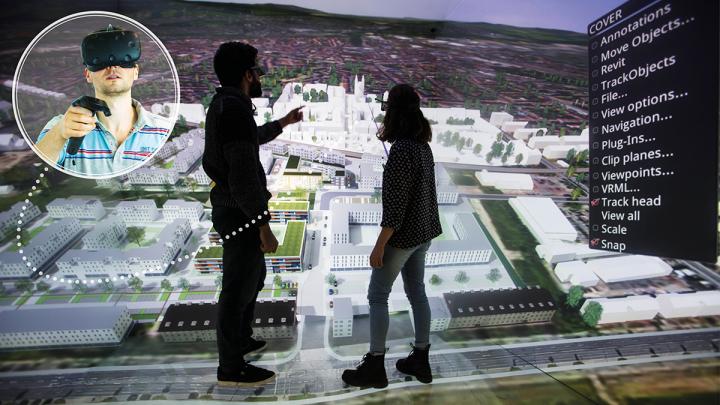
A new software platform developed by HLRS and the KoLab project enables collaboration at a distance in three-dimensional spaces.
IMAGE

Credit: HLRS/Fabian Dembski

Simulations using supercomputers or construction data from CAD systems are normally visualized and analyzed in a Cave 3D facility. In an era of “social distancing” resulting from the coronavirus pandemic, however, this is not always possible.

To address this problem, visualization experts from six universities in Baden-Württemberg, including members of the Visualization Department of the High-Performance Computing Center Stuttgart (HLRS), working together in a project titled “Virtual Collaboration Laboratories Baden-Württemberg” (KoLab), have developed a new software platform that makes it possible for persons located in different places to meet and collaborate in virtual environments (virtual reality and augmented reality, VR/AR).

Using new VR-software developed by KoLab, combined with inexpensive, commercially available VR-headsets and controllers, teams of scientists, researchers, developers, and users can gather in a virtual meeting room, with hardware located wherever is most convenient. Meeting participants are represented by avatars that can communicate in virtual reality, where they can collaboratively observe, analyze, and interact with 3D visualizations — all from their workplaces or even home offices.

Especially in situations where spontaneous in-person meetings are difficult — for example, when colleagues work at different locations, or when new kinds of challenging conditions arise, such as the “social distancing” that has become necessary due to current the coronavirus pandemic — this technology will empower collaboration and dramatically simplify complicated work processes. Even in times without the coronavirus pandemic, it will accelerate scientific discovery and significantly shorten the time it takes to bring new products to market. It is also expected that the new software will prove to be extremely useful for education and training. It will not only support and simplify education of students at universities but could also be integrated into modern distance learning frameworks.

The KoLab-BW project is a collaboration among researchers at the High-Performance Computing Center Stuttgart (HLRS), the Visualization Research Center of the University of Stuttgart (VISUS), Ulm University, the Competence Center for Virtual Reality at the Mannheim University of Applied Sciences, Albstadt-Sigmaringen University, and the University of Applied Sciences Ravensburg-Weingarten. Funding for the project was provided by the Baden-Württemberg Ministry for Science, Research and Art.

Scientists and engineers interested in learning more about the new KoLab-BW software are invited to contact Visualization Department Leader and project coordinator, Dr. -Ing Uwe Wössner ([email protected]).

###

Media Contact
Christopher Williams
[email protected]

Original Source

https://www.hlrs.de/news/detail-view/2020-07-08/

Tags: CollaborationComputer ScienceHardwareMultimedia/Networking/Interface DesignPublic HealthSoftware EngineeringTechnology/Engineering/Computer Science
Share12Tweet8Share2ShareShareShare2

Related Posts

Understanding Successful Aging: Key Determinants Revealed

January 17, 2026

Revolutionizing Imaging: Rotational Ultrasound and Photoacoustic Tomography

January 16, 2026

BRISK: Innovative Suction Kit for Emergency Use

January 16, 2026

New Double Validation Metric for Radar Sensor Models

January 16, 2026
Please login to join discussion

POPULAR NEWS

  • Enhancing Spiritual Care Education in Nursing Programs

    155 shares
    Share 62 Tweet 39
  • PTSD, Depression, Anxiety in Childhood Cancer Survivors, Parents

    147 shares
    Share 59 Tweet 37
  • Robotic Ureteral Reconstruction: A Novel Approach

    77 shares
    Share 31 Tweet 19
  • Study Reveals Lipid Accumulation in ME/CFS Cells

    54 shares
    Share 22 Tweet 14

About

We bring you the latest biotechnology news from best research centers and universities around the world. Check our website.

Follow us

Recent News

Understanding Successful Aging: Key Determinants Revealed

Revolutionizing Imaging: Rotational Ultrasound and Photoacoustic Tomography

BRISK: Innovative Suction Kit for Emergency Use

Subscribe to Blog via Email

Enter your email address to subscribe to this blog and receive notifications of new posts by email.

Join 71 other subscribers
  • Contact Us

Bioengineer.org © Copyright 2023 All Rights Reserved.

Welcome Back!

Login to your account below

Forgotten Password?

Retrieve your password

Please enter your username or email address to reset your password.

Log In
No Result
View All Result
  • Homepages
    • Home Page 1
    • Home Page 2
  • News
  • National
  • Business
  • Health
  • Lifestyle
  • Science

Bioengineer.org © Copyright 2023 All Rights Reserved.