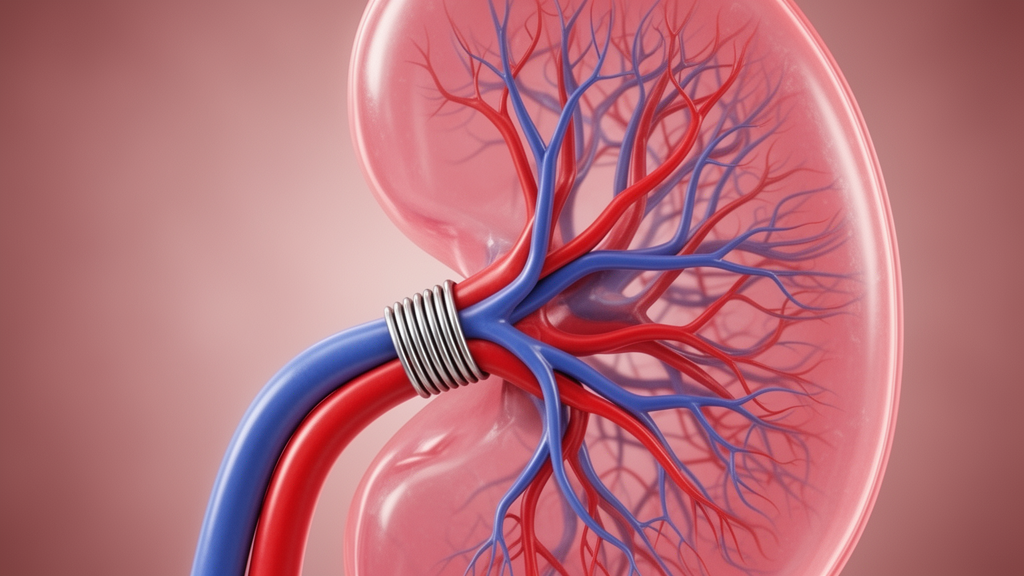
Researchers reported a clinical case involving a 56-year-old male patient with a large arteriovenous fistula in a transplanted kidney, successfully treated using minimally invasive endovascular coil embolization. The case, published in the Egyptian Journal of Radiology and Nuclear Medicine, highlights the evolution of a vascular complication in a renal allograft and demonstrates the efficacy of targeted interventional radiology techniques in preserving graft function while resolving persistent hematuria. The study serves as a detailed account of the diagnostic imaging progression and the specific procedural steps required to manage a complex vascular anomaly in a transplant setting.
Arteriovenous fistulas in transplant kidneys are uncommon but potentially serious vascular complications, most often arising after biopsy procedures or surgical trauma. While many of these fistulas are small and resolve spontaneously without intervention, larger lesions can lead to persistent hematuria, graft dysfunction, and hemodynamic compromise. The case presented in the report involved a patient with a history of end-stage renal disease who had received a kidney transplant in 2015. He presented to the hospital with altered mental status, confusion, and persistent hematuria, prompting a comprehensive diagnostic workup to identify the source of the bleeding and the cause of his neurological symptoms.
Initial imaging with a contrasted computed tomography scan of the abdomen and pelvis revealed diffuse enlargement of the right transplant kidney with a loss of normal corticomedullary differentiation. The scan also identified a pseudoaneurysm in the superior medial aspect of the transplant kidney, measuring 1.4 by 2.2 by 1.6 centimeters. Concurrently, the patient exhibited regional lymphadenopathy, which raised concerns for a lymphoproliferative disease. To further characterize the suspected malignancy, ultrasound-guided core biopsies of the transplant kidney and a lymph node were performed. Histopathology confirmed the presence of chronic lymphocytic leukemia/small lymphocytic lymphoma involvement in the transplant kidney, explaining the marked graft enlargement and lymphadenopathy as a separate process from the vascular abnormality.
Despite the identification of the lymphoproliferative disease, the patient’s hematuria persisted over the following two weeks, necessitating further vascular evaluation. A repeat computed tomography angiography demonstrated a significantly enlarged tubular vascular structure within the transplant kidney, measuring 70.5 by 24.2 millimeters. The imaging also showed early venous opacification of the right common iliac vein during the arterial phase, a finding strongly suggestive of a large arteriovenous fistula. This temporal evolution from a pseudoaneurysm to a large fistula with substantial arteriovenous shunting indicated that the vascular abnormality was progressing and required intervention to prevent further complications such as high-output heart failure or graft loss.
Interventional radiology was consulted for endovascular treatment given the size of the fistula and the ongoing symptoms. The procedure utilized ultrasound-guided retrograde access to the right common femoral artery, through which a 5 French sheath was placed. A diagnostic angiogram performed via a 5 French Glide catheter confirmed the presence of a large arteriovenous fistula in the superior portion of the transplant kidney. The fistula was supplied by both anterior and posterior branches of the transplant renal artery, identifying the specific feeding vessels that needed to be targeted for occlusion to stop the abnormal blood flow.
Selective microcatheterization was performed using a Lantern microcatheter to precisely target each feeding vessel. The anterior renal artery was occluded using a combination of one POD3 20 cm coil and one 4 mm by 10 cm Ruby coil. The posterior renal artery feeders were embolized with three separate coils: an Azur 6 mm by 17 cm coil, a 5 mm by 11 cm coil, and a 4 mm by 7 cm coil. This superselective approach allowed for the targeted occlusion of the fistula while minimizing the risk of infarction to the surrounding healthy renal parenchyma. The use of detachable coils provided a durable occlusion of the abnormal vascular communication.
Sequential angiograms during the procedure demonstrated a progressive reduction in flow through the fistula, culminating in complete cessation of flow. Final angiography confirmed total occlusion of the arteriovenous fistula while preserving flow through the main transplant renal artery. The puncture site was closed using an Angio-Seal device, and the estimated blood loss during the procedure was less than 10 milliliters. The patient remained hemodynamically stable throughout the intervention, indicating that the procedure was technically successful and well-tolerated by the patient’s cardiovascular system.
Post-procedural monitoring confirmed the immediate success of the embolization. The patient’s hematuria subsided within 24 hours of the intervention. A post-procedure Doppler ultrasound showed no residual flow within the previously identified arteriovenous fistula, confirming the absence of turbulent bidirectional flow that had been observed prior to treatment. The patient was maintained on bed rest for four hours as a standard precaution following femoral artery access. The rapid resolution of hematuria provided early clinical evidence that the vascular shunt had been effectively closed.
A follow-up computed tomography angiography performed four days after the embolization provided definitive confirmation of durable occlusion. The imaging demonstrated no residual aneurysm, fistula, or active contrast extravasation. The transplant kidney showed preserved perfusion, and the patient was in stable condition with complete resolution of hematuria. This outcome supported the conclusion that endovascular coil embolization is a safe and effective treatment for large arteriovenous fistulas in transplanted kidneys, allowing for targeted occlusion while preserving renal function.
The case underscores the importance of early recognition and serial imaging in the management of vascular complications in renal allografts. The temporal evolution of the vascular abnormality, from a pseudoaneurysm to a large fistula, highlights the potential for progression in a diseased allograft, particularly following biopsy procedures. Although the exact cause of the interval enlargement was not definitively determined, the case illustrates the need for vigilant monitoring in patients with persistent hematuria. The successful use of minimally invasive techniques in this case aligns with contemporary outcome data that favor transcatheter embolization over surgical interventions for graft-sparing treatment.
By preserving the main renal arterial flow, the interventional approach avoided the need for surgical graft removal, which would have been a more drastic measure. The case demonstrates that large arteriovenous fistulas in transplanted kidneys can develop and progress during hospitalization and should be considered in the differential diagnosis of patients with persistent hematuria. The combination of diagnostic imaging and precise interventional techniques allowed for the successful management of a complex vascular complication, ultimately preserving the function of the transplanted kidney and improving the patient’s clinical status.
A large arteriovenous fistula alters cardiovascular hemodynamics by permitting arterial blood to bypass the high-resistance capillary network, leading to a precipitous fall in systemic vascular resistance. In response to this reduced vascular resistance, compensatory physiological mechanisms trigger increases in stroke volume, heart rate, and cardiac output to sustain adequate systemic perfusion. Over time, persistent hemodynamic shunting elevates venous return to the heart, which can progressively induce ventricular dilation, left-ventricular hypertrophy, and eventually high-output heart failure due to chronic volume overload. At the local tissue level, continuous arteriovenous shunting compromises parenchymal microcirculation, precipitating renal ischemia, secondary pseudoaneurysm formation, and progressive graft dysfunction within the transplant kidney.
Within the broader literature on renal transplantation, arteriovenous fistulas represent recognized iatrogenic complications typically arising from percutaneous allograft biopsy or inadvertent surgical trauma during transplantation. Percutaneous needle biopsy establishes direct vascular communications when adjacent arterial and venous branches suffer simultaneous injury. Epidemiological surveillance indicates that the reported postbiopsy incidence of arteriovenous fistulas varies considerably across investigations, ranging from approximately 1 percent to as high as 10 to 16 percent depending on surveillance protocols. The vast majority of these vascular lesions remain small and asymptomatic, with approximately 70 percent resolving spontaneously without active clinical intervention. Consequently, clinical guidelines favor conservative surveillance for asymptomatic lesions, reserving intervention for presentations marked by persistent hematuria, progressive vascular enlargement, compromised graft perfusion, or refractory hypertension.
The therapeutic success observed in this individual aligns with historical outcome cohorts evaluating endovascular management for transplant vascular complications. In a published study by Serna-Higuita and colleagues examining 452 renal transplant biopsies, twelve patients developed allograft arteriovenous fistulas that required embolization, with superselective transcatheter intervention achieving a technical success rate of 92 percent while preserving allograft function in most recipients. Similarly, investigation by Osako and colleagues documented favorable technical and clinical endpoints following transcatheter embolization for postbiopsy fistulas. Earlier research series evaluating superselective microcatheter access and metallic coil deployment consistently demonstrated high rates of definitive vascular occlusion, achieving targeted lesion closure while restricting renal parenchymal infarction and sustaining functional allograft survival.
Comprehensive diagnostic imaging plays a pivotal role in identifying these vascular malformations and distinguishing their features. Color Doppler ultrasound serves as the preferred initial examination for suspected allograft vascular complications, characteristically revealing disorganized high-velocity blood flow, low-resistance arterial waveforms, and arterialization within draining venous channels, alongside classic bidirectional turbulent flow patterns. Computed tomography angiography subsequently clarifies angioarchitecture by delineating feeding arterial branches, venous drainage paths, and accompanying aneurysmal expansion, where early contrast opacification of the draining iliac vein signals marked arteriovenous shunting. In this patient, the diagnostic course was further complicated by pre-existing cardiovascular comorbidity, concurrent chronic lymphocytic leukemia infiltration, and biopsy-associated hemorrhage managed with local hemostatics. The clinical team noted persistent uncertainty regarding whether the subsequent fistula development stemmed from direct needle trauma during tissue sampling or reflected the natural evolution of the pre-existing pseudoaneurysm within a diseased allograft.
Subject of Research: Embolization of a large arteriovenous fistula in a transplanted kidney: a case report
Article Title: Embolization of a large arteriovenous fistula in a transplanted kidney: a case report
Article References: Qassab, H., Esswein, A., Ghouri, M., & Elhelf, I. (2026). Embolization of a large arteriovenous fistula in a transplanted kidney: a case report. Egyptian Journal of Radiology and Nuclear Medicine, 57(1), Article 202. https://doi.org/10.1186/s43055-026-01874-1
Image Credits: AI Generated
DOI: 10.1186/s43055-026-01874-1
Keywords: Embolization, large, arteriovenous, fistula, transplanted, kidney, case, report, scientific research
News Source: Ophelia Keating. (November 9, 2026). Coil Embolization Resolves Large Arteriovenous Fistula in Transplanted Kidney. Scienmag.