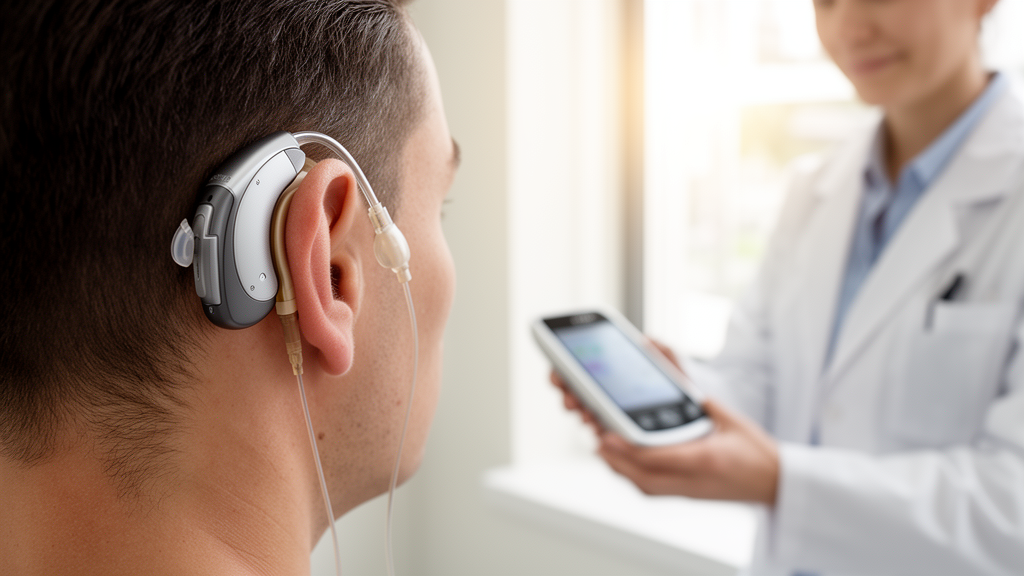
Cochlear implantation provides substantial audiological benefits for individuals experiencing severe-to-profound sensorineural hearing loss secondary to mitochondrial encephalomyopathy, lactic acidosis, and stroke-like episodes, commonly known as MELAS syndrome. According to a systematic review conducted by David H. Elisha, Ryan Hossain, Adrien A. Eshraghi, and colleagues, published in the Journal of Rare Diseases, electronic cochlear prostheses successfully restore speech perception and functional auditory processing in this unique clinical population. While hearing loss represents one of the most pervasive complications of mitochondrial disease, surgical intervention in affected individuals entails heightened clinical complexity due to baseline metabolic vulnerabilities, pronounced anesthetic sensitivities, and perioperative risks of systemic decompensation. The synthesis demonstrates that direct electrical stimulation of spiral ganglion neurons can bypass damaged peripheral receptor systems to achieve marked communicative improvements.
Mitochondrial encephalomyopathy, lactic acidosis, and stroke-like episodes is an uncommon disorder of mitochondrial DNA with an estimated prevalence of roughly 0.016 percent. Human mitochondrial DNA is a circular, double-stranded molecule of 16,569 base pairs that exhibits a spontaneous mutation rate between ten and one hundred times higher than nuclear DNA. Although multiple genetic variants have been tied to the syndrome, an adenine-to-guanine transition at nucleotide position 3243 of the transfer RNA leucine gene accounts for approximately 80 percent of documented cases. Mutations at nucleotide position 3271 occur in fewer than 10 percent of individuals, while an isolated substitution at nucleotide 3291 has been identified in single case reports. Pathophysiologically, the 3243 substitution impairs mitochondrial translation, severely compromising cellular oxygen consumption and cellular adenosine triphosphate generation across metabolically active organs such as skeletal muscle, the nervous system, and the central auditory apparatus.
Sensorineural hearing loss represents an extraordinarily prevalent comorbidity in individuals harboring the m.3243A>G mutation, with documented rates spanning from 27 to 78 percent among patients with MELAS syndrome, and reaching up to 81 percent in dedicated regional cohort investigations. In approximately 20 percent of affected individuals, the deficit progresses toward severe-to-profound deafness. Pathologically, auditory decline stems primarily from bioenergetic collapse within cochlear lateral wall structures, specifically affecting the stria vascularis and outer hair cells of the organ of Corti. The stria vascularis maintains endolymphatic osmolarity and generates the endocochlear potential through abundant sodium-potassium ATPase transport pumps and specialized potassium channels including NKCC1, KCNQ1, Kir4.1, Kir5.1, and Kv channels. Because outer hair cells possess intense metabolic demands and lack regenerative capability, disruption of ionic homeostasis and ATP depletion precipitate progressive cochlear atrophy, frequently prompting initial presentation to otolaryngologists prior to systemic recognition.
To rigorously consolidate evidence on the surgical and functional efficacy of cochlear implantation in this population, the investigators executed a pre-planned systematic review compliant with the Preferred Reporting Items for Systematic Reviews and Meta-Analyses guidelines. The study protocol was registered prospectively with the International Platform of Registered Systematic Review and Meta-analysis Protocols under the registration code INPLASY202570034. Comprehensive electronic database queries were run across PubMed, Embase, Web of Science, and Scopus up to March 2025. Two independent reviewers applied targeted search algorithms combining controlled vocabulary for cochlear implantation and MELAS syndrome while explicitly excluding non-human studies, commentaries, and secondary reviews. Methodological rigor and risks of bias were systematically assessed using modified Joanna Briggs Institute appraisal checklists, resolving discrepancies through consensus and senior author adjudication.
The electronic screening process initially retrieved 292 candidate records, which yielded 227 citations following deduplication. Title and abstract evaluations removed 195 non-relevant articles, leaving 32 publications for full-text assessment. Twenty-four candidate reports were subsequently eliminated due to inappropriate study designs, disparate outcome measures, alternative indications, non-qualifying patient populations, or mismatched interventions. Ultimately, eight qualifying studies encompassing a collective total of ten patients with MELAS-associated hearing loss were included in the qualitative synthesis. Six investigations detailed surgical and operative findings, four documented standardized post-implantation aided speech perception metrics, three reported Speech Intelligibility Rating scores, and two tracked Categories of Auditory Performance classifications, reflecting the rarity of this metabolic disorder in surgical otologic literature.
Aided speech recognition testing demonstrated consistent gains in sentence-level comprehension following cochlear implant activation. In evaluations employing Bamford-Kowal-Bench sentence protocols, pre-implantation scores under acoustic amplification revealed severe deficits, with scores documented as low as zero to 2 percent. Following surgical implantation, recipients achieved substantial improvements. In one case report by Crundwell and colleagues, female voice recognition rose to 80 percent at four months and phoneme discrimination reached 100 percent after one year, accompanied by high patient satisfaction. In an additional patient, bilateral baseline scores of 42 percent advanced to between 94 and 100 percent. Similarly, Hill and associates reported a patient achieving a 92 percent score on Bamford-Kowal-Bench sentences and a 97 percent score on City University of New York sentence lists at two years without visual lip-reading cues, facilitating return to full-time employment and unassisted telephone conversation.
Word-level recognition assessments likewise reflected restored discrimination of complex linguistic stimuli. Evaluating monosyllabic and disyllabic speech perception, Sun and co-authors described an individual who underwent sequential bilateral cochlear implantation, receiving a right implant followed two months later by a contralateral device. By three months, monosyllabic word recognition reached 76 percent in the right ear and 44 percent in the left ear, while spondee discrimination reached 95 percent and 100 percent, respectively. At twelve months, unilateral right-sided recognition peaked at 96 percent for monosyllables and 100 percent for spondees, yielding final bilateral composite scores of 72 percent and 100 percent. In a parallel investigation by Yasumura and colleagues, word discrimination scores progressed from 0 percent with conventional hearing aids to 72 percent under closed-set conditions and 44 percent in open-set formats within three months of unilateral implantation.
Electrophysiological assessments gathered across the reviewed cohorts provided objective documentation that functional central neural pathways were successfully stimulated. Interventions monitored through Auditory Brainstem Response, middle latency response testing, brainstem auditory evoked potentials, and neural response telemetry demonstrated intact electrical transmission along the cochlear nerve and ascending brainstem nuclei. Rosenthal and collaborators recorded repeatable post-implantation middle latency potentials occurring 10 to 50 milliseconds post-stimulus, confirming preserved cortical auditory processing across thalamocortical networks. Scarpelli and colleagues noted stable evoked responses correlating with marked social communication improvements despite concurrent systemic complications. These diagnostic findings verify that despite extensive strial degeneration within the cochlea, spiral ganglion neural populations and auditory brainstem relays remain responsive to direct artificial electrical excitation.
Notwithstanding positive audiological gains, the systematic review emphasizes that perioperative management demands rigorous multidisciplinary coordination among otologists, anesthesiologists, geneticists, and metabolic experts. Due to underlying defects in oxidative phosphorylation, individuals with MELAS are exceptionally vulnerable to metabolic decompensation, severe lactic acidosis, and electrolyte instability. In a cited cohort of nine patients with MELAS undergoing surgical procedures, seven developed perioperative hyponatremia and hyperkalemia. Such electrolyte shifts elevate risks of cardiac arrhythmias and hemodynamic instability, mandating frequent serial evaluations of serum electrolytes, lactate, and glucose. Furthermore, agents such as propofol, volatile inhalational anesthetics, and depolarizing neuromuscular agents like succinylcholine carry recognized risks of mitochondrial inhibition or hyperkalemic paralysis, supporting the use of alternative intravenous regimens featuring dexmedetomidine or remifentanil.
The review authors underscore substantial limitations in the available evidence base, most notably the very small collective sample size of ten patients and a heavy reliance on isolated case reports and uncontrolled observational series. Heterogeneity in reported outcome metrics, missing technical device specifications, and variable follow-up durations further constrain broad statistical comparisons. Moreover, diagnostic overlap presents challenges, as exemplified by cases sharing the m.3243A>G mutation where phenotypic profiles align more closely with maternally inherited diabetes and deafness rather than classic MELAS. While potential subclinical central processing deficits and variable tissue heteroplasmy warrant cautious preoperative counseling, the compiled evidence confirms that cochlear implantation represents a viable, effective auditory rehabilitative strategy when paired with specialized perioperative metabolic precautions.
Subject of Research: Systematic review of cochlear implantation outcomes and perioperative considerations in MELAS syndrome
Article Title: Cochlear implantation in MELAS syndrome: a systematic review of audiological outcomes, surgical considerations, and clinical implications
Article References: Elisha, D. H., Hossain, R., Cohen, D. H., Monterrubio, A., Zalta, M., Mittal, R., & Eshraghi, A. A. (2026). Cochlear implantation in MELAS syndrome: a systematic review of audiological outcomes, surgical considerations, and clinical implications. Journal of Rare Diseases, 5(1), Article 65. https://doi.org/10.1007/s44162-026-00202-5
Image Credits: AI Generated
DOI: 10.1007/s44162-026-00202-5
Keywords: MELAS syndrome, cochlear implantation, sensorineural hearing loss, systematic review, audiological outcomes, m.3243A>G mutation, speech perception, stria vascularis, electrophysiological testing, auditory brainstem response, middle latency response, perioperative management, metabolic decompensation, anesthetic sensitivity, mitochondrial disease, rare diseases, PRISMA
News Source: Ophelia Keating. (November 20, 2026). Cochlear Implants Improve Hearing in Rare MELAS Syndrome Despite Perioperative Challenges. Scienmag.