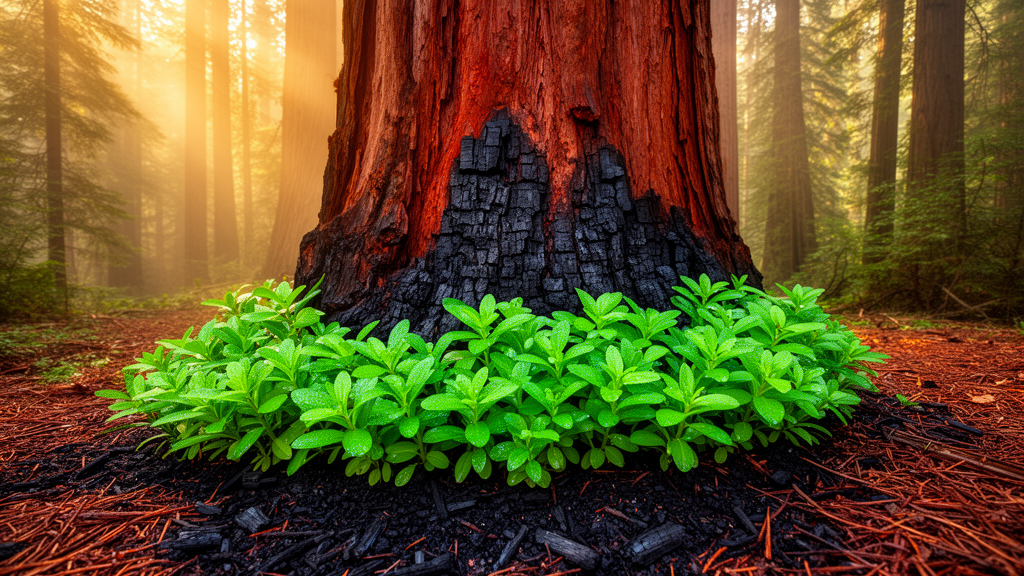
Two years following the high-severity 2020 CZU Lightning Complex in central California, coast redwood basal resprouting presence and shoot abundance did not decline under extreme fire injury but instead climbed steadily across the entire damage gradient. Publishing in Fire Ecology, researchers Jackson T. Carrasco, Jeffrey M. Kane, and Alan J. Tepley evaluated how secondary Sequoia sempervirens stands recovered across state and county parks in the Santa Cruz Mountains after burning under altered modern fire regimes. Rather than reaching an upper threshold where severe heating exhausted dormant bud banks or halted regeneration, the probability of basal resprout emergence and the accumulated vegetative biomass grew continuously alongside fire severity. The field investigation revealed that relativized fire-damage metrics, specifically the bole char ratio calculated by dividing bole char height by total tree height, provided the single most informative predictor of both sprouting presence and total sprout productivity.
The research addresses urgent ecological questions regarding forest resilience as climate change, historic fire exclusion policies, and past intensive timber harvesting alter wildfire size and severity across western North America. The coast redwood ecosystem, stretching along the Pacific coast from southwest Oregon to Big Sur, California, evolved under historically frequent surface fires where mature trees relied on thick fibrous bark and elevated crown bases. However, twentieth-century clear-cutting converted primary groves into uniform secondary forests that now dominate protected reserves. In August 2020, the CZU Lightning Complex burned 34,000 hectares over 37 days across the Santa Cruz Mountains, with fifty-two percent of the burn footprint categorized as high-severity fire exceeding 572 relative differenced normalized burn ratio units. This extensive burn perimeter offered an unprecedented setting to examine post-fire recovery mechanisms across diverse topographies and historical management units.
To evaluate post-fire vegetative persistence, the researchers sampled secondary redwood stands across six state and county parks: Año Nuevo State Park, Big Basin State Park, Butano State Park, Henry Cowell State Park, Wilder Ranch State Park, and Pescadero Creek County Park. Elevations ranged between 10 and 800 meters across slopes spanning 3 to 65 percent, situated on coarse loamy mixed soils of the Ben Lomond series. The 30-year regional climate average reflected a mean annual temperature of 14.6 degrees Celsius and 108 centimeters of annual precipitation falling predominantly during winter months. Weather in the year preceding the wildfire had been exceptionally warm and dry, delivering only 48 centimeters of precipitation at an average temperature of 15.8 degrees Celsius, followed by slightly wetter post-fire conditions averaging 115 centimeters and 15.0 degrees Celsius. Within this landscape, the authors selected 77 focal redwoods using a stratified random design across five damage classes based on bole char ratios, maintaining at least 200 meters between trees to avoid spatial autocorrelation.
Every selected focal tree occupied a dominant or codominant canopy position, exhibited a diameter at breast height exceeding 30 centimeters, and belonged to mature secondary forest stands where heights ranged from 21 to 67 meters and diameters spanned 31 to 170 centimeters. Field crews gathered laser rangefinder measurements for total height, crown base height, bole char height, and crown damage height, which captured combined foliar scorch and consumption after burned needles dropped. Bole char height and crown damage height were relativized to total tree height to produce the bole char ratio and crown damage ratio. To evaluate sprout productivity, crews tallied all basal shoots around each trunk into three length classes, sampled up to 30 individual stems per tree for caliper diameter and length, and harvested representative subsets to construct species-specific allometric biomass equations.
Beyond individual tree dimensions, the study quantified stand competition and fine-scale climatic stress to determine how local microenvironments shaped redwood regeneration. Light availability was captured 0.8 meters above ground beneath each focal tree canopy using upward-facing 180-degree hemispherical digital fisheye photographs analyzed for percentage canopy openness. Regional moisture stress was derived from the United States Geological Survey Basin Characterization Model at a 270-meter resolution, generating climatic water deficit estimates averaged over 30-year baseline normals alongside two-year, one-year, and seasonal pre-fire intervals. To complement the 77 intensively measured focal trees, the team incorporated data from a companion investigation comprising 65 fixed-radius plots of one-twenty-fifth hectare containing 718 individual redwoods across the CZU burn zone. In that larger inventory, 106 trees lacked basal sprouts and complete genet mortality occurred in 7.1 percent of surveyed stems, providing robust statistical power to isolate the environmental factors that govern whether a fire-damaged redwood successfully resprouts or fails completely.
Analytical workflows combined machine-learning boosted regression trees using tenfold cross-validation with generalized linear models and mixed-effects regressions evaluated by cross-validated normalized root mean squared error, log loss, and corrected Akaike information criteria. Boosted regression trees established that bole char ratio held the highest relative influence, displaying a monotonic positive trajectory where resprouting probability and shoot abundance grew with elevated fire injury. In cross-validated generalized linear models, the bole char ratio yielded the lowest log loss of 0.33 for resprout presence, with baseline resprout probability reaching 0.49 even on trees experiencing fire damage approaching zero. For resprout abundance, the ratio minimized normalized error for total dry biomass, foliar biomass, and total leaf area, confirming that proportional trunk charring provides an exceptionally reliable indicator of post-fire regenerative vigor.
Crucially, the empirical data revealed no evidence of a fire-damage ceiling or threshold above which basal resprouting declined or collapsed. Redwoods displaying 100 percent bole char ratios exhibited the highest probability of sprouting and produced the greatest volume of basal shoot biomass, retaining strong regenerative capacity despite severe canopy consumption. Complete genet mortality within the companion plot network was confined to exposed ridgeline sites characterized by severe soil erosion that left roots and lignotubers physically unshielded from flame contact. The authors emphasized that mineral soil and thick basal bark effectively insulate dormant bud banks against lethal temperatures during high-intensity canopy burns. Once crown foliage and apical shoots are consumed, the cessation of downward auxin transport triggers dormant meristematic tissues located at stem bases and underground lignotubers.
While fire severity provided the dominant positive impulse for vegetative vigor, pre-fire climatic water deficit acted as a consistent secondary constraint that moderated total sprout productivity. Generalized linear models demonstrated that secondary redwoods growing on drier sites with higher cumulative climatic water deficit produced significantly lower total resprout biomass, reduced leaf mass, and smaller total leaf area. For total resprout biomass, the regression model combining bole char ratio and pre-fire climatic water deficit yielded an adjusted coefficient of determination of 0.50, with water deficit exerting a statistically significant negative coefficient. Although trees in warmer and drier locations with higher water deficit still resprouted after fire, their overall resprouting abundance was slightly reduced compared to trees experiencing lower pre-fire moisture stress.
Unexpectedly, tree size metrics including trunk diameter and calculated pre-fire biomass did not limit or enhance post-fire basal resprouting across the sampled stem diameter range of 31 to 170 centimeters. The researchers also examined interactions between trunk epicormic sprouting and basal reiteration, observing that 44.2 percent of focal stems produced no epicormic foliage along their charred trunks. However, where epicormic sprouting did occur along the bole, it correlated positively with the probability of basal resprout presence. This positive association suggests that heat damage sufficient to trigger stem-based epicormic buds does not fatally disrupt internal vascular transport or deplete systemic carbohydrate pools, demonstrating that epicormic and basal sprouting operate as mutually compatible persistence strategies rather than competing metabolic sinks.
These results suggest that high-severity wildfire in secondary coast redwood stands does not imply the loss of redwood stands, though canopy structure may be severely altered. Nevertheless, the documented sensitivity of resprout biomass to pre-fire water deficit underscores that intensifying climate change and multi-year droughts could steadily erode this historical resilience. As fire return intervals shorten and seasonal moisture deficits expand across California, continued long-term monitoring across full climatic and elevation gradients remains essential to ensure that iconic coast redwood ecosystems endure amid escalating atmospheric and environmental stresses.
Subject of Research: Post-fire basal and epicormic resprouting dynamics in coast redwood secondary forests
Article Title: Prolific post-fire persistence: resilience and resprouting in the iconic coast redwood
Article References: Carrasco, J. T., Kane, J. M., & Tepley, A. J. (2026). Prolific post-fire persistence: resilience and resprouting in the iconic coast redwood. Fire Ecology, 22(1), Article 108. https://doi.org/10.1186/s42408-026-00564-7
Image Credits: AI Generated
DOI: 10.1186/s42408-026-00564-7
Keywords: Sequoia sempervirens, coast redwood, CZU Lightning Complex, basal resprouting, epicormic resprouting, bole char ratio, climatic water deficit, fire ecology, secondary forest, wildfire severity, bud bank reserves, vegetative persistence, Santa Cruz Mountains, crown damage ratio, forest resilience, resprout biomass, boosted regression trees, tree allometry
News Source: Drew Townsend. (November 11, 2026). Coast Redwood Basal Resprouting Increases Continuously With Higher Wildfire Damage. Scienmag.