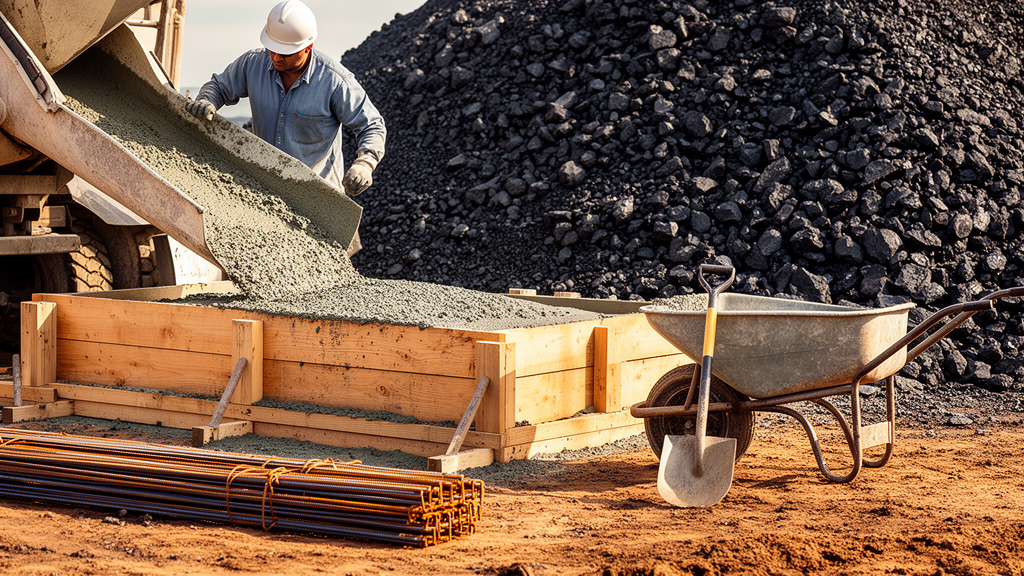
Researchers in India have shown that coal mine overburden, the shale- and sandstone-rich waste stripped away to reach buried coal seams, can completely replace natural river sand in a one-part alkali-activated concrete. In the study, published in Discover Concrete and Cement, a mixture containing 100 percent coal mine overburden as the fine aggregate reached a 28-day compressive strength of 48.99 megapascals, within 1.67 percent of the 49.82 megapascals achieved by the control mix that used entirely natural sand. The work, carried out by Sanchita Nawale and Rahul V. Ralegaonkar, addresses two problems at once: the ecological damage caused by unregulated river sand extraction and the enormous land, dust and air-quality burdens created by stockpiled mining waste.
The binder system was deliberately chosen to avoid ordinary Portland cement, which the authors note is associated with nearly 8 percent of global carbon dioxide emissions. Fly ash and ground granulated blast furnace slag, both sourced from local factories in Nagpur, Maharashtra, served as the aluminosilicate precursors, while powdered sodium metasilicate acted as the alkali activator. In a one-part, or just-add-water, system, the dry ingredients are blended in advance and only need water at the mixing site, avoiding the corrosive alkaline solutions required by conventional two-part alkali activation. The coal mine overburden itself was collected from a mining location in the Nagpur region and used in its raw, unprocessed state.
The experimental programme screened seven mixtures across a sequential matrix. Fly ash to slag ratios of 50:50, 25:75 and 0:100 were combined with sodium metasilicate dosages of 8 and 10 percent by binder mass, and overburden replacement levels of 0, 25, 50, 75 and 100 percent. The total binder content was held at 700 kilograms per cubic metre and the water-to-binder ratio at 0.35 throughout, so that water content would not confound the comparisons. Specimens were cast in 100 millimetre cube moulds, demoulded after 24 hours and stored at room temperature with no external water curing, and compressive strength was measured at 1, 7 and 28 days following relevant Indian Standard procedures.
Strength developed rapidly under these ambient conditions. First-day strengths ranged from about 5 to 7 megapascals, most mixes reached 35 to 45 megapascals by seven days, and 28-day values spanned roughly 42 to 48 megapascals. The concrete attained more than 98 percent of its 28-day strength by day seven, a pace the authors attribute chiefly to the high reactivity of slag under alkaline conditions, which rapidly dissolves calcium-, silica- and alumina-bearing phases and forms calcium-rich C-A-S-H-type reaction products. As those readily reactive phases are consumed and the matrix densifies, the rate of strength gain slows, with the slower-reacting fly ash contributing to later-age development. A one-way analysis of variance across the seven mix means gave F = 80.24 with p = 4.93 × 10⁻¹⁰ at α = 0.05, confirming the differences were statistically significant; strength values were reported as means of three specimens with standard deviations, coefficients of variation and 95 percent confidence intervals.
Although the control mix C1 was strongest, the fully overburden-bearing mix C7 was selected as the optimum because its strength deficit was marginal. Its supporting mechanical properties were measured directly: a splitting tensile strength of 3.90 megapascals, a flexural strength of 5.60 megapascals, a bond strength of 14.74 megapascals and a modulus of elasticity of 27.90 gigapascals. The tensile value corresponds to about 8.9 percent of compressive strength, within the generally accepted 8 to 12 percent range, and the flexural result exceeded the Indian Standard threshold of 10 percent of compressive strength, which for this mix was 4.38 megapascals. The modulus, determined with a compressometer under uniaxial compression, sits about 20.3 percent below the roughly 35 gigapascals predicted by the empirical relation used for conventional concrete at this strength, a difference the authors link to the different aggregate characteristics, pore structure and binder chemistry of the alkali-activated system.
Bond behaviour was assessed with a reinforcement pull-out test according to IS 2770 (Part 1):1967. The specimen sustained a maximum load of 77.80 kilonewtons, yielding the 14.74 megapascal bond strength, which exceeds the 2 to 5 megapascals typically reported for ordinary Portland cement concrete and points to strong adhesion between the matrix and embedded steel. Drying shrinkage, measured on 75 × 75 × 300 millimetre prisms over 28 days, was concentrated early: 0.023 percent strain in the first seven days, progressing through 0.028 and 0.031 percent at 14 and 21 days to 0.037 percent at 28 days. This comparatively low value is notable because one-part alkali-activated systems, particularly those rich in slag, can shrink considerably depending on their pore structure and curing conditions.
Durability indicators were also quantified. Chloride content, determined by argentometric titration, was 345.89 milligrams per litre, well inside the 2000 milligrams per litre limit for mixing water, and sulphate content was 90.43 milligrams per litre against a permissible maximum of 400 milligrams per litre under IS 456:2000. A carbonation test sprayed with pH indicator on a freshly fractured surface showed extensive pink coloration, indicating high alkalinity, minimal carbonation depth and continued protection of embedded reinforcement. The authors caution, however, that these chloride and sulphate values should only be compared with literature results obtained under identical test procedures and exposure conditions, and that chloride behaviour was measured as a concentration rather than a penetration depth, so no direct numerical comparison with penetration-depth data is possible.
Scanning electron microscopy paired with energy-dispersive X-ray spectroscopy revealed a relatively dense, compact matrix in which gel phases surround and partially bind unreacted particles, leaving few visible voids. The spectra showed strong peaks for oxygen, silicon, sodium and calcium, with aluminium and trace elements such as iron, manganese, zinc, titanium and magnesium originating from the precursor materials. The coexistence of calcium with silicon and aluminium is consistent with C-A-S-H-type binding products, while the sodium-silicon-aluminium-rich environment supports a possible N-A-S-H contribution. The authors are careful to note that SEM-EDS alone cannot definitively identify specific reaction phases, so these gel assignments remain supported interpretations, and they recommend complementary X-ray diffraction and Fourier-transform infrared spectroscopy in future work.
The sustainability assessment, conducted for one cubic metre of concrete within a defined system boundary covering raw materials, production and a 50-kilometre transport of overburden, used embodied-energy coefficients from the Inventory of Carbon and Energy database. Because the overburden was used raw and unprocessed, no beneficiation energy was assigned. Conventional M30-grade reference concrete was estimated at 2434.8 megajoules per cubic metre against 1778.3 megajoules per cubic metre for the new mix, a 26.96 percent reduction, with sodium metasilicate’s high intensity of 10.95 megajoules per kilogram contributing substantially to the remaining total. Estimated material costs, based on local market unit rates, fell 11.13 percent, from ₹5800.2 to ₹5154.5 per cubic metre. The authors stress these figures are not a full cradle-to-grave life-cycle assessment: global warming potential, water use, construction-stage, service-life and end-of-life impacts were not quantified, and embodied energy should not be read as an equivalent carbon reduction. They also note the results do not establish superiority over ordinary Portland cement concrete, since no parallel OPC programme was run, and identify CMO variability with mining location, limited long-term durability testing and the absence of field-scale validation as key limitations. Within those bounds, the study demonstrates that complete replacement of natural sand with coal mine overburden is technically feasible in the investigated one-part alkali-activated system, without reducing the material to a low-strength product.
Subject of Research: Using coal mine overburden as a complete replacement for natural fine aggregate in one-part alkali-activated concrete
Article Title: Investigation of coal mine overburden as a sustainable fine aggregate in alkali-activated concrete
Article References: Nawale, S., & Ralegaonkar, R. V. (2026). Investigation of coal mine overburden as a sustainable fine aggregate in alkali-activated concrete. Discover Concrete and Cement, 2(1), Article 82. https://doi.org/10.1007/s44416-026-00119-8
Image Credits: AI Generated
DOI: 10.1007/s44416-026-00119-8
Keywords: coal mine overburden, alkali-activated concrete, fine aggregate, fly ash, ground granulated blast furnace slag, sodium metasilicate, compressive strength, drying shrinkage, embodied energy, construction materials, mining waste, sustainable concrete
News Source: Denise Maddox. (October 29, 2026). Coal Mine Waste Replaces All Natural Sand in Alkali-Activated Concrete. Scienmag.