


In the relentless pursuit of enhancing global food production while curbing environmental degradation, agricultural science has uncovered a groundbreaking insight that could reshape the future of farming. A recent, comprehensive study integrating satellite data with expansive field observations across two decades has illuminated the profound influence of crop canopy architecture on both yield and greenhouse gas emissions. Traditionally, efforts to boost agricultural productivity have concentrated on optimizing crop genetics, fertilization protocols, and water management, often demanding significant inputs and sophisticated technology. However, the spatial arrangement of plant foliage—the canopy structure—has remained conspicuously underexplored until now.
The study delves into four staple crops essential to global food security: rice, wheat, maize, and soybean. Researchers discovered a compelling and consistent pattern: crop varieties exhibiting a clumped canopy architecture substantially outperform those with more dispersed arrangements. Not only do clumped canopies capture sunlight more efficiently, driving higher photosynthetic activity and gross primary production, but they also mitigate nitrous oxide emissions, a potent greenhouse gas linked with nitrogen fertilizer application. This dual benefit is particularly striking given that soil properties, known to heavily influence N2O fluxes, were accounted for, confirming the intrinsic value of canopy configuration.
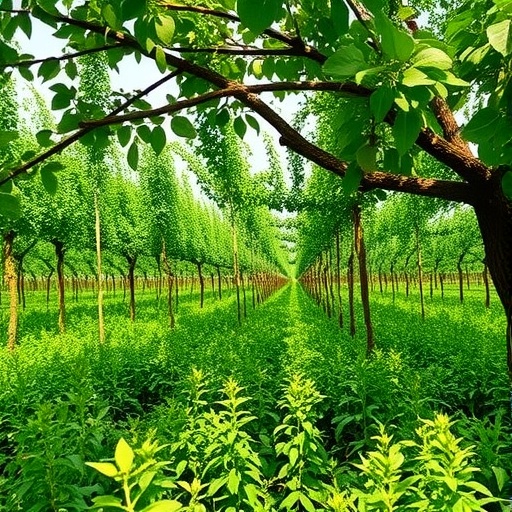
Canopy architecture refers to the three-dimensional distribution of leaves and stems within a crop stand. This physical arrangement governs the interception and distribution of light within the plant community, directly affecting photosynthesis and biomass accumulation. By cultivating crop varieties that favor clumped arrangements, light interception is maximized through synergistic shading and radiation use efficiency enhancements. The resulting boost in photosynthetic carbon fixation translates directly into increased crop yields, a critical metric in feeding the world’s burgeoning population.
Perhaps even more impressively, the study reports a substantial reduction in nitrous oxide emissions associated with clumped canopies—approximately a 41.6% decrease on a global scale. Nitrous oxide is a greenhouse gas with a global warming potential nearly 300 times greater than carbon dioxide over a 100-year period. Agrarian ecosystems contribute significantly to anthropogenic N2O emissions primarily through microbial processes in nitrogen-rich soils. The findings suggest that optimized canopy architecture alters microenvironmental conditions such as soil moisture, temperature, and nitrogen demand, thereby shifting microbial activities to curtail this gas’s release.
The implications of these findings extend beyond environmental sustainability to profound economic benefits. By aligning crop canopy traits toward an ideal clumped structure, the global food production could be raised by an astonishing 336 million tons annually. This increase represents a potential economic gain valued at approximately US$108 billion per year. Such an outcome promises to alleviate pressures on agricultural expansion, conserving biodiversity hotspots and reducing the carbon footprint of farming systems.
This research is a testament to the power of integrative approaches combining remote sensing technology with ground-truth measurements. Satellite platforms, with their ability to capture landscape-scale data on vegetation indices and canopy structure over time, provided a unique vantage point to link canopy architectural traits with ecosystem functioning across diverse agroecological zones. Meanwhile, rigorous fieldwork and soil sampling facilitated the important mechanistic understanding of nitrogen cycling dynamics beneath these vegetative structures.
Critically, this study challenges the conventional paradigms governing crop breeding and management strategies. While the pursuit of high-yield varieties continues to dominate, the spatial organization of the canopy could be an overlooked lever offering simultaneous gains in productivity and ecological footprint mitigation. To characterize canopy architecture as an agronomic trait worth selection marks a paradigm shift with the potential to be widely adopted globally, given its generality across major crop species.
The findings also encourage a reassessment of fertilization practices. Since canopy architecture influences plant nitrogen demand and microenvironmental factors impacting soil microbial processes, integrating canopy management with nutrient applications could optimize fertilizer use efficiency while curtailing environmental losses. This integrative approach harbors potential for more sustainable intensification of agriculture amid growing concerns about nutrient runoff, water contamination, and climate change.
Future research is poised to explore the genetic and physiological underpinnings of canopy architecture in crop species, unraveling the pathways through which leaf and stem spatial patterns are regulated. Breeding programs may soon incorporate canopy design as a standard criterion, leveraging advanced phenotyping and genomic tools. Moreover, agricultural modeling efforts can now incorporate canopy architectural parameters to predict crop performance and greenhouse gas fluxes more accurately under changing climatic and management scenarios.
From a policy perspective, incentivizing the adoption of crop varieties with favorable canopy traits aligns well with global sustainability goals. Governments and international agricultural organizations could promote canopy-informed crop selection and management as part of climate-smart agriculture initiatives. This strategy holds promise not only for large-scale commercial farming but also for smallholder farmers who would benefit from improved yields and reduced input costs.
Climate change mitigation efforts stand to gain significantly from incorporating canopy architecture into agricultural strategies. By reducing nitrous oxide emissions, agriculture can contribute more effectively to carbon neutrality targets and enhance overall greenhouse gas inventories. Additionally, higher crop yields facilitated by improved canopy structure can reduce the need for converting natural ecosystems into farmland, preserving carbon stocks and biodiversity.
The study underscores the need for multidisciplinary collaboration, involving agronomists, ecologists, remote sensing experts, and soil scientists to harness the full potential of canopy architecture. Awareness programs and extension services can disseminate knowledge about canopy benefits to farmers and agribusiness stakeholders, encouraging field-level implementation and iterative refinement of best practices.
Importantly, the results emphasize that canopy architecture impacts are robust across diverse soil types and climatic conditions, suggesting broad applicability. Yet, site-specific variations in soil nitrogen dynamics must be considered to tailor management practices optimally. This nuanced understanding ensures the applicability of canopy-based interventions in varied agroecosystems globally.
In conclusion, the recognition of clumped canopy architecture as a pivotal factor influencing crop productivity and environmental sustainability marks a revolutionary advancement in agricultural science. By shifting focus from solely genetic and nutrient management toward structural plant traits, the research pioneers a novel path to feeding a growing population while addressing the urgent imperative of reducing greenhouse gas emissions. This breakthrough promises to reshape agricultural paradigms and catalyze innovations that balance food security with planetary health.
Subject of Research: Global impacts of crop canopy architecture on agricultural productivity and nitrous oxide emissions for major staple crops.
Article Title: Clumped canopy architecture raises global crop yield and reduces N₂O emissions.
Article References:
Yan, Y., Dang, C., Liu, L. et al. Clumped canopy architecture raises global crop yield and reduces N₂O emissions. Nat. Plants (2026). https://doi.org/10.1038/s41477-025-02172-w
DOI: https://doi.org/10.1038/s41477-025-02172-w
Tags: agricultural productivity optimizationcanopy architecture influenceclumped canopy structurecrop yield improvementenvironmental impact of farminggreenhouse gas mitigation strategiesnitrous oxide emissions reductionphotosynthetic efficiency in cropsrice wheat maize soybean researchsatellite data in agriculturestaple crops for food securitysustainable farming practices



