
Credit: Paula Martínez-Cristóbal, IRB Barcelona
In most cases, prostate cancer is cured by surgical removal of the tumour and/or by radiotherapy. However, 20% of patients will need treatment to remove tumour cells but this treatment ceases to be effective after two or three years and the cancer develops further. Once this stage of the disease has been reached, there is no cure. A team headed by Xavier Salvatella, ICREA researcher at the Institute for Research in Biomedicine (IRB Barcelona), has discovered a new avenue through which to attack prostrate cancer cells that have developed drug-resistance. Published in the journal Structure, part of the Cell group, the study opens up new therapeutic avenues against a disease that causes 75,000 deaths a year in Europe alone (source: European Science Hub, 2015).
A clear target and new sites of attack
The survival and proliferation of prostate tumour cells calls for highly active androgen receptor protein. The drug used to remove tumour cells interferes with this protein by binding to a specific region of the receptor and blocking its activity. "Over time, the protein accumulates alterations and mutates, and there comes a point where it is futile to target this region with drugs because, in fact, it is no longer there," says Salvatella.
The Molecular Biophysics Laboratory, headed by Salvatella, studies the tridimensional structure and atomic movements of the androgen receptor, with the aim to find new binding sites. It has been known for some years that the protein has a small region, spanning only 20 amino acids, that is important for tumour cell survival. The study now describes for the first time that this region–usually without a structure and therefore a priori disregarded as a drug target–has a helix shape. Upon gaining this helix–it is not known how the helix occurs–, another protein, called TFIIF, binds to it. The study reveals that this interaction stimulates the activity of the androgen receptor and, consequently, facilitates the survival and multiplication of tumour cells.
To this 20-residue motif in the androgen receptor the IRB Barcelona teams now adds the protein TFIIF as a potential therapeutic target for prostate cancer. "The fact that TFIIF is a folded protein with a more defined structure makes it easier to search for drugs that can interfere with its interaction with the motif. For prostate tumour cells that have become resistant to treatment, we believe that this interaction could be their last mechanism through which to survive and proliferate," explains Salvatella.
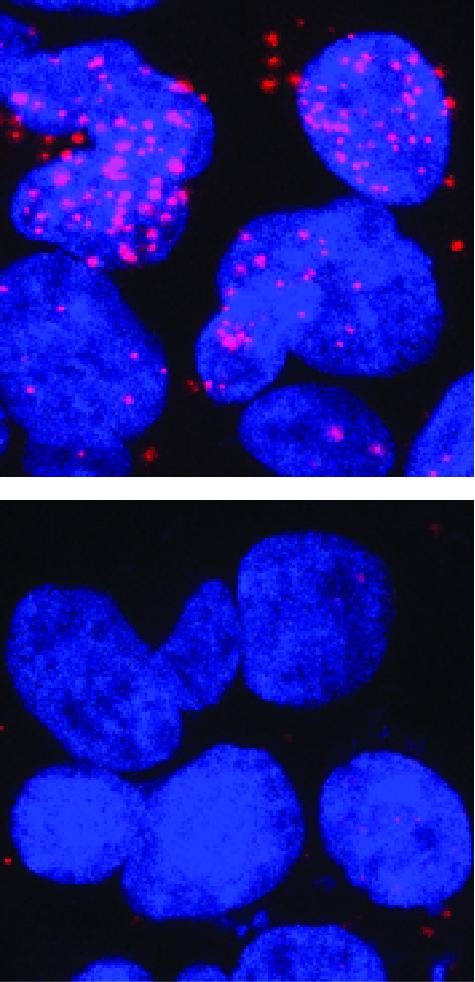
"Using cells in vitro, we have seen that if we remove this region, the TFIIF protein can't bind to the androgen receptor. So if the interaction does not occur, the androgen receptor loses activity, which is what we are interested in achieving," says Elzbieta Maria Szulc, "la Caixa" PhD student at IRB Barcelona and co-first author of the study with Eva de Mol, a former "la Caixa" PhD student in the same lab who started this line of research.
In collaboration with experts in computational modelling, the scientists are searching for drugs that interfere with TFIIF. "We don't know whether such drugs will have a positive effect on cells, but the data available is promising," says Salvatella.
###
This study has involved Angel R. Nebreda's lab and the Experimental Bioinformatics Lab, both at IRB Barcelona, and also the University of Barcelona. The work was funded by the European Research Council (ERC), the Fundación "la Caixa", the Marie Curie Programme of the European Union, and the Spanish Ministry of Economy and Competitiveness, the latter through ERDFs.
Reference article:
Eva De Mol, Elzbieta Szulc, Claudio Di Sanza, Paula Martínez-Cristóbal, Carlos W. Bertoncini, R. Bryn Fenwick, Marta Frigolé-Vivas, Marianela Masín, Irene Hunter, Víctor Buzón, Isabelle Brun-Heath, Jesús García, Gianni De Fabritiis, Eva Estébanez-Perpiñá, Iain J. McEwan, Angel R. Nebreda, and Xavier Salvatella Regulation of androgen receptor activity by transient interactions of its transactivation domain with general transcription regulators
Structure (2017) https://doi.org/10.1016/j.str.2017.11.007
VIDEO MEET OUR SCIENTISTS: Xavier Salvatella "Magical Choreography" https://www.youtube.com/watch?v=Agh1aBX277Y
Media Contact
Sònia Armengou
[email protected]
34-934-037-255
http://www.irbbarcelona.org
Original Source
https://www.irbbarcelona.org/en/news/closing-in-on-advanced-prostate-cancer http://dx.doi.org/10.1016/j.str.2017.11.007