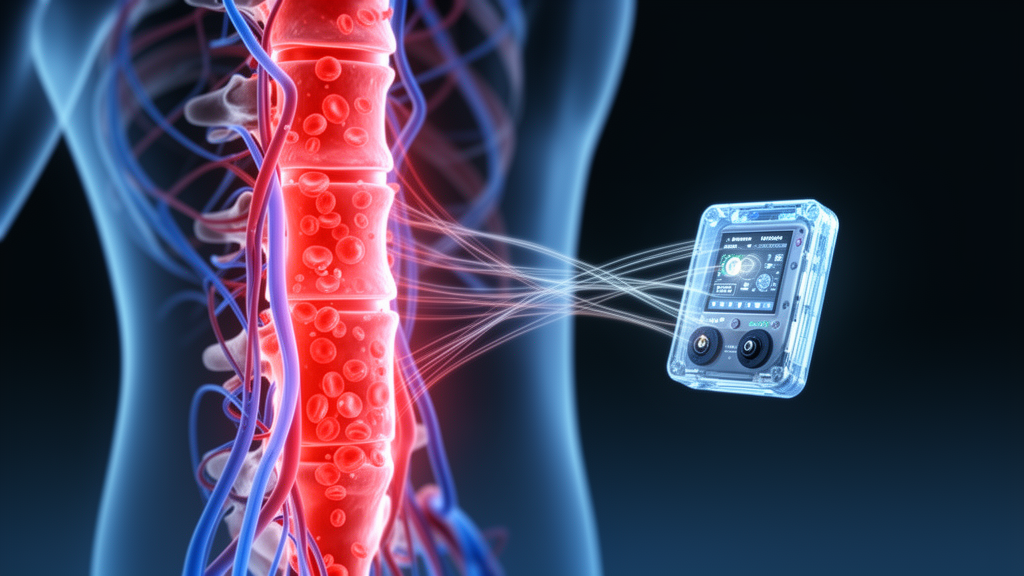
Engineers and physicians at Johns Hopkins have built a closed-loop feedback controller that regulates blood flow in the injured spinal cord by automatically adjusting norepinephrine infusion in real time, according to a study published in Nature Biomedical Engineering. Instead of the standard clinical practice of targeting arterial blood pressure and hoping tissue perfusion follows, the system measures flow velocity in a spinal cord artery directly with ultrasound and tunes the vasopressor dose every second to hold flow at a clinician-set target.
The motivation comes from a gap in current intensive care for acute spinal cord injury. Clinical management aims to support tissue perfusion, but existing methods rely on indirect control of arterial blood pressure without measuring local blood flow, which limits the ability to tailor drug delivery to the injured tissue. Mean arterial pressure does not necessarily correlate with blood flow in the tissue of interest, so periods of inadequate perfusion can go undetected even when blood pressure targets appear to be met.
To design the controller, the team first built a rodent model of spinal cord intensive care. In anaesthetised rats with a T3 contusion injury, they placed a femoral arterial catheter to record mean arterial pressure and oriented an ultrasound probe over the cord in the mid-sagittal plane. Spectral Doppler of the sulcal artery yielded a continuous measure of maximum flow velocity, while end-tidal carbon dioxide and body temperature were held constant so that other physiological variables would not confound the measurements.
Because patients with spinal cord injury often spend extended periods in the intensive care unit and encounter many kinds of blood pressure fluctuation, the researchers queried the MIMIC-III clinical database for arterial pressure tracings from patients hospitalised with acute spinal cord injury. They then reproduced the observed patterns of pressure change in rats using a lower body negative pressure chamber, which produced step decreases, gradual slopes and sinusoidal fluctuations in mean arterial pressure. These clinically inspired challenges supplied the data for identifying the dynamic relationships, expressed as transfer functions, between pressure and flow.
The system was decomposed into subsystems. One transfer function mapped mean arterial pressure to spinal cord flow velocity and captured the local autoregulation physiology; a step increase in pressure of 15 mm Hg raised flow velocity by 19.9 percent on average, with a standard deviation of 10.4 percent, showing that flow is not perfectly autoregulated during dynamic changes. A second set of transfer functions mapped the norepinephrine infusion rate to pressure and to flow, using short intra-arterial infusion pulses in rats. On average, raising the infusion rate by 1 microgram per kilogram per minute increased mean arterial pressure by 8.25 mm Hg and flow velocity by 7.97 percent, though with considerable variability between animals.
With the subsystem models in hand, the team designed an H-infinity optimal controller, a control-theory approach that minimises the worst-case deviation of flow from its target while respecting clinically informed constraints. Weighting functions forced the controller to prioritise low-frequency errors in flow, to keep pressure near baseline, and to suppress rapid, potentially unsafe swings in the infusion rate. The trade-off was speed: after a drop in blood flow, the controller needed roughly 100 to 200 seconds to return flow to target, which the authors note remains below the threshold for neuronal damage and far shorter than the times patients currently spend below blood pressure goals in the intensive care unit. An overly aggressive design, by contrast, could drive dangerous hypertension with excess norepinephrine.
In computer simulations, the controller recovered equilibrium within roughly 100 seconds across three clinically motivated scenarios: a deliberate step increase in the flow target, a steep pressure drop resembling orthostatic hypotension or a vasovagal episode, and a slower pressure decline. The real system was then implemented in rats at an update rate of 1 hertz, with the flow signal compared against the target every second and a programmable syringe pump adjusting the norepinephrine rate accordingly. Flow velocity reached 90 percent of a new target in 105.2 seconds on average and settled by 215.2 seconds. During rapid pressure drops, the root-mean-square flow error fell from 22.6 percent with constant dosing to 10.0 percent with the controller, and during gradual drops from 18.7 percent to 8.4 percent, differences that were statistically significant.
The team also tested whether automated flow control protects neurological function. Injured rats were randomised to closed-loop or constant-dose norepinephrine and then subjected to three hours of intense haemodynamic instability, mimicking the secondary damage a patient might suffer during a difficult intensive care stay. Rats on constant dosing showed a significant decline in BBB locomotor scores and in a quantitative gait-based walking score derived from DeepLabCut video tracking and principal component analysis. Rats under closed-loop control showed no statistically significant decline on either measure, and the deterioration in the open-loop group was significantly greater than in the closed-loop group. The authors caution that this was a short survival study with only four rats per group, measuring functional outcomes only, so the treatment effect could be inflated or temporary; longer observation, larger samples and histological assays are needed.
To move toward clinical translation, the researchers repeated the entire pipeline in pigs, whose spinal anatomy and physiology more closely resemble those of humans. Pressure challenges were generated with controlled haemorrhage rather than the negative pressure chamber, and norepinephrine was given intravenously. The redesigned controller again tracked flow targets and outperformed constant dosing during pressure challenges, with a mean rise time of 83.3 seconds and settling time of 119.9 seconds when the target changed. In a separate pig, the controller maintained flow close to periodically adjusted targets for more than 180 minutes, with infusion rates of 0.04 to 0.26 micrograms per kilogram per minute, a time course approaching real intensive care use. The controller also compensated for disturbances unrelated to pressure, including rises in intraspinal pressure from saline injection and falls in arterial carbon dioxide from hyperventilation, and worked when ultrasound was replaced by near-infrared spectroscopy of paraspinal muscle combined with an intraoperatively designed, pig-specific controller.
Several hurdles remain before bedside use. The average transfer functions fitted in animals may not generalise to human patients, many of whom are older with comorbidities that alter their response to norepinephrine, and evolving injury physiology may require controllers to be refreshed over time. Flow velocity measured by Doppler may not perfectly reflect the volume of blood actually delivered to tissue, and what flow velocity is ideal for recovery remains unknown. Long-term, stable sensing in the noisy intensive care environment, probe fixation, and integration of intraspinal pressure monitoring, cerebrospinal fluid drainage and intravenous fluids all need further work, and patients on maximal norepinephrine infusions would require multimodal treatment beyond what a single-drug controller can deliver. As a proof of feasibility, however, the team recorded sulcal artery flow velocity with the same ultrasound technique in a human patient during elective spine surgery, and because the system uses already-approved components, norepinephrine, ultrasound or near-infrared spectroscopy and infusion pumps, the authors argue that translation can proceed along established device-software regulatory pathways.
Subject of Research: A closed-loop feedback controller that regulates spinal cord blood flow after injury by adjusting norepinephrine infusion based on real-time ultrasound flow measurement
Article Title: Optimal closed-loop feedback control of blood flow after spinal cord injury with norepinephrine
Article References: Routkevitch, D., Kramer, P., Lopez, A. F., Hao, C., Baca, E. C., Soulé, Z., Kats, N., Weber-Levine, C., Jiang, K., Davidar, A. D., Vattipally, V. N., Bhimreddy, M., Menta, A. K., Jillala, R. R., Bykov, B., Lu, N., Pelline, M., Bohluli, R., Babu, N. A., … Thakor, N. V. (2026). Optimal closed-loop feedback control of blood flow after spinal cord injury with norepinephrine. Nature Biomedical Engineering. https://doi.org/10.1038/s41551-026-01777-6
Image Credits: AI Generated
DOI: 10.1038/s41551-026-01777-6
Keywords: spinal cord injury, closed-loop control, norepinephrine, blood flow, ultrasound, H-infinity controller, mean arterial pressure, perfusion, rodent model, porcine model, intensive care, biomedical engineering
News Source: Cassandra Pierce. (October 29, 2026). Closed-loop controller keeps spinal cord blood flow on target after injury. Scienmag.