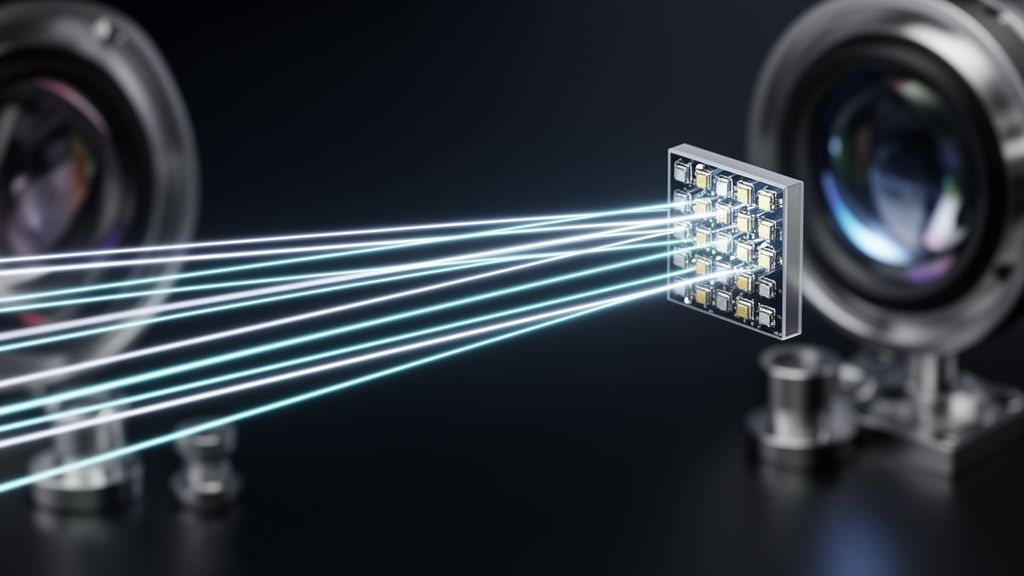
Researchers Hasan Aldiabat and Nedal Al-Ababneh have developed a Gaussian-Gaussian analytical approximation to evaluate light-intensity distribution at the detector plane of lens-based free-space optical interconnects. Their method simplifies optical field calculations by approximating the zeroth-order Bessel kernel found in the finite-aperture Collins diffraction integral. By substituting a Gaussian function within the near-axis region, the mathematical framework produces a compact, closed-form mathematical expression for the field arriving at the detector plane.
The analytical approach is designed to bypass repeated numerical integration typically demanded when evaluating diffraction integrals. By establishing this closed-form expression, the model enables rapid evaluation of beam spot characteristics across the optical path. Furthermore, the formulation allows direct calculation of collected detector power and inter-channel crosstalk, resolving key analytical values without the performance overhead of iterative integration routines.
To test the reliability of their analytical formulation, the authors compared its predictions directly against numerical evaluations of the Collins diffraction integral. This comparative analysis demonstrated close agreement between the analytical model and direct integration across the parameter configurations investigated in the study. These comparative results indicate that the Gaussian simplification reliably mirrors the optical field distribution within the evaluated interconnect configurations.
The researchers established explicit boundaries regarding the applicable domain of the formulation. Because the zeroth-order Bessel kernel is approximated by a Gaussian function strictly within the near-axis region, the model is intended exclusively for the main-lobe and near-axis detector-coupling region. Consequently, the simplified expression does not reproduce the zeros and oscillatory sidelobes characteristic of the exact Bessel function.
This defined scope ensures the mathematical model is well-suited for repeated link-level calculations in computing-system and dense optical-interconnect design. By delivering a closed-form solution that accurately captures main-lobe coupling while eliminating repeated numerical integrals, the analytical framework provides system designers with an efficient method for examining crosstalk and spot behavior in lens-based free-space optical systems.
Subject of Research: Analytical crosstalk modeling for lens-based free-space optical interconnects
Article Title: A closed-form Gaussian–Gaussian model for crosstalk analysis in free-space optical interconnects
Article References: Aldiabat, H., & Al-Ababneh, N. (2027). A closed-form Gaussian–Gaussian model for crosstalk analysis in free-space optical interconnects. Cluster Computing, 30(1), Article 38. https://doi.org/10.1007/s10586-026-06836-w
Image Credits: AI Generated
DOI: 10.1007/s10586-026-06836-w
Keywords: free-space optical interconnects, optical crosstalk, Gaussian-Gaussian model, Collins diffraction integral, Bessel kernel, detector-plane field, light-intensity distribution, lens-based interconnects, inter-channel crosstalk, closed-form analytical model, spot characteristics, collected detector power, numerical integration, near-axis approximation, optical computing systems, link-level calculations
News Source: Denise Maddox. (November 20, 2026). Closed-Form Optical Model Accelerates Crosstalk Analysis in Free-Space Interconnects. Scienmag.