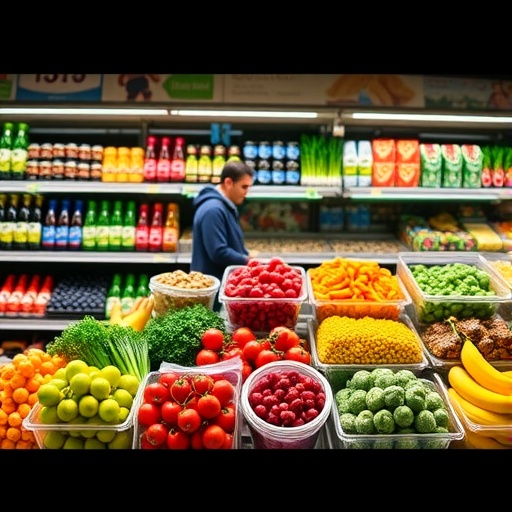
In a groundbreaking advancement that could redefine food retailing, recent research has illuminated the profound impact of closed refrigerated display cabinets on the microbiological safety and sensory quality of perishable foods. This study, published in Food Science and Biotechnology, provides compelling evidence that utilizing sealed, temperature-controlled display units in supermarkets and grocery stores is not merely a matter of convenience or aesthetic appeal—it is a vital technology for enhancing food safety and extending shelf life.
Perishable foods, such as fresh meats, dairy products, seafood, and fresh-cut fruits and vegetables, are notorious for their vulnerability to microbial contamination and rapid quality degradation. Traditional refrigerated cabinets, often open to air circulation and store environments, expose these delicate products to external contaminants, temperature fluctuations, and drying effects, all of which accelerate spoilage and increase the risk of foodborne illnesses. The study’s authors, Jang, Yoon, Choo, and colleagues, embarked on a meticulous investigation into how enclosing these display units could mitigate these risks while simultaneously maintaining or even improving the foods’ sensory attributes—color, texture, aroma, and flavor—that are crucial for consumer acceptance.
The research hinged on a comparative analysis of closed refrigerated display cabinets versus conventional open-display models commonly seen in retail settings. Using advanced microbiological assays, the researchers tracked microbial populations on various perishable products over time under both display conditions. They concurrently conducted sensory evaluations with trained panelists to assess consumer-relevant quality parameters. Their findings revealed sharp contrasts: closed cabinets maintained significantly lower levels of total microbial load, including key spoilage organisms and potential pathogens. Moreover, these units preserved moisture levels more effectively, preventing desiccation that often compromises texture and visual appeal.
One central element of this technology’s success lies in its ability to maintain a stable, cool environment with minimal exposure to ambient air that often carries airborne microbes and contaminants. The study highlights how precise regulation of temperature and humidity within closed display systems plays a critical role in reducing microbial proliferation. This control prevents the condensation cycles that typically occur in open cabinets, which can create microenvironments favorable for bacterial growth. Furthermore, by limiting airflow exchange, these cabinets reduce the risk of cross-contamination between products.
The practical implications for food retailers and consumers are profound. For retailers, adopting closed refrigerated display technology could reduce product wastage by extending shelf life, ultimately improving profitability. Retailers would face fewer returns and complaints related to spoilage or compromised food safety, enhancing brand reputation and customer satisfaction. For consumers, decreased microbial loads translate to a lower risk of foodborne illness, a matter of increasing concern in many parts of the world.
A critical aspect of this advancement relates to sensory quality—arguably as important as safety when it comes to food choice. The researchers documented notable improvements in attributes such as color retention and firmness in fruits and vegetables, as well as texture and moistness in dairy and meat products. These improvements were credited to the controlled microenvironment within the cabinets, which curbed oxidative damage and moisture loss. The data suggest that food retailers could leverage this technology not only to keep food safer for longer, but also visibly fresher and more appealing to shoppers.
The study provides an essential bridge between microbiological science and practical food engineering, emphasizing how integrating technology with retail design can contribute to public health on a broad scale. The closed refrigerated display cabinet represents a highly effective intervention in the food supply chain’s final links, where food quality and safety are most vulnerable. While previous innovations have focused largely on packaging or supply chain logistics, this research spotlights display technology as a previously underappreciated front for quality control.
Future research directions prompted by this study include optimizing cabinet design for different food categories, evaluating energy efficiency impacts, and exploring consumer behavior modification in response to new display technologies. Incorporating sensors and Internet of Things (IoT) features into closed cabinets may further enhance their efficacy, enabling real-time monitoring of environmental parameters and predictive spoilage alerts.
The societal context lends urgency to this advancement. Foodborne illnesses continue to be a significant global health challenge, with millions affected annually despite advanced food safety regulations. By installing better environmental controls at points of sale, closed refrigerated display cabinets could act as a frontline defense in reducing pathogen exposure and spoilage, preventing illness, and minimizing food wastage. This aligns closely with global sustainability goals, addressing both health and environmental considerations.
Retailers who invest in closed display technology may also benefit from marketing advantages. Demonstrating a commitment to food safety and quality can differentiate brands in competitive markets increasingly dominated by health-conscious consumers. Such innovations resonate with a growing demographic that prioritizes transparency and product integrity when making food choices.
From a technical standpoint, the study’s findings also implicate material science developments in the design of display cabinet seals, lighting, and refrigeration mechanics. Advances in low-emissivity glass, antimicrobial coatings, and energy-efficient compressors underpin the feasibility of widespread adoption. These components work synergistically to maximize cabinet performance while minimizing operational costs.
As food systems become more complex and consumer expectations rise, innovations like closed refrigerated display cabinets provide a critical tool in ensuring that perishable foods reach customers in optimal condition. This research exemplifies how interdisciplinary approaches—combining microbiology, food science, engineering, and retail innovation—can yield practical solutions with significant public health benefits.
In summary, the integration of closed refrigerated display cabinets into retail food environments promises to revolutionize how perishable foods are presented, preserving safety and sensory quality better than ever before. This technology’s potential to reduce microbial contamination, maintain product freshness, and extend shelf life positions it as a vital advancement for future food retail strategies.
The implications extend beyond supermarkets; restaurants, cafeterias, and food service operators could also harness such controlled-display technologies to enhance food safety standards across the board. As the food industry strives to minimize loss and ensure quality, this research illuminates an exciting pathway toward smarter, safer, and more sustainable food distribution.
It is clear that closed refrigerated display cabinets are not simply an upgrade but a transformative innovation in food retail. Their adoption aligns with growing demands for safer food systems, higher quality produce, and reduced environmental impact, positioning them at the forefront of future retail infrastructure.
Subject of Research: The impact of closed refrigerated display cabinets on microbiological safety and sensory quality of perishable foods.
Article Title: Closed refrigerated display cabinets can significantly improve microbiological safety and sensory quality of perishable foods.
Article References:
Jang, AR., Yoon, JH., Choo, E. et al. Closed refrigerated display cabinets can significantly improve microbiological safety and sensory quality of perishable foods. Food Sci Biotechnol (2025). https://doi.org/10.1007/s10068-025-02039-y
Image Credits: AI Generated
DOI: 01 December 2025
Tags: advancements in food retailingclosed refrigerated display cabinetscomparison of display cabinet modelsfood safety technologyfoodborne illness preventionimpact of air circulation on foodimproving food sensory attributesmicrobial contamination in retailmicrobiological safety of perishablessensory quality of foodshelf life extension for perishablestemperature-controlled display units