High Mountain Asia (HMA), encompassing the Tibetan Plateau and the surrounding Hindu Kush, Karakoram, and Himalayan ranges, harbors the world’s third-largest amount of glacial ice. It is the source of more than 10 major Asian rivers and vital water resources for nearly 2 billion people.
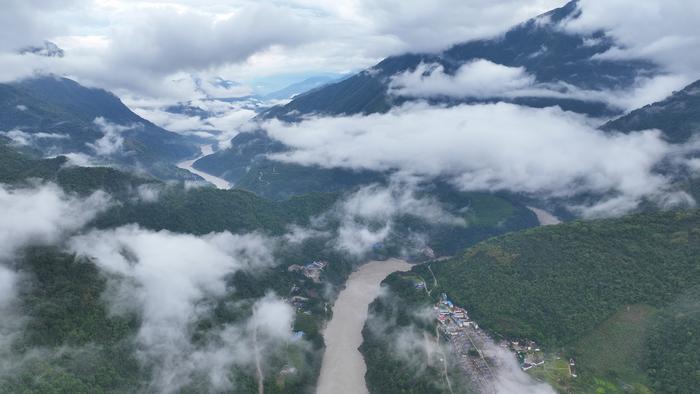
Credit: LI Weibiao
High Mountain Asia (HMA), encompassing the Tibetan Plateau and the surrounding Hindu Kush, Karakoram, and Himalayan ranges, harbors the world’s third-largest amount of glacial ice. It is the source of more than 10 major Asian rivers and vital water resources for nearly 2 billion people.
Recent decades have witnessed a dipolar trend in HMA precipitation, characterized by an increase in the north but a decrease in the southeast. These changes have significant implications for water resource security and ecological equilibrium in both local and downstream regions.
Researchers from the Institute of Atmospheric Physics (IAP) of the Chinese Academy of Sciences (CAS), the Pacific Northwest National Laboratory in the U.S., the Max Planck Institute for Meteorology in Germany, and Ocean University of China have unraveled the mechanisms driving these precipitation alterations.
More notably, however, the researchers also predict that, due to air pollution control measures, the currently drying Himalayan region will transition to wetter conditions by the 2040s under medium to high greenhouse gas emission scenarios.
The study was published in Nature on Oct. 11.
The focus of the study was primarily on long-term summer precipitation changes in HMA, spanning over a decade, rather than year-to-year fluctuations. According to Dr. JIANG Jie of IAP, the study’s lead author, summer HMA precipitation changes are “anchored” by two dominant patterns: a westerly-associated pattern and a monsoon-associated pattern. The former increases precipitation over the northern HMA region while decreasing it over the southeastern region. The latter corresponds to an out-of-phase variation between South Asia and the southeastern HMA region.
The researchers used various evidence from climate model simulations to reveal that uneven emissions of anthropogenic aerosols in Eurasia have weakened the jet stream and reinforced the westerly-associated precipitation pattern since the 1950s. In contrast, the monsoon-associated precipitation pattern is influenced by the interdecadal Pacific oscillation (IPO), an internal variability that fluctuates every 20 to 30 years. The recent IPO cycle, beginning in the late 1990s and transitioning from warmer-than-normal to cooler-than-normal sea surface conditions in the tropical central-eastern Pacific, has led to increased summer monsoon rainfall in South Asia and reduced precipitation over the southeastern HMA region.
Jointly influenced by these two dominant patterns, a drying trend has accelerated in the southeastern Himalaya over the past two decades. However, long-term climate model projections paint a different picture, suggesting a widespread trend of increased wetness over HMA throughout the 21st century, including the currently drying Himalayan region. Identifying the reasons behind this transition from drying to future wetting, as well as its timing, is crucial.
The researchers found that reductions in anthropogenic aerosol emissions due to clean air policies, combined with increased greenhouse gas concentrations, are responsible for the emerging wetter trend in HMA. The tipping point in precipitation regime changes, shifting from “South Drying-North Wetting” to universal wetting, will primarily be determined by alterations in anthropogenic aerosol emissions. In contrast, the impacts of greenhouses gases emissions are the same in the past seven decades and the future, favoring a general increase in precipitation.
According to Dr. JIANG, “Analyzing observed changes in HMA precipitation reveals that variations are the result of a delicate balance between anthropogenic external forcing and internal variability, such as the IPO.”
Based on climate model simulations, the researchers found that this human-induced wetting over the southeastern Himalaya will exceed the precipitation changes caused by climatic internal variability in the 2040s, coinciding with a global warming of 0.6–1.1 °C compared to the present, under medium to high greenhouse gas emission scenarios.
Prof. ZHOU Tianjun noted that changes in HMA precipitation patterns in the future will add “significant complexity” to projections about HMA water resources. He therefore suggested it is important to understand the impact of aerosol reduction in shaping the region’s climate and water resources.
Journal
Nature
DOI
10.1038/s41586-023-06619-y
Article Title
Precipitation regime changes in High Mountain Asia driven by cleaner air
Article Publication Date
11-Oct-2023