Dresden scientists develop self-cleaning aluminium surface
Credit: © Fraunhofer IWS Dresden
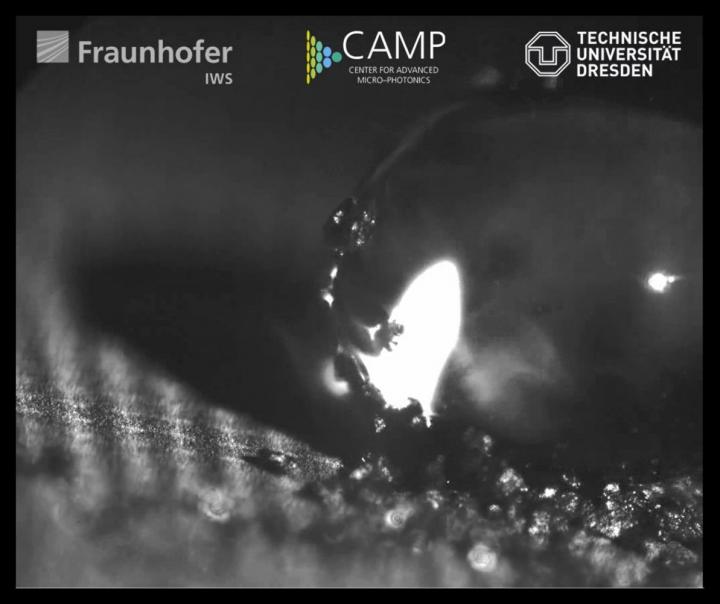
For several years, scientists at TU Dresden and Fraunhofer IWS have been developing functionalised surfaces by means of laser-based manufacturing processes. Now, they have created a periodic surface structure that is not only water and ice repellent, but also remove dirt particles solely by rolling water drops. In this context, they particularly focussed on the material aluminium. “This material is used in many industrial branches – either in the automotive sector, aircraft construction or the food industry. The use of aggressive cleaning chemicals is particularly critical in food industry, as we naturally do not want to bring these chemicals in contact with our food,” emphasises Stephan Milles, PhD student at Technische Universität Dresden. In particular, the Dresden scientists studied the function of self-cleaning laser-structured aluminium. A special camera was used to analyse the self-cleaning effect of the aluminium surfaces and filmed the process at 12,500 frames per second. Thomas Kuntze, scientist in the Microtechnology Technology Field at Fraunhofer IWS, explains: “This way we can perfectly see how a water drop can remove the dirt from the aluminium surface. This method is also suitable for understanding other processes, such as laser cutting and welding or additive manufacturing”.
###
About the Center for Advanced Micro Photonics (CAMP)
In close cooperation with Fraunhofer IWS, the Chair of Large Area Laser Based Surface Structuring at TU Dresden is operating the “Center for Advanced Micro Photonics” – CAMP. Prof. Lasagni explains: “We are currently working on several exciting projects with the goal of producing large-area fine-structured structures on metals, ceramics or polymers in the shortest possible time”. In these projects, the scientists are continuously developing further a technology known as “Direct Laser Interference Patterning”, which offers extraordinary properties compared to classical laser-based processes. Examples of such developments are applied in the “LAMPAS” and “SHARK” projects funded by the European Union. Here the scientists design laser sources and intelligent structuring processes to provide profitable solutions for surface functionalisation in various fields of application, such as automotive, food and home appliance industries.
Background
The project “Fabrication of large area two and three-level multiscale structures with multi-functional surface properties using laser fabrication methods” was funded by the German Research Foundation (DFG) as part of the Reinhart-Koselleck project (Project number: 323477257). Professor Andrés Lasagni, holder of the professorship for laser-based methods for large-area surface structuring (LMO), heads the project. The full article can be read in the journal Applied Surface Science. Dr. Marcos Soldera supported this research, who followed the Alexander von Humboldt Foundation’s call from Argentina to Germany to carry out applied research.
About Technische Universität Dresden
Technische Universität Dresden (TUD) is one of the top universities in Germany and Europe. Strong in research and considered excellent with respect to the range and the quality of degree programmes it offers, it is also closely interconnected with culture, business and society. As a modern university with a broad array of disciplines and with its five Schools it has a diverse scientific spectrum that only few other German universities are able to match. TUD is Saxony’s largest university with approximately 32,000 students and 8,300 employees – among them 600 professors.
Since 2012, TU Dresden has been one of eleven Universities of Excellence in Germany. It was able to successfully defend this title on 19th July 2019.
Further information
Link video at Youtube: https:/
Chair of large area laser based surface structuring at TU Dresden: https:/
Center for Advanced Micro Photonics (CAMP): https:/
Media Contact
Andrés Fabián Lasagni
[email protected]
Related Journal Article
http://dx.