• HOME
  • NEWS
  • EXPLORE
    • CAREER
      • Companies
      • Jobs
    • EVENTS
    • iGEM
      • News
      • Team
    • PHOTOS
    • VIDEO
    • WIKI
  • BLOG
  • COMMUNITY
    • FACEBOOK
    • INSTAGRAM
    • TWITTER
Saturday, February 7, 2026
BIOENGINEER.ORG
No Result
View All Result
  • Login
  • HOME
  • NEWS
  • EXPLORE
    • CAREER
      • Companies
      • Jobs
        • Lecturer
        • PhD Studentship
        • Postdoc
        • Research Assistant
    • EVENTS
    • iGEM
      • News
      • Team
    • PHOTOS
    • VIDEO
    • WIKI
  • BLOG
  • COMMUNITY
    • FACEBOOK
    • INSTAGRAM
    • TWITTER
  • HOME
  • NEWS
  • EXPLORE
    • CAREER
      • Companies
      • Jobs
        • Lecturer
        • PhD Studentship
        • Postdoc
        • Research Assistant
    • EVENTS
    • iGEM
      • News
      • Team
    • PHOTOS
    • VIDEO
    • WIKI
  • BLOG
  • COMMUNITY
    • FACEBOOK
    • INSTAGRAM
    • TWITTER
No Result
View All Result
Bioengineer.org
No Result
View All Result
Home NEWS Science News Biology

Clarifying the mechanism for making blood cells

Bioengineer by Bioengineer
January 24, 2018
in Biology, Science News
Reading Time: 2 mins read
0
Share on FacebookShare on TwitterShare on LinkedinShare on RedditShare on Telegram
IMAGE

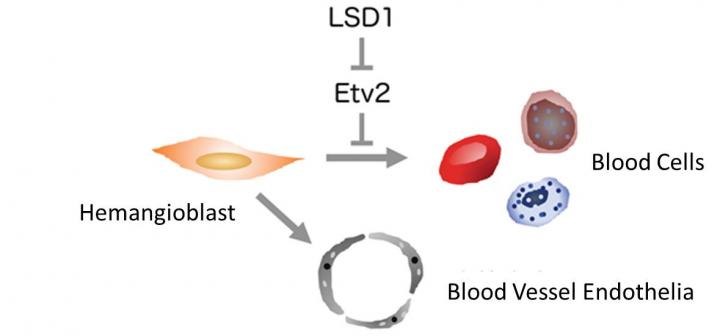
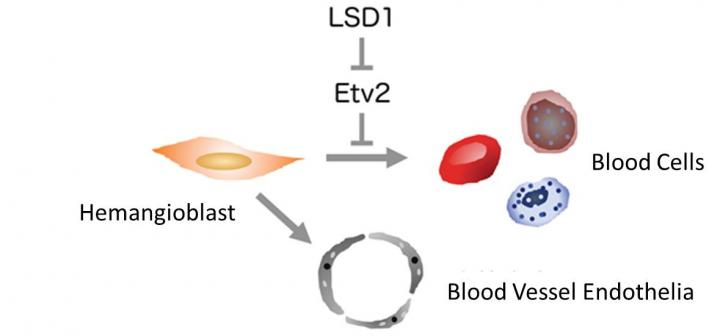
IMAGE: The proposed model for the mechanism of making blood cells from hemangioblasts is shown.

Credit: University of Tsukuba

In 1917, Florence Sabin, the first female member of the US National Academy of Sciences, discovered hemangioblasts, the common precursor cells for blood cells and blood vessel endothelia. Her discovery faced a great deal of critical opinions, but by the end of the 20th century, those opinions were overcome, and the existence of hemangioblasts had at long last come to be acknowledged. In the present day, the existence of hemangioblasts has been proven not only in chicken embryos, which Sabin had studied, but in the embryos of humans, mice, and fish as well. Furthermore, it has become clear that the precursor cells are present not only during the fetal period, but also in adult organisms. However, the mechanism by which hemangioblasts differentiated into blood cells and vascular endothelia remained a mystery in many aspects.

A research group led by Lecturer Makoto Kobayashi of the University of Tsukuba Faculty of Medicine, has managed to shed light on the puzzling mechanism by which hemangioblasts become blood cells. Although hemangioblasts are the common precursor cells for blood cells and vascular endothelia that are present during the fetal period, the discovery of hemangioblasts in adult organisms has begun to garner attention from the medical world.

In the research conducted by Kobayashi's group, mutant zebrafish in which the differentiation from hemangioblasts into blood cells was inhibited were isolated, and the responsible gene was identified to be histone demethylase LSD1. Furthermore, phenotype recovery experiments involving gene knockdown clarified that the point of action of LSD1 is the gene silencing of Etv2, a transciption factor gene required for hemangioblast formation. These results show that epigenetic gene silencing of Etv2 by LSD1 is important in determining the destinies for blood cell differentiation.

This phenomenon is the epigenetic control that makes hematopoetic stem cells and vascular endothelial cells, and further development of the results of this study could lead to future medical applications.

###

Media Contact

Masataka Watanabe
[email protected]
81-298-532-039
Share12Tweet8Share2ShareShareShare2

Related Posts

Palmitoylation of Tfr1 Drives Platelet Ferroptosis and Exacerbates Liver Damage in Heat Stroke

February 7, 2026

Oxygen-Enhanced Dual-Section Microneedle Patch Improves Drug Delivery and Boosts Photodynamic and Anti-Inflammatory Treatment for Psoriasis

February 7, 2026

Scientists Identify SARS-CoV-2 PLpro and RIPK1 Inhibitors Showing Potent Synergistic Antiviral Effects in Mouse COVID-19 Model

February 7, 2026

Neg-Entropy: The Key Therapeutic Target for Chronic Diseases

February 7, 2026
Please login to join discussion

POPULAR NEWS

  • Robotic Ureteral Reconstruction: A Novel Approach

    Robotic Ureteral Reconstruction: A Novel Approach

    82 shares
    Share 33 Tweet 21
  • Digital Privacy: Health Data Control in Incarceration

    63 shares
    Share 25 Tweet 16
  • Study Reveals Lipid Accumulation in ME/CFS Cells

    57 shares
    Share 23 Tweet 14
  • Breakthrough in RNA Research Accelerates Medical Innovations Timeline

    53 shares
    Share 21 Tweet 13

About

We bring you the latest biotechnology news from best research centers and universities around the world. Check our website.

Follow us

Recent News

Palmitoylation of Tfr1 Drives Platelet Ferroptosis and Exacerbates Liver Damage in Heat Stroke

Oxygen-Enhanced Dual-Section Microneedle Patch Improves Drug Delivery and Boosts Photodynamic and Anti-Inflammatory Treatment for Psoriasis

Scientists Identify SARS-CoV-2 PLpro and RIPK1 Inhibitors Showing Potent Synergistic Antiviral Effects in Mouse COVID-19 Model

Subscribe to Blog via Email

Enter your email address to subscribe to this blog and receive notifications of new posts by email.

Join 73 other subscribers
  • Contact Us

Bioengineer.org © Copyright 2023 All Rights Reserved.

Welcome Back!

Login to your account below

Forgotten Password?

Retrieve your password

Please enter your username or email address to reset your password.

Log In
No Result
View All Result
  • Homepages
    • Home Page 1
    • Home Page 2
  • News
  • National
  • Business
  • Health
  • Lifestyle
  • Science

Bioengineer.org © Copyright 2023 All Rights Reserved.