Credit: COPYRIGHT (C) TOYOHASHI UNIVERSITY OF TECHNOLOGY. ALL RIGHTS RESERVED.
Overview
A research group of Assistant Prof. Yuu Hirose of the Department of Applied Chemistry and Life Science at Toyohashi University of Technology, Niigata University, the Japan Agency for Marine-Earth Science and Technology (JAMSTEC), and the National Institute of Polar Research, has revealed the community structure of microorganisms living around freshwater lakes in the Langhovde and Skarvsnes ice-free areas of Antarctica. An analysis of samples collected from lake shores, puddles, etc. using a next-generation sequencer has verified that cyanobacteria and tardigrades are widely distributed and specific eukaryotic algae are dominant in certain sites. This knowledge will contribute to clarification of adaptation mechanisms of microorganisms to severe physical stresses in Antarctica, e.g. low temperatures, ultraviolet irradiation and freeze-thaw cycles.
Details
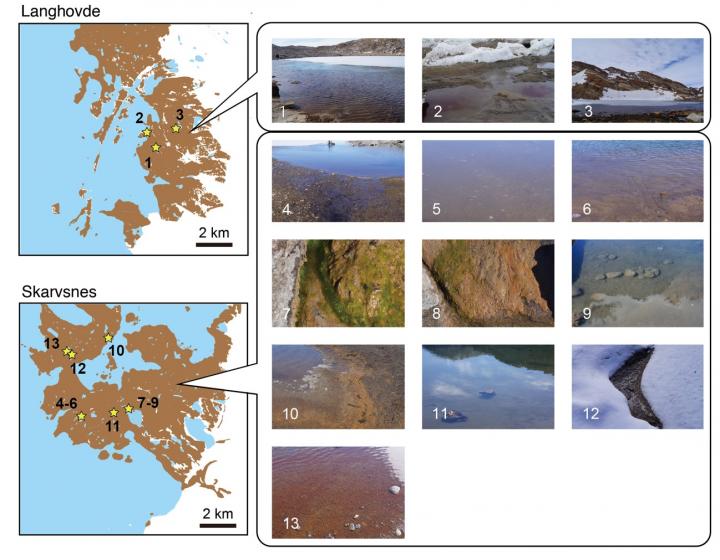
Most of Antarctica is covered with thick snow and ice, however; there are ice-free areas where land is exposed. The ice-free areas occupy only about 0.2% of the area in Antarctica, but a variety of microorganisms have been observed, and the areas are also called “Antarctic oases”. Two ice-free areas called Langhovde and Skarvsnes exist near Showa Station, Antarctica, and there are 50 or more large and small lakes in these areas (Fig. 1). Water does not freeze at the bottom of these lakes throughout the year and a unique ecosystem called “moss pillar,” that mainly includes moss and fungi, is distributed. Assistant Prof. Yuu Hirose and others of the Department of Applied Chemistry and Life Science at Toyohashi University of Technology focused on shores of freshwater lakes and also puddles and streams from snow meltwater. These environments are completely frozen during the winter season and accordingly are under more extreme stress (e.g. freezing and thawing and temperature changes), than that at the bottom of lakes.
In recent years, a technique for analyzing microbial community structure in environments using a next-generation sequencer has been developed. This method has a higher sensitivity and better quantitative properties than those of conventional techniques such as microscope observation. Assistant Prof. Hirose used this method to analyze microbial community structures at a total of 13 sites in the vicinity of Antarctic freshwater lakes (Fig. 2). The results revealed that filamentous cyanobacteria were widely distributed, and also that the proportion of unicellular cyanobacteria and cyanobacteria with cell differentiation capacity (called heterocysts*1), was small. The most widely distributed eukaryote was tardigrades with resistance to dryness and low temperatures. It was verified that specific eukaryotic algae such as cryptophyceae and green algae were dominant in some sites. There were also sites including nematodes feeding on algae. It is interesting that the fungi most dominant in moss pillars were not majority in these areas. The above results revealed that a variety of organisms lived even under severe environments e.g. the shallower parts of lakes, and puddles and streams.
*1Heterocyst: Cells dedicated to nitrogen fixation in filamentous cyanobacteria and formed mostly under nitrogen-deficient conditions.
Future Outlook
Clarification of the molecular mechanism how microorganisms living in these areas adapt to severe stresses is expected in the future. It is important to clarify the relationship between environmental factors, such as temperature and light conditions, and community structures of microorganisms. The monitoring and maintenance of the Antarctic ecosystem based on these information are also important.
###
Reference
Investigating Algal Communities in Lacustrine and Hydro-Terrestrial Environments of East Antarctica using Deep Amplicon Sequencing. Hirose, Y., Shiozaki, T., Otani, M., Kudoh, S., Imura S., Eki, T., Harada, N.
Microorganisms 2020, 8(4), 497, doi.org/10.3390/microorganisms8040497
This work was supported by JSPS KAKENHI Grant Number JP15H05712, “Plankton in polar regions -toward an understanding of their characteristics (representative: Naomi Harada).” The collection of samples was conducted as ordinary research observations of the 60th Japanese Antarctic Research Expedition.
Media Contact
Yuko Ito
[email protected]
Related Journal Article
http://dx.