• HOME
  • NEWS
  • EXPLORE
    • CAREER
      • Companies
      • Jobs
    • EVENTS
    • iGEM
      • News
      • Team
    • PHOTOS
    • VIDEO
    • WIKI
  • BLOG
  • COMMUNITY
    • FACEBOOK
    • INSTAGRAM
    • TWITTER
Tuesday, July 7, 2026
BIOENGINEER.ORG
No Result
View All Result
  • Login
  • HOME
  • NEWS
  • EXPLORE
    • CAREER
      • Companies
      • Jobs
        • Lecturer
        • PhD Studentship
        • Postdoc
        • Research Assistant
    • EVENTS
    • iGEM
      • News
      • Team
    • PHOTOS
    • VIDEO
    • WIKI
  • BLOG
  • COMMUNITY
    • FACEBOOK
    • INSTAGRAM
    • TWITTER
  • HOME
  • NEWS
  • EXPLORE
    • CAREER
      • Companies
      • Jobs
        • Lecturer
        • PhD Studentship
        • Postdoc
        • Research Assistant
    • EVENTS
    • iGEM
      • News
      • Team
    • PHOTOS
    • VIDEO
    • WIKI
  • BLOG
  • COMMUNITY
    • FACEBOOK
    • INSTAGRAM
    • TWITTER
No Result
View All Result
Bioengineer.org
No Result
View All Result
Home NEWS Science News Biology

Circular RNA makes fruit flies live longer

Bioengineer by Bioengineer
July 7, 2020
in Biology
Reading Time: 3 mins read
0
IMAGE
Share on FacebookShare on TwitterShare on LinkedinShare on RedditShare on Telegram

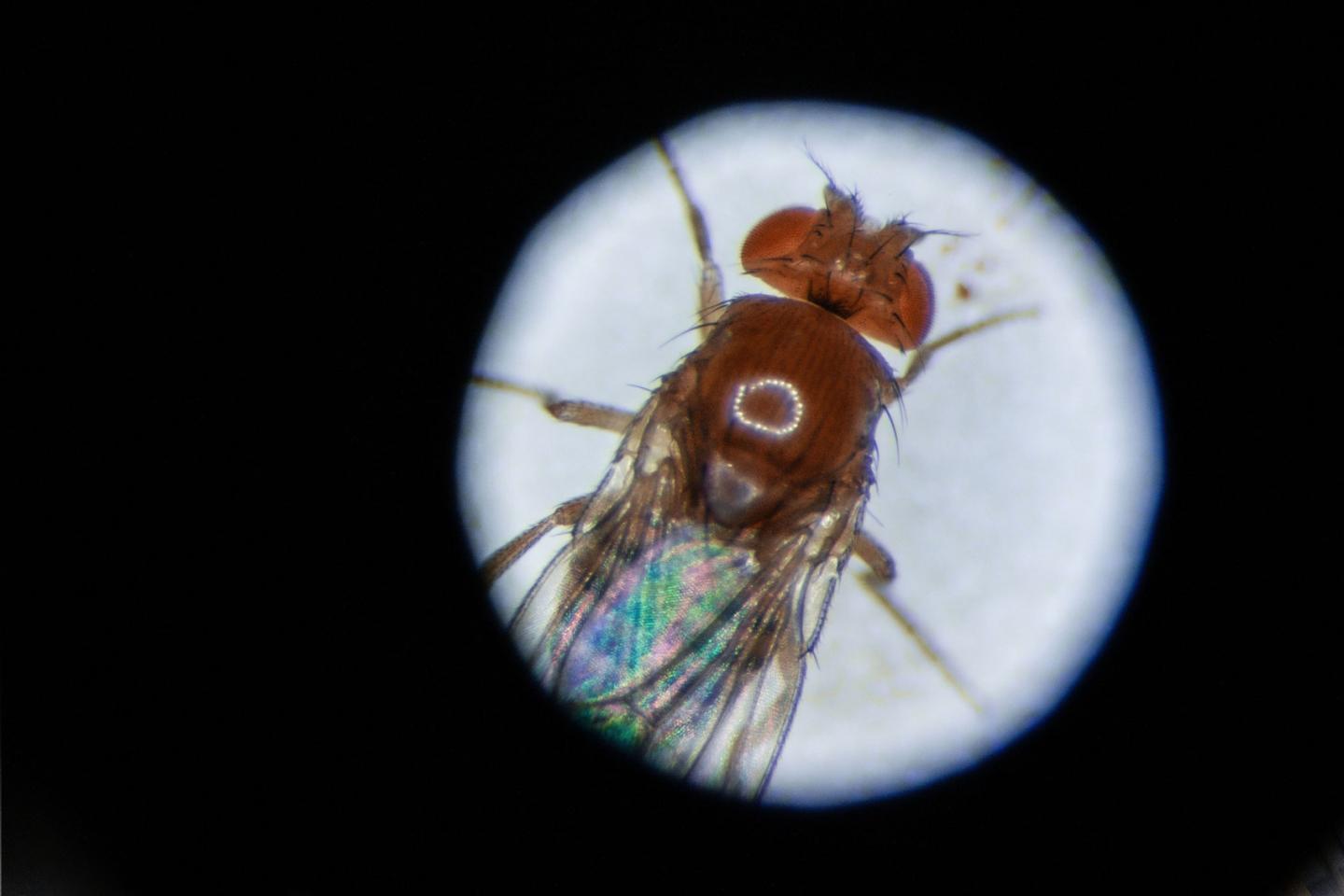
The molecule influences the insulin signalling pathway and thus prolongs life
IMAGE

Credit: F. Vinken

Ribonucleic acid, or RNA, is part of our genetic code and present in every cell of our body. The best known form of RNA is a single linear strand, of which the function is well known and characterized. But there is also another type of RNA, so-called “circular RNA”, or circRNA, which forms a continuous loop that makes it more stable and less vulnerable to degradation. CircRNAs accumulate in the brain with age. Still, the biological functions of most circRNAs are not known and are a riddle for the scientific community. Now scientists from the Max Planck Institute for Biology of Ageing have come one step closer to answer the question what these mysterious circRNAs do: one of them contributes to the ageing process in fruit flies.

Carina Weigelt and other researchers in the group led by Linda Partridge, Director at the Max Planck Institute for Biology of Ageing, used fruit flies to investigate the role of the circRNAs in the ageing process. “This is unique, because it is not very well understood what circRNAs do, especially not in an ageing perspective. Nobody has looked at circRNAs in a longevity context before”, says Carina Weigelt who conducted the main part of the study. She continues: “Now we have identified a circRNA that can extend lifespan of fruit flies when we increase it, and it is regulated by insulin signaling”.

Specific circRNA influences lifespan via insulin signalling

The insulin pathway regulates ageing, metabolism, reproduction and growth in worms, flies and humans. When this pathway is blocked by different methods, for instance by using genetically modified flies that lack insulin, the flies live longer. But it is not known how exactly this happens. The scientists now believe that part of the answer could lie with the circRNAs. They found a specific circRNA, called circSulfateless (circSfl), that behaved differently compared to other circRNAs. CircSfl was expressed at much higher levels in the long-lived fruit flies that lacked insulin as compared to normal flies. Furthermore, when flies were genetically manipulated to have higher level of circSfl, these flies also lived longer. These findings show that not only is circSfl dependent on insulin – circSfl itself can also directly influence the lifespan of fruit flies.

In the cells the necessary proteins that the body needs for all sorts of functions are made from normal linear RNAs, but generally not from circular RNAs. Again, the scientists found another difference between circSfl and other circular RNAs: a protein is indeed made from circSfl. The exact function of this protein is not known, but Carina Weigelt says: ” The circSfl protein is similar but not identical to the classical Sfl protein originating from the linear Sfl RNA. We don’t know exactly how the circSfl-derived protein influences ageing, but perhaps it interacts with similar proteins as the regular Sfl protein.”

What does this mean for ageing research? Carina Weigelt says: “We want to understand how ageing works and why the flies lacking insulin are long-lived. It seems like one of the mechanisms is circSfl. We now want to further investigate the ageing process by looking at other circular RNAs also in other animals.” Because circular RNAs also accumulate in the mammalian brain, these findings most likely also have important implications for humans.

###

Original publication

Weigelt CM, Sehgal R, Tain LS, Cheng J, Eßer J, Pahl A, Dieterich C, Grönke S and Partridge L.
An insulin-sensitive circular RNA that regulates lifespan in Drosophila.
Mol Cell 2020; 26 June, 2020

Media Contact
Dr. Linda Partridge
[email protected]

Original Source

https://www.mpg.de/15015089/circular-rna-life-span

Related Journal Article

http://dx.doi.org/10.1016/j.molcel.2020.06.011

Tags: BiologyMolecular Biology
Share12Tweet8Share2ShareShareShare2

Related Posts

Here are a few rewritten headlines for a science magazine post, each with a slightly different tone: Intriguing & poetic: How do organs sculpt themselves? Sea stars hold the secret Direct & research-focused: Sea stars reveal the hidden rules of organ formation Metaphorical & inviting: Tiny architects beneath the waves: What sea stars teach us about building organs Short & punchy: Star-shaped clues to how our organs take shape Question-led: Could a sea star show us how organs form? Elegant & feature-style: The body’s blueprint, glimpsed in a sea star’s arm

July 6, 2026
Bacteria evolve faster with unconventional gene copies — Biology

Bacteria evolve faster with unconventional gene copies

July 6, 2026

Neighbours rewire soil feedback via root microbiome shifts

July 6, 2026

Evolution-Inspired Biosensors Revolutionize Lipid Tracking in Real Time

July 2, 2026
Please login to join discussion

POPULAR NEWS

  • Detection of EDCs in Breast Milk and Infant Urine Up to Six Months Highlights Early Exposure Risks

    77 shares
    Share 31 Tweet 19
  • New Drug Candidate Developed at McMaster Shows Potential for Treating Brain Cancer

    58 shares
    Share 23 Tweet 15
  • Saying Goodbye to PGY-6: Pediatric Fellowship Realities

    103 shares
    Share 41 Tweet 26
  • KTU Researchers Explore Ultrasound’s Role in Enhancing Blood Flow Beyond Diagnostics

    53 shares
    Share 21 Tweet 13

About

We bring you the latest biotechnology news from best research centers and universities around the world. Check our website.

Follow us

Recent News

Flame retardant BDE-209 targets molecularly linked to ulcerative colitis

Ultra-high frequency particle impacts mimic rockbursts to shatter hard rock

Kidney transplant outcomes in older adults studied by German researchers

Subscribe to Blog via Email

Enter your email address to subscribe to this blog and receive notifications of new posts by email.

Join 83 other subscribers
  • Contact Us

Bioengineer.org © Copyright 2023 All Rights Reserved.

Welcome Back!

Login to your account below

Forgotten Password?

Retrieve your password

Please enter your username or email address to reset your password.

Log In
No Result
View All Result
  • Homepages
    • Home Page 1
    • Home Page 2
  • News
  • National
  • Business
  • Health
  • Lifestyle
  • Science

Bioengineer.org © Copyright 2023 All Rights Reserved.