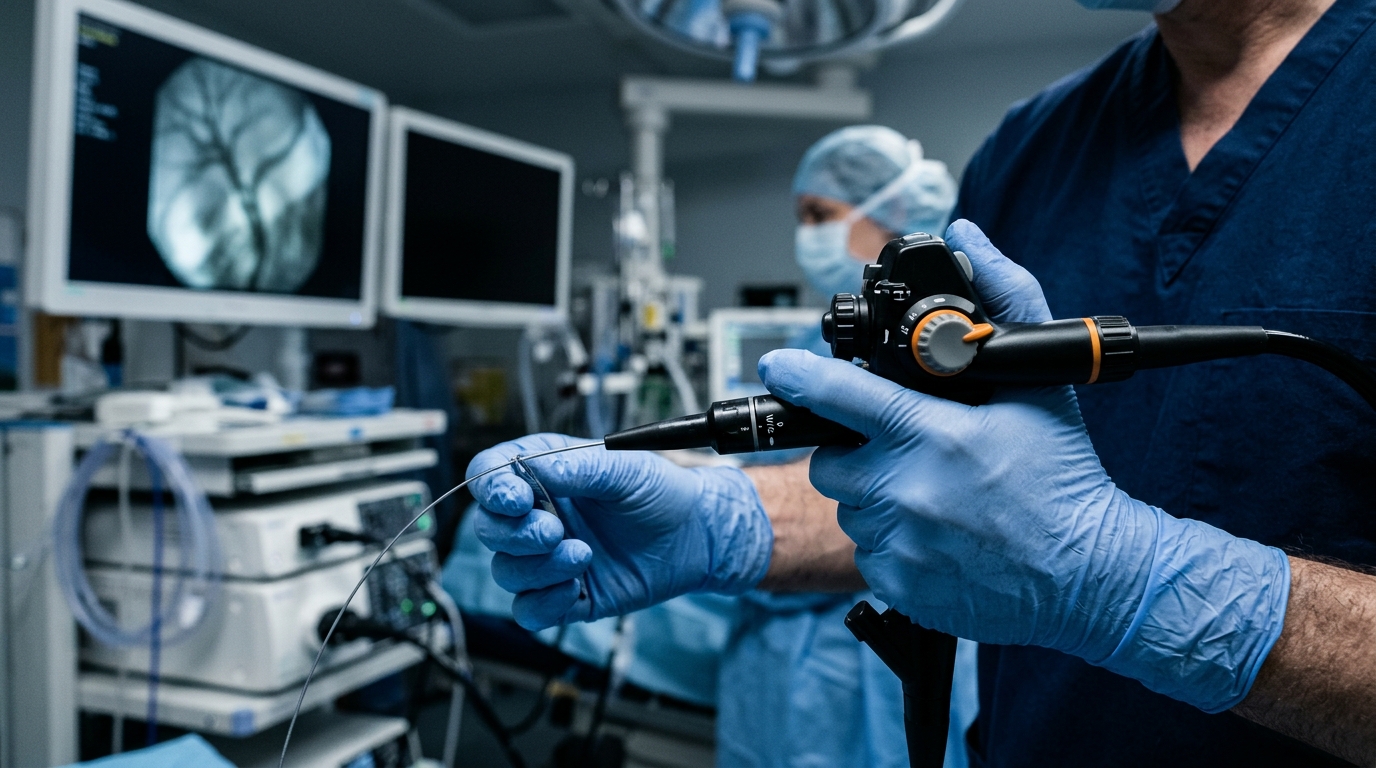
When a guidewire cannot cross a benign bile duct stricture during endoscopic retrograde cholangiopancreatography, endoscopists at a Turkish tertiary referral center have turned to a digital single-operator cholangioscope to finish the job. In a retrospective study spanning 2023 to 2025, researchers report that direct visualization of the biliary tree allowed selective guidewire cannulation in 22 of 25 patients whose conventional wire passage had failed, a technical success rate of 88 percent. Early clinical success, defined as symptomatic and biochemical improvement without reintervention within one month, was reached in 20 patients, or 80 percent.
The technique addresses a stubborn problem in therapeutic endoscopy. Biliary strictures arising after liver transplantation, iatrogenic biliary injury, or primary sclerosing cholangitis can be so complex that standard ERCP equipment cannot thread a wire across them, particularly after living-donor liver transplantation. Without wire passage, dilation and stenting cannot proceed, and patients may face percutaneous drainage or surgery. Digital single-operator cholangioscopy changes the geometry of the problem: the operator steers a cholangioscope into the ducts, sees the stricture directly, and can guide the wire through under visual control rather than relying on fluoroscopic guesswork.
This retrospective study at a tertiary referral center included 25 patients with benign biliary strictures who underwent DSOC-assisted selective guidewire cannulation after failed conventional guidewire passage across the stricture between 2023 and 2025. The authors defined technical success as successful guidewire passage across the stricture followed by dilation and stent placement. Four patients experienced adverse events, a rate of 16 percent: two cases of cholangitis, one of pancreatitis, and one of bleeding. The authors describe the cohort as selected and complex, since every patient represented a failed standard attempt before the cholangioscope was deployed.
Subgroup findings carry particular weight for transplant centers. Among the 15 living-donor liver transplantation recipients in the cohort, technical success reached 86.7 percent. Among the LDLT recipients, the right anterior sectoral duct was the most frequently cannulated branch, at 69.2 percent.
Patients with biliary injury fared even better on the technical side. In that subgroup, technical success was 100 percent and early clinical success 83.3 percent. Among patients with biliary injury, technical success was 100 percent and early clinical success 83.3 percent.
The authors are careful about what the numbers do and do not show. The design is retrospective, the sample is small, and there is no comparison arm, so the results cannot establish that cholangioscopy-guided cannulation outperforms other rescue strategies such as percutaneous transhepatic approaches. The conclusion states explicitly that comparative studies are needed to determine whether this approach reduces the need for percutaneous or surgical interventions. What the data do support is a narrower claim: in the majority of these selected patients with complex benign strictures, DSOC-guided cannulation restored endoscopic access after conventional wire passage had failed, with the strongest results in LDLT recipients and patients with biliary injury.
Published online on 3 November 2026 in BMC Gastroenterology as an open-access research article, the study carries the caveat that the shared version is an early, peer-reviewed accepted manuscript subject to further edits before the final version of record. The authors, led by Ahmet Burak Fedai with colleagues including Bülent Ödemiş and Nazmi Gökhan Ünver, frame the work as an evaluation of technical and clinical outcomes with a particular focus on LDLT recipients, the population in which failed wire passage is most consequential.
The authors state that comparative studies are needed to determine whether this approach reduces the need for percutaneous or surgical interventions. In this cohort, 22 of 25 patients achieved technical success and 20 of 25 achieved early clinical success, defined as symptomatic and biochemical improvement without reintervention within one month. The authors note that the cohort was selected and complex, since every patient represented a failed conventional attempt, and that the retrospective design cannot establish whether this approach outperforms other rescue strategies.
Subject of Research: Digital single-operator cholangioscopy for selective biliary cannulation after failed conventional guidewire passage across benign biliary strictures
Article Title: Digital single-operator cholangioscopy for selective biliary cannulation after failed conventional guidewire passage across benign biliary stricture
Article References: Fedai̇, A. B., Ödemi̇ş, B., Kenarlı, K., Karataş, G., Oktay, M. E., Deniz, E., & Ünver, N. G. (2026). Digital single-operator cholangioscopy for selective biliary cannulation after failed conventional guidewire passage across benign biliary stricture. BMC Gastroenterology. https://doi.org/10.1186/s12876-026-05481-2
Image Credits: AI Generated
DOI: 10.1186/s12876-026-05481-2
Keywords: ERCP, cholangioscopy, biliary stricture, guidewire cannulation, liver transplantation, living-donor liver transplantation, biliary injury, endoscopy, cholangitis, stent placement, Digital, single-operator
News Source: Ophelia Keating. (November 7, 2026). Cholangioscope-guided wire passage rescues difficult benign biliary strictures. Scienmag.