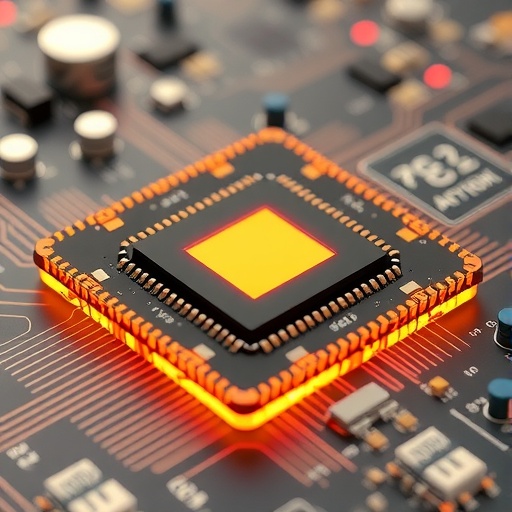
The evolution of digital image sensors has been a cornerstone of technological advancement in fields ranging from machine vision to biomedical imaging. These sensors have progressively pushed the boundaries of pixel miniaturization and pixel density, allowing for a greater capture of spatial information. However, despite these advances, a fundamental limitation persists—the spatial bandwidth product (SBP), which dictates the maximum amount of spatial information a sensor can record. This limitation has become a significant bottleneck in the quest for multidimensional sensing of light fields and spectra, hindering the next wave of sensor technology development. A recent breakthrough reported by Xie et al. introduces a novel solution that promises to redefine these constraints fundamentally.
At the heart of this innovation lies the integration of a microelectromechanical system (MEMS) actuator with a chip-scale image sensor. This synergy between microscale mechanical actuation and advanced sensor technology enables what was previously thought impossible: overcoming the pixel size limitations through precise mechanical modulation of the sensor’s position. The researchers’ approach diverges from traditional methods focused solely on electronic and optical improvements, instead embracing a physical manipulation strategy that enhances the effective sampling capabilities of the digital sensor array.
The theoretical framework underpinning this advancement is rooted in Fourier optics, a branch of physics that deals with the way light waves propagate and are transformed through optical systems. By developing a rigorous model based on these principles, the team could predict and characterize how a dynamically modulated image sensor could capture spatial details far beyond static sensor capabilities. This approach facilitates a more detailed reconstruction of the image data by synthesizing multiple shifted captures into a composite high-resolution output.
Fabrication of the sensor was conducted using advanced micromachining processes. The integration process is delicate, requiring precise alignment and calibration to ensure that the MEMS actuator’s movements align synchronously with sensor readout sequences. This level of engineering precision ensures that each modulation step effectively contributes to the spatial bandwidth enhancement without introducing artifacts or mechanical noise, which has traditionally plagued mechanically augmented imaging systems.
One of the most striking results from the device’s performance is the enhancement of the spatial bandwidth product by as much as 33.7 times compared to a sensor operating without position modulation. This dramatic increase signifies not only a quantitative improvement but also a qualitative leap, opening new avenues for sensors to record more comprehensive light field information and spectral data without requiring smaller pixels where noise would otherwise increase prohibitively.
Beyond the theoretical and experimental achievements, the practical implications are vast. When integrated into conventional camera systems, the sensor demonstrated a substantial improvement in imaging resolution. The ability to pinpoint point-like targets with enhanced accuracy has particular significance for applications in machine vision where precise localization is critical, such as in autonomous vehicle navigation, industrial quality control, and high-precision metrology.
Additionally, these improvements are expected to catalyze advancements in biomedical imaging. Many biomedical applications depend on capturing detailed spatial and spectral information of biological tissues, which often exhibit subtle variations vital for diagnostics. The capacity of the MEMS-integrated sensor to deliver richer data with superior resolution could transform imaging techniques such as fluorescence microscopy, optical coherence tomography, and hyperspectral imaging.
Furthermore, the approach adopted by Xie and colleagues introduces a new paradigm in sensor design—one where mechanical actuation complements electronic sensing rather than competing with it. This fusion may inspire future research into hybrid sensor systems, where multiple modalities of enhancement are layered to break traditional performance ceilings. Such systems could redefine how data capture is optimized across diverse spectral bands and spatial dimensions.
While this technology boasts enormous potential, challenges remain in refining the integration process to ensure robustness and reliability under various operating conditions. The MEMS actuator, being a micro-scale mechanical device, must maintain consistent performance over millions of cycles, particularly in demanding environments or portable applications. Advances in materials science and actuator design will be crucial to extend the lifespan and enhance the durability of these sensors.
Moreover, managing power consumption becomes vital as the mechanical actuation adds an additional layer of operational complexity. The research team has made strides in optimizing actuator drive protocols to minimize energy usage while still achieving precise sensor positioning. These efficiency gains are essential for enabling deployment in mobile or embedded systems where power availability is constrained.
The modularity of this design also presents exciting possibilities for customization. By adjusting the actuator’s movement parameters, the sensor can be tailored to specific imaging tasks or system architectures. This flexibility is a significant advantage over fixed traditional sensors and aligns well with the growing demand for adaptable solutions in the era of AI-driven imaging and real-time data processing.
Integrating this MEMS-augmented sensor technology into existing imaging platforms could accelerate the transition towards smarter, higher fidelity imaging systems. The enhanced spatial bandwidth allows for richer data capture necessary to feed machine learning algorithms that rely on high-quality inputs for successful inference and decision-making. This relationship between hardware capability and computational analysis epitomizes the future trajectory of imaging technologies.
Finally, the discovery reported by Xie and colleagues not only pushes the limits of today’s digital image sensors but also redefines the fundamental design philosophy for the next generation of imaging devices. By combining microelectromechanical precision with optical and electronic advancements, they unlock new sensory dimensions. This work signifies a crucial leap forward in overcoming the longstanding obstacle imposed by pixel miniaturization limits.
The implications of such a leap extend well beyond traditional imaging. Fields ranging from environmental monitoring to advanced robotics and augmented reality stand to benefit immensely. As human-machine interfaces and autonomous systems demand ever more detailed and accurate environmental sensing, this sensor technology could become a foundational element in the architectures of future smart systems.
In conclusion, the integration of MEMS actuators with chip-scale image sensors represents a landmark advancement. It transcends pixel size barriers and redefines how spatial bandwidth product can be enhanced effectively. With a measured 33.7-fold increase in SBP and demonstrable improvements in imaging performance, this approach positions itself at the nexus of innovation for next-generation multispectral and multidimensional imaging systems. The ripple effects of this research are poised to influence multiple industries, heralding a new era of sensor technology that is both versatile and profoundly capable.
Subject of Research: Chip-scale image sensors integrated with microelectromechanical system (MEMS) actuators to overcome spatial bandwidth product limitations in imaging.
Article Title: A chip-scale image sensor integrated with a microelectromechanical system actuator.
Article References:
Xie, R., Liu, X., Zhan, H. et al. A chip-scale image sensor integrated with a microelectromechanical system actuator. Nat Electron (2026). https://doi.org/10.1038/s41928-026-01600-9
Image Credits: AI Generated
DOI: https://doi.org/10.1038/s41928-026-01600-9
Tags: advanced biomedical imaging sensorschip-scale image sensorFourier optics in image sensinghigh-density pixel arraysmachine vision sensor advancementsmechanical modulation of image sensorsMEMS actuator integrationmicroelectromechanical systems in imagingmultidimensional light field sensingnext-generation digital image sensorspixel miniaturization technologyspatial bandwidth product limitation