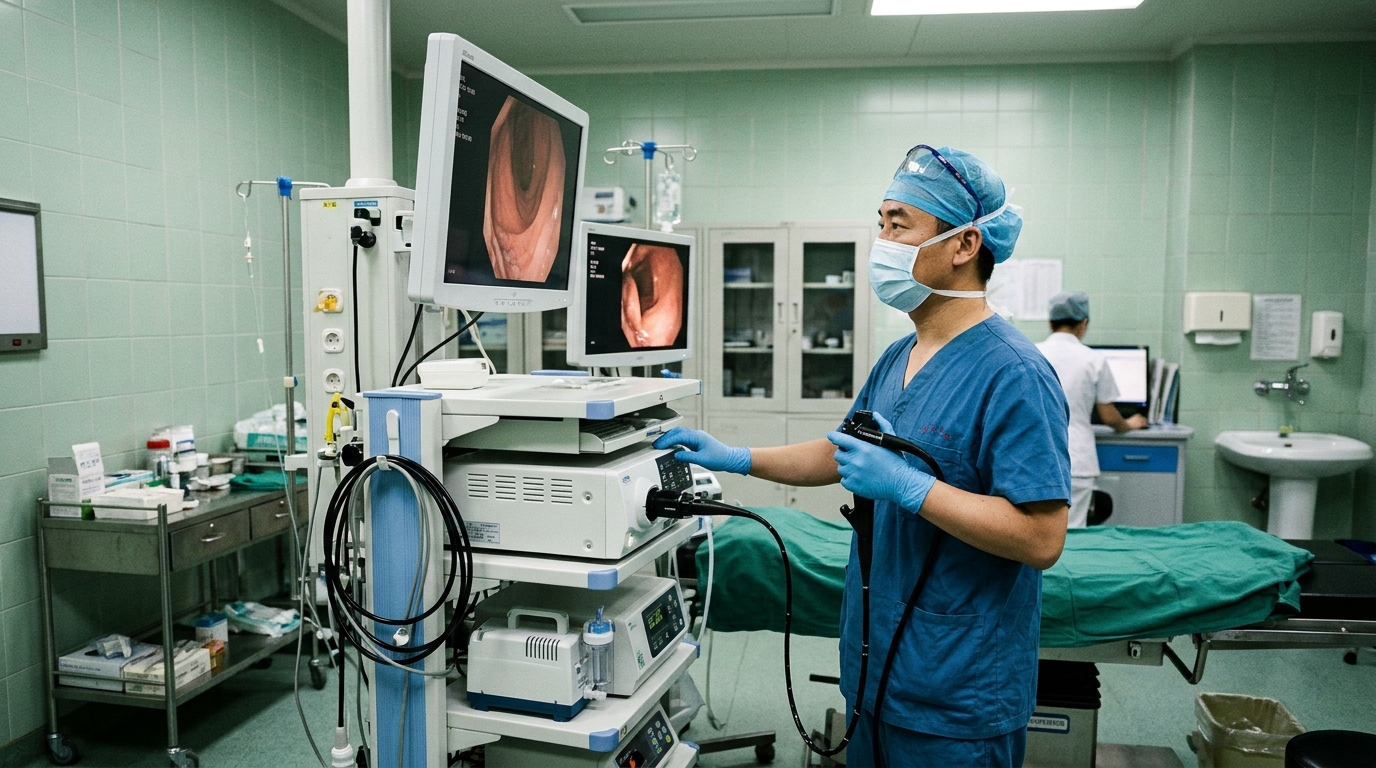
A five-year repeated cross-sectional analysis of an organized colorectal cancer screening program at a county-level hospital in Eastern China found an overall adenoma detection rate of 43.6 percent, alongside a measurable reduction in advanced adenoma detection in its final year. The investigation evaluated colonoscopy outcomes recorded between 2021 and 2025 across a medical alliance that serves 126 villages and residential communities. Because county-level medical alliances provide a substantial portion of organized screening across China, tracking annual colonoscopy findings offers critical visibility into community-level detection patterns.
Researchers examined records from 1,003 colonoscopies conducted over the five-year evaluation window to determine whether lesion detection rates remained stable or shifted over successive screening cycles. Due to the absence of linkable personal identifiers across screening rounds, the team evaluated the dataset as sequential annual cross-sectional samples. Investigators analyzed two standard endoscopic metrics: the overall adenoma detection rate, defined as the proportion of colonoscopies detecting either non-advanced or advanced adenomas, and the advanced adenoma detection rate.
Under the operational criteria used by the screening initiative, an advanced adenoma was defined by a lesion diameter of ten millimeters or larger, villous or tubulovillous histology, high-grade dysplasia, or the presence of three or more synchronous adenomas. Colorectal cancer cases were excluded from both primary detection calculations, though the research team also evaluated a parallel colorectal cancer-inclusive program yield definition to assess broader institutional detection performance across the cohort.
Across all 1,003 procedures, advanced adenomas were identified in 22.0 percent of cases, accounting for 221 examinations, while invasive colorectal cancer was detected in 1.0 percent of colonoscopies, representing 10 individuals. The overall adenoma detection rate remained relatively consistent across the multi-year timeline, showing no statistically significant heterogeneity between individual years based on a chi-square test yielding a p-value of 0.617.
In contrast, the detection of advanced adenomas demonstrated a notable temporal decline between the start and conclusion of the observation period. The unadjusted advanced adenoma detection rate fell from 24.8 percent in 2021 to 17.1 percent in 2025. After logistic regression modeling adjusted for participant age group, sex, and calendar year, the adjusted odds ratio for 2025 compared to 2021 stood at 0.54, with a 95 percent confidence interval spanning 0.34 to 0.87 and a p-value of 0.011.
When annual performance rates were standardized to the pooled age and sex distribution of the study cohort, the standardized advanced adenoma detection rate dropped from 24.3 percent in 2021 to 15.0 percent in 2025. Demographic evaluations revealed that participant characteristics strongly influenced yields; male sex was associated with higher detection, carrying an adjusted odds ratio of 2.14 for general adenomas and 2.02 for advanced lesions. Similarly, participants aged 70 years or older exhibited adjusted odds ratios of 2.13 for adenomas and 3.07 for advanced adenomas.
In procedural assessments focused on the 2025 screening cohort, adjusted adenoma detection rates differed significantly among individual endoscopists, producing a p-value of less than 0.001. Conversely, the advanced adenoma detection rate did not show statistically significant variation across different endoscopists in that same calendar year, with a p-value of 0.27. Sensitivity analyses showed that adjusted risk estimates for 2025 remained comparable when incorporating records from 2020 or when applying colorectal cancer-inclusive program yield definitions.
The study authors highlighted notable interpretive boundaries, pointing out that conventional three-criterion advanced adenoma detection rates could not be reconstructed from the aggregated outcome field. Furthermore, because the observed drop in advanced adenoma detection was confined to the final calendar year, the available retrospective dataset cannot establish whether the shift stemmed from changes in referral criteria, participant demographics, procedural endoscopy quality, endoscopist variability, diagnostic classification practices, or chance alone.
Consequently, the investigators concluded that the observed decrease in advanced lesions represents an unexplained temporal signal that requires prospective verification in structured longitudinal cohorts. To enhance the monitoring and interpretation of colonoscopy yields in regional alliances, the researchers recommended that future public health screening frameworks systematically capture referral pathways, pre-colonoscopy screening test results, stable unique participant identifiers, detailed procedural quality metrics, and individual operator identities.
Subject of Research: Colorectal cancer screening and adenoma detection rates in a Chinese county medical alliance
Article Title: Adenoma and advanced adenoma detection in a county-level medical alliance colorectal cancer screening program in Eastern China: a 5-year repeated cross-sectional analysis
Article References: Bao, J.-H., Ma, C.-Y., Wang, W., Mao, Y., & Yu, G.-F. (2026). Adenoma and advanced adenoma detection in a county-level medical alliance colorectal cancer screening program in Eastern China: a 5-year repeated cross-sectional analysis. BMC Gastroenterology. https://doi.org/10.1186/s12876-026-05549-z
Image Credits: AI Generated
DOI: 10.1186/s12876-026-05549-z
Keywords: colorectal cancer screening, adenoma detection rate, advanced adenoma detection rate, colonoscopy, medical alliance, Eastern China, repeated cross-sectional study, cancer prevention, gastroenterology, endoscopy quality, screening yield, villous histology, high-grade dysplasia, demographic risk factors, endoscopist variability, public health screening
News Source: Ophelia Keating. (November 13, 2026). China Screening Program Tracks Adenoma Rates Over Five Years in County Alliance. Scienmag.