• HOME
  • NEWS
  • EXPLORE
    • CAREER
      • Companies
      • Jobs
    • EVENTS
    • iGEM
      • News
      • Team
    • PHOTOS
    • VIDEO
    • WIKI
  • BLOG
  • COMMUNITY
    • FACEBOOK
    • INSTAGRAM
    • TWITTER
Saturday, November 28, 2026
BIOENGINEER.ORG
No Result
View All Result
  • Login
  • HOME
  • NEWS
  • EXPLORE
    • CAREER
      • Companies
      • Jobs
        • Lecturer
        • PhD Studentship
        • Postdoc
        • Research Assistant
    • EVENTS
    • iGEM
      • News
      • Team
    • PHOTOS
    • VIDEO
    • WIKI
  • BLOG
  • COMMUNITY
    • FACEBOOK
    • INSTAGRAM
    • TWITTER
No Result
View All Result
Bioengineer.org
No Result
View All Result
Home NEWS Science News Health

Child Anthropometric Failure Disproportionately Affects Marginalized Groups in Lagging Indian States

by
November 26, 2026
in Health
Reading Time: 2 mins read
0
Child Anthropometric Failure Disproportionately Affects Marginalized Groups in Lagging Indian States

Child Anthropometric Failure Disproportionately Affects Marginalized Groups in Lagging Indian States

Share on FacebookShare on TwitterShare on LinkedinShare on RedditShare on Telegram

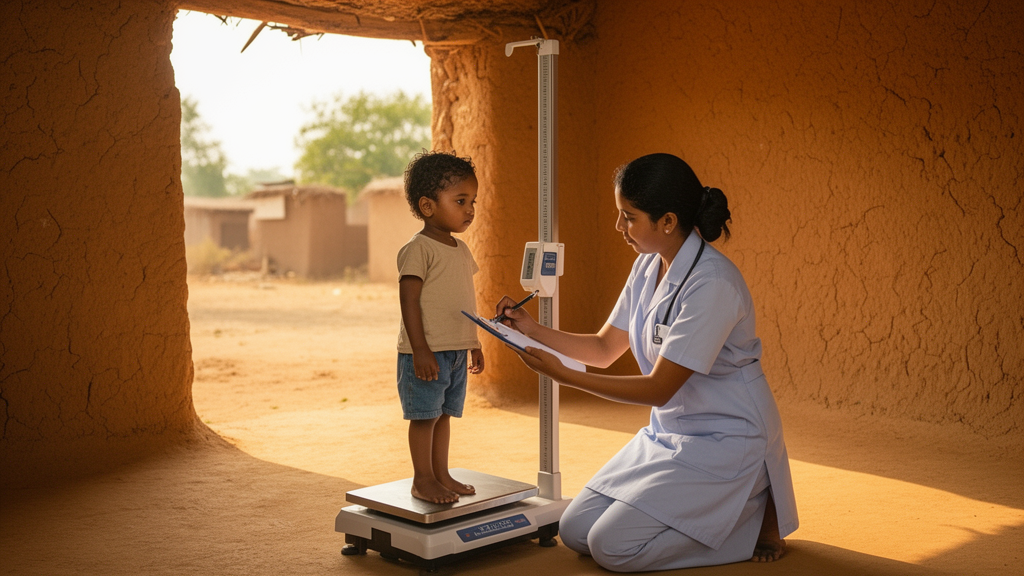
In India’s socio-economically lagging Empowered Action Group states and Assam, 60.60 percent of children under five from Scheduled Castes and Scheduled Tribes experience anthropometric failure, compared to 52.95 percent of non-Scheduled Caste and non-Scheduled Tribe children. This measurable gap demonstrates that social identity functions as a fundamental determinant of early childhood nutritional deprivation across these lagging regions.

To investigate the drivers of this childhood health challenge, the study examined under-five population records from the fifth National Family Health Survey, conducted between 2019 and 2021.

The research team employed Fairlie’s decomposition technique to partition the observed gap in the Composite Index of Anthropometric Failure between social groups into distinct socio-economic and bio-demographic components.

The decomposition model successfully explained 67.29 percent of the total gap in anthropometric failure between Scheduled Castes and Scheduled Tribes and non-scheduled populations. Household wealth disparities served as the primary explanatory driver, accounting for 55.24 percent of the explained divide, demonstrating that economic marginalization represents the dominant barrier separating the nutritional trajectories of children across these social strata.

Maternal education constituted the second largest explanatory component, accounting for 20.22 percent of the analyzed gap. Furthermore, maternal Body Mass Index contributed 8.38 percent to the explained disparity, while maternal mass media exposure accounted for 6.42 percent. Across the surveyed geographic territories, spatial analysis revealed significant regional variation, establishing that Bihar recorded the highest prevalence of anthropometric failure at 63.32 percent.

The findings indicate that anthropometric failure in Assam and the Empowered Action Group states reflects a severe cluster of disadvantages disproportionately concentrated within marginalized communities. Economic deprivation severely restricts access to vital health determinants, including diverse dietary intake and quality healthcare services, while maternal educational disadvantages correspond to persistent gaps in health literacy, which affect the adoption of optimal feeding and hygiene behaviors.

The analysis also highlights the intergenerational transmission of childhood undernutrition, as evidenced by the measurable contributions of maternal Body Mass Index and maternal anemia.

The study concludes that universal health interventions remain insufficient to resolve these deeply rooted disparities across marginalized communities. Achieving parity requires socially targeted policies, such as bolstering economic safety nets for Scheduled Caste and Scheduled Tribe families and prioritizing localized community health outreach through Accredited Social Health Activists to advance structural justice and support a malnutrition-free India.

Subject of Research: Disparities in childhood anthropometric failure across Indian social groups

Article Title: Social group disparities in anthropometric failure among under-five children in EAG states of India and Assam: a decomposition analysis

Article References: Chowdhury, S. (2026). Social group disparities in anthropometric failure among under-five children in EAG states of India and Assam: a decomposition analysis. BMC Public Health. https://doi.org/10.1186/s12889-026-30487-6

Image Credits: AI Generated

DOI: 10.1186/s12889-026-30487-6

Keywords: anthropometric failure, Composite Index of Anthropometric Failure, child malnutrition, Empowered Action Group states, Assam, Scheduled Castes, Scheduled Tribes, National Family Health Survey, NFHS-5, Fairlie decomposition, household wealth, maternal education, maternal body mass index, maternal anemia, Bihar, Accredited Social Health Activists, under-five children

News Source: Ophelia Keating. (November 26, 2026). Child Anthropometric Failure Disproportionately Affects Marginalized Groups in Lagging Indian States. Scienmag.

Tags: Accredited Social Health Activistsanthropometric failureAssamBiharchild malnutritioncomposite index of anthropometric failureEmpowered Action Group statesFairlie decompositionhousehold wealthmaternal anemiamaternal body mass indexmaternal educationNational Family Health SurveyNFHS-5Scheduled CastesScheduled Tribesunder-five children
Share12Tweet7Share2ShareShareShare1

Related Posts

Targeted Radionuclide Therapy Linked to Longer Survival in Neuroendocrine Tumour Cohort

Targeted Radionuclide Therapy Linked to Longer Survival in Neuroendocrine Tumour Cohort

November 28, 2026
Heterozygous EpCAM Mutation Increases MASLD Susceptibility in Mice Fed High-Fat Diet

Heterozygous EpCAM Mutation Increases MASLD Susceptibility in Mice Fed High-Fat Diet

November 28, 2026

YouTube Videos on Dental Antibiotic Use Show Low Educational Quality

November 28, 2026

Optimizing SGLT2 Inhibitors Saves 1.55 Billion Euros Across Dutch Cardiorenal Care

November 28, 2026

POPULAR NEWS

  • Single-Session Bilateral Whole-Lung Lavage Shows Feasibility in Severe Pregnancy aPAP Cases

    Single-Session Bilateral Whole-Lung Lavage Shows Feasibility in Severe Pregnancy aPAP Cases

    29 shares
    Share 12 Tweet 7
  • Plant-Synthesized Zinc Oxide Nanoparticles Inhibit Citrus Canker Pathogen in Laboratory Testing

    29 shares
    Share 12 Tweet 7
  • Pre-Weaning Hemodynamic Ratio Associates With Adult VA-ECMO Weaning Success

    29 shares
    Share 12 Tweet 7
  • Dual-Laser Guidance System Improves Puncture Efficiency in CT-Guided Lung Biopsy Model

    29 shares
    Share 12 Tweet 7

About

We bring you the latest biotechnology news from best research centers and universities around the world. Check our website.

Follow us

Recent News

Targeted Radionuclide Therapy Linked to Longer Survival in Neuroendocrine Tumour Cohort

Heterozygous EpCAM Mutation Increases MASLD Susceptibility in Mice Fed High-Fat Diet

YouTube Videos on Dental Antibiotic Use Show Low Educational Quality

Subscribe to Blog via Email

Enter your email address to subscribe to this blog and receive notifications of new posts by email.

Join 89 other subscribers
  • Contact Us

Bioengineer.org © Copyright 2023 All Rights Reserved.

Welcome Back!

Login to your account below

Forgotten Password?

Retrieve your password

Please enter your username or email address to reset your password.

Log In
No Result
View All Result
  • Homepages
    • Home Page 1
    • Home Page 2
  • News
  • National
  • Business
  • Health
  • Lifestyle
  • Science

Bioengineer.org © Copyright 2023 All Rights Reserved.