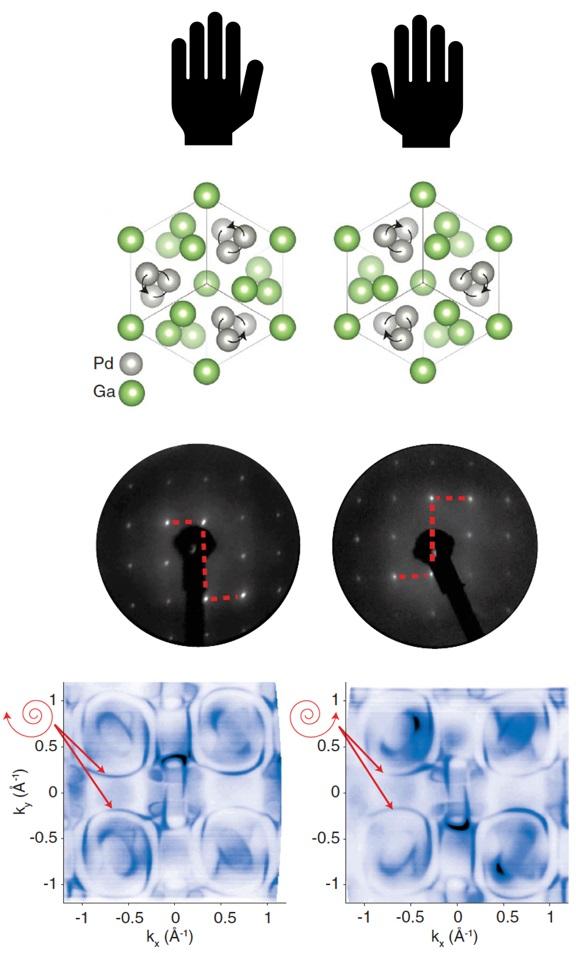
Credit: Paul Scherrer Institute/Niels Schröter
In topological materials, electrons can display behaviour that is fundamentally different
from that in ‘conventional’ matter, and the magnitude of many such ‘exotic’ phenomena is
directly proportional to an entity known as the Chern number. New experiments establish
for the first time that the theoretically predicted maximum Chern number can be reached
— and controlled — in a real material.
When the Royal Swedish Academy of Sciences awarded the Nobel Prize in Physics 2016 to
David Thouless, Duncan Haldane and Michael Kosterlitz, they lauded the trio for having
“opened the door on an unknown world where matter can assume strange states”. Far from
being an oddity, the discoveries of topological phase transitions and topological phases of
matter, to which the three theoreticians have contributed so crucially, has grown into one of the most active fields of research in condensed matter physics today. Topological materials hold the promise, for instance, to lead to novel types of electronic components and superconductors, and they harbour deep connections across areas of physics and mathematics. While new phenomena are discovered routinely, there are fundamental aspects yet to be settled. One of those is just how ‘strong’ topological phenomena can be in a real material. Addressing that question, an international team of researchers led by PSI postdoctoral researcher Niels Schröter provide now an important benchmark. Writing in Science, they report experiments in which they observed that in the topological semimetal palladium gallium (PdGa) one of the most common classifiers of topological phenomena, the Chern number, can reach the maximum value that is allowed in any metallic crystal. That this is possible in a real material has never been shown before. Moreover, the team has established ways to control the sign of the Chern number, which might bring new
opportunities for exploring, and exploiting, topological phenomena.
Developed to the maximum
In theoretical works it had been predicted that in topological semimetals the Chern number
cannot exceed a magnitude of four. As candidate systems displaying phenomena with such
maximal Chern numbers, chiral crystals were proposed. These are materials whose lattice
structures have a well-defined handedness, in the sense that they cannot transformed into
their mirror image by any combination of rotations and translations. Several candidate
structures have been studied. A conclusive experimental observation of a Chern number of
plus or minus four, however, remained elusive. The previous efforts have been hindered by
two factors in particular. First, a prerequisite for realizing a maximal Chern number is the
presence of spin-orbit coupling, and at least in some of the materials studied so far, that
coupling is relatively low, making it difficult to resolve the splittings of interest. Second,
preparing clean and flat surfaces of relevant crystals has been highly challenging, and as a
consequence spectroscopic signatures tended to be washed out.
Schröter et al. have overcome both of these limitations by working with PdGa crystals. The
material displays strong spin-orbit coupling, and well-established methods exist for
producing immaculate surfaces. In addition, at the Advanced Resonant Spectroscopies
(ADRESS) beamline of the Swiss Light Source at PSI, they had unique capabilities at their
disposal for high-resolution ARPES experiments and thus to resolve the predicted tell-tale
spectroscopic patterns. In combination with further measurements at the Diamond Light
Source (UK) and with dedicated ab initio calculations, these data revealed hard and fast
signatures in the electronic structure of PdGa that left no doubt that the maximal Chern
number has been realized.
A hand on the Chern number
The team went one step further, beyond the observation of a maximal Chern number. They
showed that the chiral nature of the PdGa crystals offers a possibility to control the sign of
that number as well. To demonstrate such control, they grew samples that were either leftor right-handed (see the figure). When they looked then at the electronic structures of the two enantiomers, they found that the chirality of the crystals is reflected in the chirality of the electronic wave function. Taken together, this means that in chiral semimetals the
handedness, which can be determined during crystal growth, can used to control topological
phenomena emerging from the behaviour of the electrons in the material.
This sort of control opens a trove of new experiments. For example, novel effects can be
expected to arise at the interface between different enantiomers, one with Chern number +4 and the other one with -4. And there are real prospects for applications, too. Chiral topological semimetals can host fascinating phenomena such as quantized photocurrents. Intriguingly, PdGa is known for its catalytic properties, inviting the question about the role of topological phenomena in such processes.
Finally, the findings now obtained for PdGa emerge from electronic band properties that are
shared by many other chiral compounds — meaning that the corner of the “unknown world
where matter can assume strange states” into which Schröter and colleagues have now
ventured is likely to have a lot more to offer.
###
This work was carried out in close collaboration with the group of Claudia Felser at the Max Planck Institute for Chemical Physics of Solids in Dresden (Germany), and with colleagues at the Swiss Federal Laboratories for Materials Science and Technology (EMPA), the École Polytechnique Fédérale de Lausanne (EPFL), the Donostia International Physics Center in Donostia-San Sebastian and IKERBASQUE Bilbao (Spain), the University of Oxford (UK), Diamond Light Source (UK), and the University of Illinois at Urbana-Champaign (US).
About PSI
The Paul Scherrer Institute PSI develops, builds and operates large, complex research facilities and makes them available to the national and international research community. The institute’s own key research priorities are in the fields of matter and materials, energy and environment and human health. PSI is committed to the training of future generations. Therefore about one quarter of our staff are post-docs, post-graduates or apprentices. Altogether PSI employs 2100 people, thus being the largest research institute in Switzerland. The annual budget amounts to approximately CHF 407 million. PSI is part of the ETH Domain, with the other members being the two Swiss Federal Institutes of Technology, ETH Zurich and EPFL Lausanne, as well as Eawag (Swiss Federal Institute of Aquatic Science and Technology), Empa (Swiss Federal Laboratories for Materials Science and Technology) and WSL (Swiss Federal Institute for Forest, Snow and Landscape Research).
Contact
Dr. Niels Bernhard Schröter
Laboratory for Condensed Matter
Paul Scherrer Institute, Forschungsstrasse 111, 5232 Villigen PSI, Switzerland
Telephone: +41 56 310 50 51, e-mail: [email protected] [German, English]
Original publication
Observation and manipulation of maximal Chern numbers in the chiral topological semimetal PdGa
Niels B.M. Schröter et al.
Science 9. July 2020
DOI: 10.1126/science.aaz3480
Media Contact
Niels Schröter
41-563-105-051
Related Journal Article
http://dx.