• HOME
  • NEWS
  • EXPLORE
    • CAREER
      • Companies
      • Jobs
    • EVENTS
    • iGEM
      • News
      • Team
    • PHOTOS
    • VIDEO
    • WIKI
  • BLOG
  • COMMUNITY
    • FACEBOOK
    • INSTAGRAM
    • TWITTER
Wednesday, August 26, 2026
BIOENGINEER.ORG
No Result
View All Result
  • Login
  • HOME
  • NEWS
  • EXPLORE
    • CAREER
      • Companies
      • Jobs
        • Lecturer
        • PhD Studentship
        • Postdoc
        • Research Assistant
    • EVENTS
    • iGEM
      • News
      • Team
    • PHOTOS
    • VIDEO
    • WIKI
  • BLOG
  • COMMUNITY
    • FACEBOOK
    • INSTAGRAM
    • TWITTER
  • HOME
  • NEWS
  • EXPLORE
    • CAREER
      • Companies
      • Jobs
        • Lecturer
        • PhD Studentship
        • Postdoc
        • Research Assistant
    • EVENTS
    • iGEM
      • News
      • Team
    • PHOTOS
    • VIDEO
    • WIKI
  • BLOG
  • COMMUNITY
    • FACEBOOK
    • INSTAGRAM
    • TWITTER
No Result
View All Result
Bioengineer.org
No Result
View All Result
Home NEWS Science News Biology

Chelated calcium benefits poinsettias

Bioengineer by Bioengineer
February 27, 2019
in Biology
Reading Time: 3 mins read
0
IMAGE
Share on FacebookShare on TwitterShare on LinkedinShare on RedditShare on Telegram

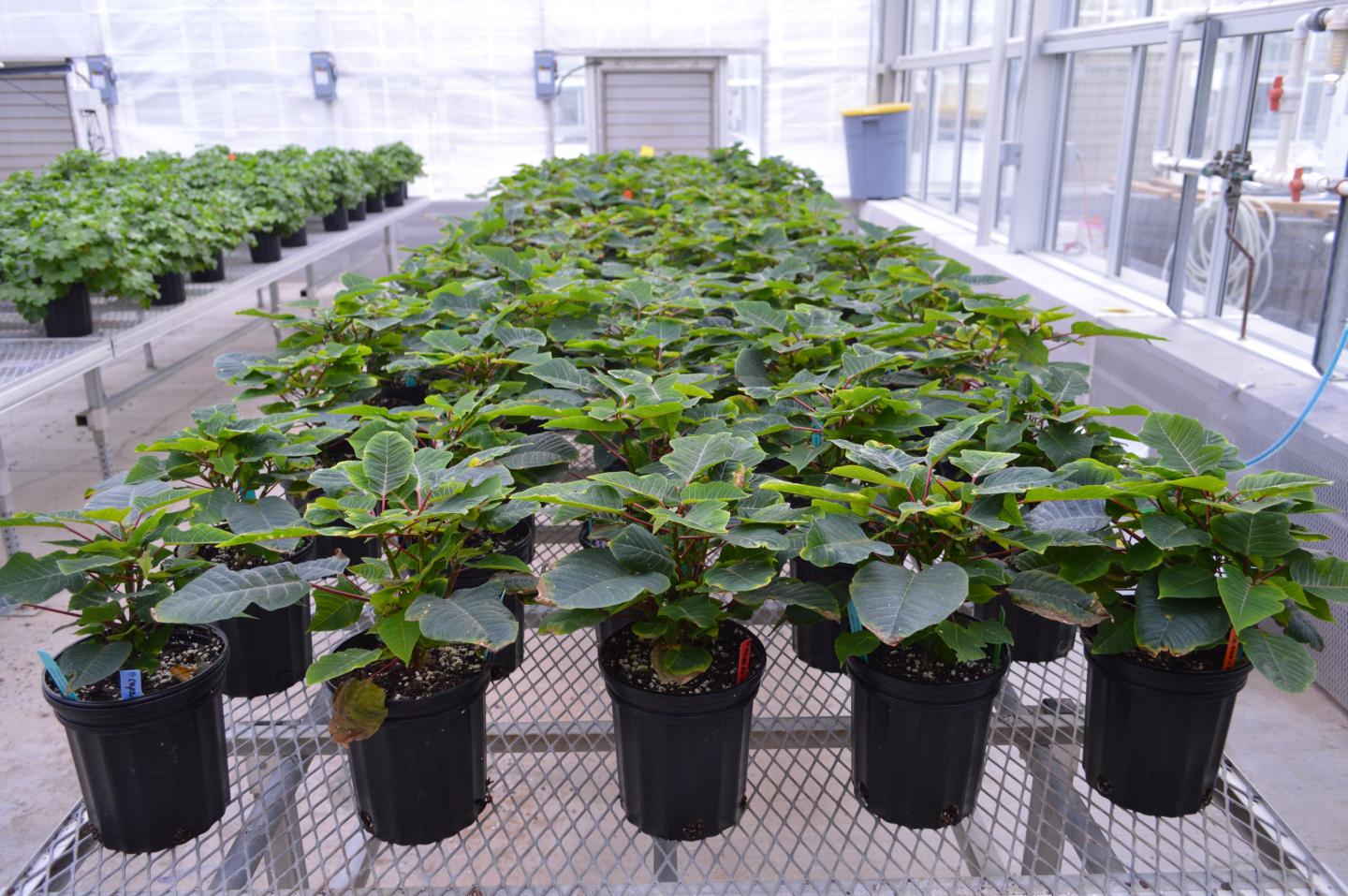
Application of chelated calcium to stock plants improves resistance to physical damage for poinsettia cuttings
IMAGE

Credit: James Faust

CLEMSON, SOUTH CAROLINA–Chelated Calcium Benefits Poinsettias

Vegetatively propagated unrooted cuttings of annual ornamentals are typically grown in equatorial locations and shipped via airfreight to propagators located in temperate climates. Cutting quality, defined as the resistance to external forces–such as physical damage and pathogen infection–has an impact on postharvest durability during shipping and propagation.

In an effort to preserve the point-of-sale presentation of these unrooted cuttings, Uttara Samarakoon and James Faust conducted a study to identify treatments that will best benefit these ornamentals during transit.

Their findings are presented in their article “Quantifying the Effects of Chelated Calcium and Salicylic Acid on the Postharvest Quality of Poinsettia Cuttings” available now as an Open Access article in the February issue of HortTechnology.

Vegetatively propagated herbaceous ornamental species typically are started from shoot tip cuttings harvested from stock plants, then densely packed into plastic bags and cardboard boxes for delivery. The time from harvesting the cuttings to their arrival at greenhouses is 48 to 72 hours. Delays during shipping or poor cold-chain management can result in leaf chlorosis, leaf abscission, delayed root initiation, and fungal infections.

A goal of the stock plant grower is to produce cuttings that can resist these physiological and pathogenic problems. Growers empirically evaluate the postharvest durability during shipping and propagation and refer to the desired characteristics as “toning”, which is defined as the change in leaf texture required to provide resistance to external forces such as physical damage or pathogen infection.

Among the discoveries of this study was to identify what methods and applications best mitigate that expected deterioration.

During the study, six treatments comprising different concentrations of either chelated calcium or salicylic acid were applied to poinsettia ‘Prestige Red’ stock plants. A non-ionic surfactant was added to each solution to improve leaf contact. All treatments were applied weekly to poinsettia stock plants as a foliar spray to “glisten” the foliage. Shoot tip cuttings were harvested weekly from the stock plants to provide cuttings for analysis and to stimulate further shoot formation.

Three different evaluations were performed to determine the treatment effects on plant tissues. The evaluations included leaf texture analysis, leaf nutrient analysis, and moisture loss.

Says Faust, “Calcium applied to poinsettias in the form of chelated calcium proved to improve leaf mechanical strength. The impact was greater than the calcium chloride application that we reported in a previous study published in HortScience. Therefore, it is recommended to apply chelated calcium to stock plants to improve resistance to physical damage for poinsettia cuttings.”

###

The complete article is available Open Access on the ASHS HortTechnology electronic journal web site: DOI: https://doi.org/10.21273/HORTTECH04200-18

You may contact James Faust of Clemson University at [email protected] or call him at (864) 633-7227.

Founded in 1903, the American Society for Horticultural Science (ASHS) is the largest organization dedicated to advancing all facets of horticulture research, education, and application. More information at ashs.org.

Media Contact
Michael Neff
[email protected]

Related Journal Article

http://dx.doi.org/10.21273/HORTTECH04200-18

Tags: Agricultural Production/EconomicsAgricultureFertilizers/Pest ManagementNaturePlant Sciences
Share13Tweet8Share2ShareShareShare2

Related Posts

Scn1b/Gsdmd knockdown promotes M2-like macrophages, modulating inflammation and fibrosis in rat ARDS

Scn1b/Gsdmd knockdown promotes M2-like macrophages, modulating inflammation and fibrosis in rat ARDS

August 26, 2026
Plant Enzymes Enable Efficient Production of N-(Hydroxycinnamoyl)tyramines with In Situ Precipitation

Plant Enzymes Enable Efficient Production of N-(Hydroxycinnamoyl)tyramines with In Situ Precipitation

August 26, 2026

FOXP3, Key Regulatory T Cell Activator, Found Across Amphibians

August 26, 2026

MSR Gene Discovery in Four Wheat Species Reveals TaMSRB5 Enhances Copper Tolerance

August 26, 2026
Please login to join discussion

POPULAR NEWS

  • AI Learns Asymmetric Relationships to Predict Stock Price Movements

    29 shares
    Share 12 Tweet 7
  • Quantum Machine Learning Methods for Remote Sensing: A Review

    29 shares
    Share 12 Tweet 7
  • New Monogamy Inequalities for Entanglement of Assistance in Two-Qubit d-Dimensional Systems

    29 shares
    Share 12 Tweet 7
  • Scn1b/Gsdmd knockdown promotes M2-like macrophages, modulating inflammation and fibrosis in rat ARDS

    29 shares
    Share 12 Tweet 7

About

We bring you the latest biotechnology news from best research centers and universities around the world. Check our website.

Follow us

Recent News

AI Learns Asymmetric Relationships to Predict Stock Price Movements

Quantum Machine Learning Methods for Remote Sensing: A Review

New Monogamy Inequalities for Entanglement of Assistance in Two-Qubit d-Dimensional Systems

Subscribe to Blog via Email

Enter your email address to subscribe to this blog and receive notifications of new posts by email.

Join 85 other subscribers
  • Contact Us

Bioengineer.org © Copyright 2023 All Rights Reserved.

Welcome Back!

Login to your account below

Forgotten Password?

Retrieve your password

Please enter your username or email address to reset your password.

Log In
No Result
View All Result
  • Homepages
    • Home Page 1
    • Home Page 2
  • News
  • National
  • Business
  • Health
  • Lifestyle
  • Science

Bioengineer.org © Copyright 2023 All Rights Reserved.