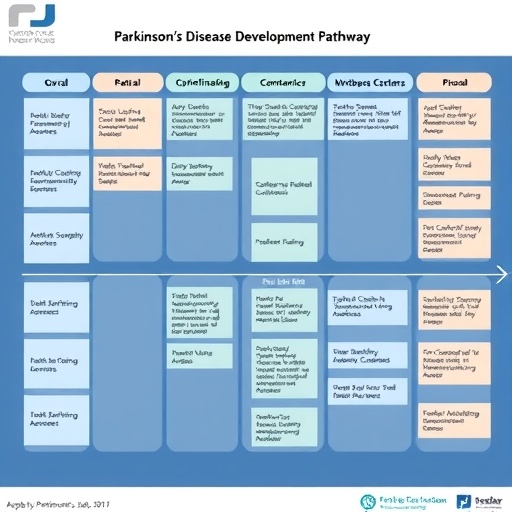
In a groundbreaking advancement poised to reshape the future of Parkinson’s disease treatments, researchers have meticulously charted the intricate developmental pathways underpinning therapeutic innovation for this debilitating neurodegenerative disorder. The exhaustive study, led by Dhruv, N.T., Robinson Schwartz, S., and Swanson-Fischer, C., analyzed the complex biological and molecular landscapes that current and future therapeutics must navigate, offering unprecedented insights into how interventions could be designed more effectively to halt or even reverse disease progression.
Parkinson’s disease, characterized by the gradual loss of dopaminergic neurons in the substantia nigra region of the brain, manifesting through tremors, rigidity, and impaired motor functions, remains a formidable challenge for medical science. Although symptomatic management has improved over the decades, no therapy to date robustly alters the underlying neurodegenerative trajectory. This pivotal research encapsulates the emerging paradigm shift, moving away from symptomatic treatment toward targeted biological modification of disease pathways.
The report notably underscores the role of alpha-synuclein protein aggregation as a critical pathological hallmark. By mapping the developmental path of therapeutics, the authors provide an extensive examination of efforts to inhibit or disaggregate alpha-synuclein fibrils using small molecules, monoclonal antibodies, and novel gene therapy approaches. These strategies aim to prevent the cytotoxic buildup that leads to neuronal cell death, a core driver of symptom progression.
Beyond addressing alpha-synuclein dynamics, the study expands its scope to include mitochondrial dysfunction and neuroinflammation, two additional axes of disease pathology. Importantly, the authors delve into the specific cellular signaling cascades and oxidative stress mechanisms implicated in dopaminergic neuron vulnerability. This holistic understanding paves the way for multi-target treatment designs, aiming to simultaneously modulate several pathological mechanisms, which could prove essential in achieving meaningful clinical outcomes.
A compelling focal point of the research is the utilization of cutting-edge technologies such as single-cell RNA sequencing and CRISPR-based gene editing models. These techniques allow for precise mapping of molecular changes during disease progression and provide platforms for rapid screening of candidate therapeutics. The study highlights how these tools enable the deconvolution of heterogenous cell populations and downstream effects, offering a clearer blueprint for intervention points.
The authors also place emphasis on the translational challenges encountered when moving from preclinical models to human trials. Through detailed analysis of pharmacokinetics, blood-brain barrier permeability, and immune system interactions, the research delineates the bottlenecks pharmaceutical development faces in delivering effective Parkinson’s therapies. Addressing these barriers is crucial, the authors argue, to avoid costly late-stage trial failures and expedite the arrival of viable treatments.
Innovative delivery systems, such as nanoparticle vehicles and viral vectors, are explored extensively as means to enhance drug targeting and sustained release within the central nervous system. These delivery modalities promise improved therapeutic indices by concentrating drug action where it is most needed while minimizing systemic side effects. The study’s insights drive home the importance of drug delivery engineering in the therapeutic development continuum.
Of particular note is the article’s discourse on patient stratification and personalized medicine approaches. By integrating genomic, proteomic, and clinical data, the researchers propose frameworks to classify Parkinson’s disease subtypes more accurately. Such stratification enhances the precision of therapeutic interventions, ensuring patients receive the most appropriate treatment based on their unique disease biology, significantly increasing the potential for successful outcomes.
Another transformative aspect covered in the research is the exploration of neuroprotective compounds derived from natural sources or synthetic analogs. These agents, often targeting antioxidative pathways or neurotrophic factors, offer hope for decelerating neuronal degeneration in early disease stages. The study draws attention to ongoing clinical trials evaluating the efficacy and safety profiles of these compounds, marking a burgeoning field within Parkinson’s drug development.
Importantly, the developmental trajectory analysis extends its view to regulatory considerations and the evolving landscape of clinical trial design. Adaptive trial frameworks, real-world data integration, and biomarker-driven endpoints are presented as crucial innovations to accelerate approval processes while maintaining rigor. The article posits that embracing these methodologies could significantly shorten the time to market for vital Parkinson’s interventions.
The collaborative nature of this research—uniting academic institutions, pharmaceutical companies, and patient advocacy groups—is highlighted as a key driver for progress. The authors advocate for enhanced data sharing and interdisciplinary synergy to surmount the multifactorial challenges posed by Parkinson’s disease. This cooperative model is presented as essential for translating complex molecular insights into tangible therapeutic advancements.
Digging deeper, the paper discusses emerging genetic therapies, including RNA interference and gene replacement strategies aimed at rectifying specific mutations linked to hereditary Parkinson’s forms. These cutting-edge avenues, while currently in early-phase development, hold promise for offering durable treatments that address root causes rather than downstream symptoms.
The study also elucidates the role of advanced imaging techniques, such as PET and MRI modalities, combined with novel radioligands in tracking therapeutic response and disease evolution in vivo. These imaging biomarkers provide critical real-time feedback to clinicians and researchers, fostering iterative refinement of treatment protocols and enhancing personalized care.
Finally, the article contemplates the broader socio-economic impact of Parkinson’s disease and the imperative for accessible, affordable therapies globally. By outlining this contextual framework, the authors reinforce the significance of their developmental mapping as more than a scientific exercise but as a cornerstone for improving patient quality of life on a worldwide scale.
This comprehensive mapping of Parkinson’s therapeutic development constitutes a landmark contribution to neurodegenerative disease research. It intricately weaves molecular biology, clinical science, and pharmaceutical innovation to outline a roadmap that could catalyze breakthroughs in treatment modalities. As the scientific community absorbs these insights, a new era in Parkinson’s therapeutics appears imminently on the horizon, promising hope for millions affected by this challenging disorder.
Subject of Research: Parkinson’s disease therapeutic development pathways
Article Title: Mapping the developmental path for Parkinson’s disease therapeutics
Article References:
Dhruv, N.T., Robinson Schwartz, S., Swanson-Fischer, C. et al. Mapping the developmental path for Parkinson’s disease therapeutics. npj Parkinsons Dis. 11, 313 (2025). https://doi.org/10.1038/s41531-025-01154-1
Image Credits: AI Generated
DOI: https://doi.org/10.1038/s41531-025-01154-1
Tags: alpha-synuclein protein aggregationbiological modification of diseasegene therapy in Parkinson’sinnovative Parkinson’s therapiesmolecular pathways in Parkinson’smonoclonal antibodies for neurodegenerationneurodegenerative disorder therapeuticsParkinson’s disease treatment developmentsmall molecules in Parkinson’s treatmentsymptomatic management of Parkinson’s diseasetargeting dopaminergic neuron losstherapeutic intervention strategies