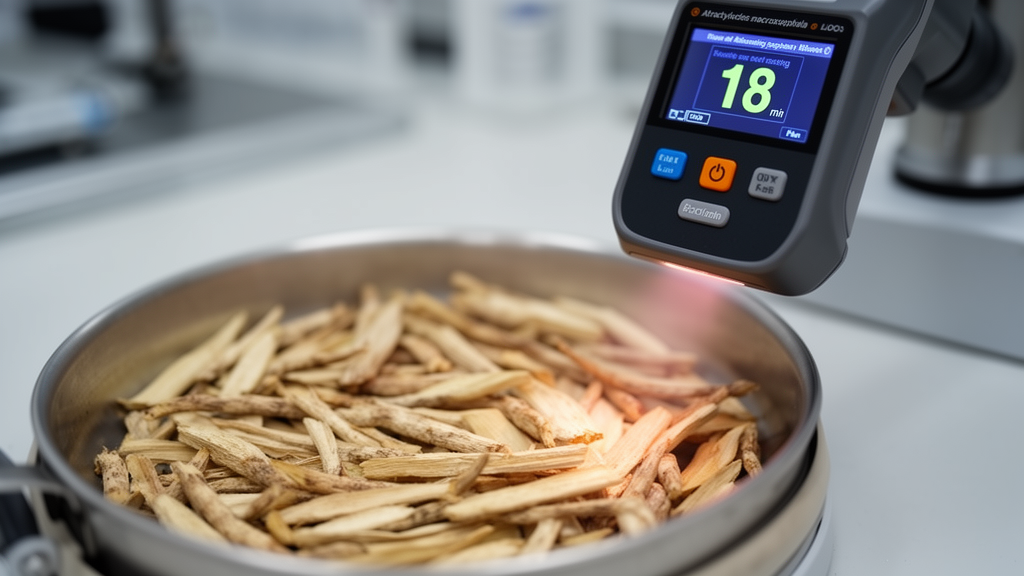
A multi-dimensional analytical study evaluating the thermal processing of Atractylodes macrocephala rhizomes has identified eighteen minutes at 280 degrees Celsius as a critical chemical and physical turning point. Operating an electromagnetic stir-frying drum on four-kilogram batches of authenticated botanical material, researchers tracked the dynamic metamorphosis that yields charred Atractylodes macrocephala, known in traditional Chinese practice as charred Baizhu. Rather than treating raw and charred herbal slices as binary states, the investigation mapped continuous changes in surface browning, internal chromaticity, macro hardness, cellular structure, volatile odor profiles, and non-volatile secondary metabolites across eight specific time intervals from zero to twenty-four minutes. The resulting analytical framework links traditional sensory criteria for proper herbal processing directly to measurable chemical markers.
The plant material, authenticated dried rhizomes of Atractylodes macrocephala within the Asteraceae family from Bozhou in Anhui Province, carries a historical record of folk culinary and medicinal applications in southern China, including traditional meat stews, vegetable preparations, and pork stomach soups designed to assist digestion. In regions such as the United States, Japan, and the United Kingdom, regulatory authorities have not classified the rhizome as a dual-purpose food and medicinal ingredient, restricting scientific inquiry primarily to isolated active compounds and therapeutic extracts. In traditional domestic practice, raw rhizomes are considered acrid and drying, motivating processing methods such as yellow stir-frying, bran stir-frying, soil stir-frying, and excipient-free charred stir-frying. In charred processing, slices undergo dry heating alone, generating aroma and structural changes exclusively through the thermal transformation of inherent botanical constituents.
Previous investigations of charred Atractylodes macrocephala relied heavily on discrete comparisons between raw and fully processed samples using standard chromatography or optimized isolated heating variables. To overcome these limitations, the research team implemented a time-resolved methodology using a numerically controlled electromagnetic stir-frying machine set at a continuous barrel temperature of 280 degrees Celsius, with temperature variability confined within ten degrees. Batches rotated at approximately ten revolutions per minute at an operating frequency of 25 Hertz. Samples weighing 500 grams were collected at intervals of zero, six, nine, twelve, fifteen, eighteen, twenty-one, and twenty-four minutes. Expert evaluation designated the untreated baseline as raw, slices heated up to fifteen minutes as under-processed, the eighteen-minute stage as properly processed, and slices heated for twenty-one to twenty-four minutes as over-processed specimens exhibiting carbonization and structural fragility.
Quantitative chromaticity analysis documented distinct visual transformations using standardized high-resolution digital photography and colorimeter measurements within a controlled darkroom environment. In the red, green, and blue color space, the red channel exhibited the steepest decline between fifteen and eighteen minutes, yielding an increased red-to-green-and-blue ratio that mirrored advancing browning. Internal powder color evaluated under the CIELab chromaticity system demonstrated that lightness values decreased steadily from 66.31 at baseline to 3.09 at eighteen minutes, before reaching 3.71 at twenty-one minutes and 3.91 at twenty-four minutes. Conversely, the total color difference relative to raw slices expanded to an absolute maximum of 187.08 at eighteen minutes. Yellow-blue chromaticity peaked at 85.21 at eighteen minutes, coinciding with a peak chroma value of 196.81, which established the eighteenth minute as the phase of maximum chromatic saturation.
Physical texture measurements and scanning electron microscopy clarified the structural breakdown occurring alongside external browning. Macro hardness testing using a texture analyzer configured with a three-point bend probe showed that structural resistance fell sharply from baseline through twelve minutes of heating, stabilized between fifteen and eighteen minutes, and dropped precipitously during the final over-processing window between twenty-one and twenty-four minutes. Scanning electron micrographs recorded at 2000 times magnification revealed that untreated rhizomes possessed dense, compact cellular matrices. Initial heating triggered cellular wall shrinkage as moisture evaporated rapidly. During intermediate roasting, continued dehydration combined with the thermal denaturation and cross-linking of native polysaccharides and proteins established a temporary macromolecular framework that provided mechanical crispness, before extreme temperatures caused chemical cleavage, structural collapse, and conversion into loose, brittle carbonaceous residue.
Aroma transitions were monitored dynamically using an array of fourteen metal oxide semiconductor electronic nose sensors in tandem with gas chromatography–mass spectrometry. Electronic nose sensor profiles, especially those responsive to nitrogen oxides, low-molecular-weight amines, furans, and volatile organic compounds, enlarged significantly during intermediate heating, peaking at eighteen minutes before declining at twenty-one minutes. Gas chromatography–mass spectrometry identified 55 volatile organic compounds across processing stages, comprising 27 alkenes, 8 aldehydes, 7 ketones, 3 esters, 2 alcohols, and 8 additional chemical classes. The sesquiterpene atractylon represented the most abundant volatile compound throughout roasting, maintaining relative contents between 30.65 percent and 43.68 percent, alongside prominent levels of gamma-elemene, valencene, and germacrene B.
Multivariate statistical modeling using orthogonal partial least squares-discriminant analysis established clear differentiation among heating intervals, demonstrating a cumulative explained variance of 0.944 and a predictive ability of 0.969 without statistical overfitting. Thirty-three differential volatiles with variable importance in projection scores exceeding 1.0, together with germacrene B, constituted 34 core compounds responsible for aroma divergence. Odor activity value calculations, defined as the ratio of volatile concentration to literature-derived sensory thresholds, highlighted 13 primary aroma contributors. Baseline samples were defined by floral, fresh, and woody notes from germacrene B, nonanal, and 2-phenylethanol. Intermediate roasting at eighteen minutes fostered substantial generation of pyrazines, including 2-ethyl-6-methylpyrazine, trimethylpyrazine, and 3-ethyl-2,5-dimethylpyrazine, which contributed nutty and roasted notes, alongside furan derivatives such as 5-hydroxymethylfurfural. Over-processed stages were marked by elevated levels of 5-methylfurfural associated with deep caramelization and pyrolysis.
Analysis of non-volatile constituents by ultra-performance liquid chromatography-quadrupole-time-of-flight mass spectrometry revealed major shifts across 33 differential chemical markers categorized predominantly into terpenoids, flavonoids, and phenylpropanoids. Principal component analysis indicated that the first two principal components captured 87.32 percent of total chemical variance, with eighteen-minute samples exhibiting the widest separation from baseline material. Early heating degraded heat-labile native compounds like atractylenolide V, while mid-stage processing between twelve and eighteen minutes induced marked accumulation of atractylenolide I, atractylenolide II, hesperetin, naringenin, and 5-hydroxymethylfurfural. These accumulations reflected multi-pathway cascades involving the oxidative conversion of atractylon into lactones, thermal hydrolysis of flavonoid glycosides into aglycones, and concurrent Maillard reactions, before extended heating triggered broader degradation of active lactones.
Statistical integration via Mantel testing and Pearson correlation analyses confirmed deep mathematical coupling between surface appearance, physical softening, and internal chemical reactions. Electronic nose responses correlated significantly with the burnt-aroma marker 5-methylfurfural (r = 0.68, p < 0.01) and with liberated flavonoid aglycones, including hesperetin (r = 0.88), naringenin (r = 0.87), and 4′,5,7-trimethoxyflavone (r = 0.84). Color parameters aligned closely with 5-hydroxymethylfurfural (r = 0.77), 5-methylfurfural (r = 0.76), and germacrene B (r = 0.65). Macro hardness correlated with 5-methylfurfural (r = 0.77) and hesperetin (r = 0.77). Furthermore, atractylenolide I and II demonstrated strong positive correlations with key pyrazines, including 2-ethyl-6-methylpyrazine and trimethylpyrazine (r = 0.83 to 0.87, p < 0.001), while correlating negatively with 2-phenylethanol and caffeic acid.
The study authors noted critical experimental boundaries, emphasizing that the chemical flavor designations rely on calculated odor activity values and published aroma descriptions rather than trained human sensory panel evaluations, and that absolute targeted quantification was not executed for every volatile constituent. Additionally, while the oxidative transformation of atractylon into atractylenolide lactones and the emergence of heterocyclic Maillard products provide a plausible molecular basis for the reduced acridity and digestive spleen-fortifying properties described in classical pharmacopeial texts, formal pharmacological confirmation remains the subject of ongoing laboratory investigations. Nonetheless, documenting the eighteen-minute thermal turning point delivers an objective multi-parameter foundation to support standardized quality control in commercial herbal processing.
Subject of Research: Thermal processing dynamics and chemical transformation of charred Atractylodes macrocephala
Article Title: Study on Changes in Apparent Properties and Key “Burnt‐Aroma” Components During the Processing of Charred Atractylodes Macrcephala Based on Multi‐Dimensional Characterization
Article References: Nui, H., Wei, R., Lu, T., Dong, Y., Liu, J., Wang, X., Zhong, G., & Zhu, J. (2026). Study on Changes in Apparent Properties and Key “Burnt‐Aroma” Components During the Processing of Charred Atractylodes Macrcephala Based on Multi‐Dimensional Characterization. Food Science & Nutrition, 14(11), Article e72518. https://doi.org/10.1002/fsn3.72518
Image Credits: AI Generated
DOI: 10.1002/fsn3.72518
Keywords: Atractylodes macrocephala, charred Atractylodes macrocephala, Baizhu, herbal processing, stir-frying, Maillard reaction, caramelization, pyrazines, atractylon, atractylenolide, 5-hydroxymethylfurfural, electronic nose, GC-MS, UPLC-Q-TOF-MS, chromaticity, texture analysis
News Source: Alan Morgan. (November 20, 2026). Charred Atractylodes Macrocephala Optimization Pinpoints Eighteen Minute Roasting Mark. Scienmag.