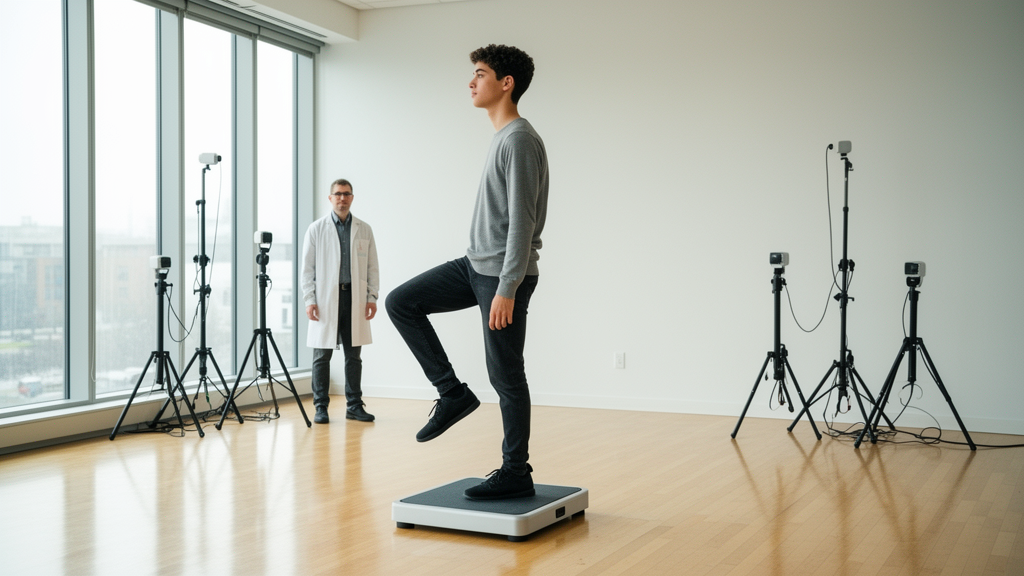
A cross-sectional investigation has revealed that cervical posture is independently linked to dynamic postural balance in young adults, demonstrating a more consistent association than either neck-related disability or smartphone addiction. Researchers examined the associations between forward head posture, neck pain, and smartphone addiction with dynamic postural control, while also comparing students with and without chronic neck pain. The findings indicate that alignment of the cervical spine accounts for a significant portion of variance in dynamic balance measurements, while other self-reported neck issues and device-use metrics did not maintain independent predictive relationships.
Although forward head posture, neck discomfort, and high smartphone utilization are increasingly observed across university cohorts, their distinct and independent contributions to dynamic balance performance have remained largely unclarified. To address this question, investigators designed a comparative study to determine whether structural alignment metrics or subjective pain and addiction measures serve as stronger indicators of dynamic stability.
The study protocol evaluated 83 university students categorized into two specific groups based on their clinical presentation: 35 participants diagnosed with chronic neck pain and 48 asymptomatic control individuals without chronic pain. By contrasting these two cohorts, the investigation sought to clarify whether the presence of persistent neck discomfort alters the functional relationship between structural head alignment and dynamic balance execution during physical reaching assessments.
Data collection involved standardized clinical and physical assessments to capture posture, balance, and subjective symptoms. Dynamic balance was assessed using the Y-Balance Test. Forward head posture was evaluated using the craniovertebral angle. Subjective neck symptoms and related functional interference were tracked using the Visual Analog Scale for pain intensity and the Neck Disability Index, while smartphone engagement was evaluated using the Smartphone Addiction Scale–Short Version.
Analysis of group differences demonstrated that participants presenting with chronic neck pain exhibited significantly higher pain intensity, higher disability ratings on the Neck Disability Index, and higher scores on the Smartphone Addiction Scale–Short Version, with all differences reaching statistical significance at p ≤ 0.005. Furthermore, students suffering from chronic neck pain showed significantly smaller craniovertebral angles (p < 0.001), indicating more pronounced forward head posture, alongside reduced dominant posteromedial reach distances (p = 0.007) and lower overall dominant composite scores on the Y-Balance Test (p = 0.033).
Bivariate evaluations incorporating false discovery rate corrections identified divergent correlation patterns between the study groups. Among asymptomatic participants without chronic neck pain, craniovertebral angle values correlated significantly with both dominant composite reach scores (ρ = 0.622, p < 0.001) and non-dominant composite reach scores (ρ = 0.610, p < 0.001). Conversely, these robust correlation patterns between cervical posture angles and dynamic reach performance were not observed to be statistically significant within the chronic neck pain cohort after false discovery rate adjustment.
Hierarchical regression modeling demonstrated that introducing postural and subjective metrics substantially improved the explanation of dynamic balance performance. Specifically, incorporating craniovertebral angle, Neck Disability Index, and smartphone addiction scores significantly boosted the explained variance for dominant reaching performance (ΔR² = 0.216, p < 0.001) and non-dominant reaching performance (ΔR² = 0.213, p < 0.001). In these fully adjusted final regression equations, craniovertebral angle emerged as an independent predictor of dynamic performance, demonstrating standardized coefficients of β = 0.494 for dominant and β = 0.483 for non-dominant composite scores (both p < 0.001).
Further exploratory adjustments demonstrated that additional consideration of daily smartphone use duration did not produce significant contributions to the regression models. Similarly, interaction terms evaluating whether the relationship between craniovertebral angle and dynamic reach differed across chronic neck pain status did not reach statistical significance. The researchers concluded that direct physical assessment of cervical posture offers informative insights into dynamic postural control in young adults, highlighting posture as a more dependable indicator than self-reported disability or mobile device usage scores.
Subject of Research: Association of cervical posture, neck pain, and smartphone addiction with dynamic balance in university students
Article Title: Neck pain, forward head posture, smartphone addiction, and dynamic postural control in university students: a cross-sectional study
Article References: Erbay, B., Aydın, A., Mermerkaya, G., Bayhan, M. S., & Sevim, M. (2026). Neck pain, forward head posture, smartphone addiction, and dynamic postural control in university students: a cross-sectional study. BMC Musculoskeletal Disorders. https://doi.org/10.1186/s12891-026-10751-x
Image Credits: AI Generated
DOI: 10.1186/s12891-026-10751-x
Keywords: cervical posture, forward head posture, dynamic postural control, Y-Balance Test, craniovertebral angle, chronic neck pain, university students, smartphone addiction, Neck Disability Index, Smartphone Addiction Scale, postural balance, biomechanics, cross-sectional study, musculoskeletal disorders, Visual Analog Scale, physical therapy
News Source: Ophelia Keating. (November 13, 2026). Cervical Posture Predicts Dynamic Postural Control in University Students. Scienmag.