The Future Circular Collider (FCC) feasibility study has concluded with the development of a specific, geolocalised territorial implementation scenario for a 91-kilometer underground ring in France and Switzerland. Published in EPJ Research Infrastructures, the brief report details the iterative process used to balance scientific objectives with environmental, societal, and economic constraints. The study confirms that the proposed infrastructure is technically feasible and environmentally compatible, providing a foundation for the formal authorisation processes required in both host states. This phased programme is designed to address major open questions in particle physics through two complementary facilities: an electron–positron collider (FCC-ee) followed by a hadron collider (FCC-hh).
The core of the FCC programme is a shared underground infrastructure that will host both collider stages sequentially. The reference layout consists of a quasi-circular tunnel approximately 90.7 kilometers long, situated deep beneath the surface to minimize environmental impact. The tunnel features alternating straight and curved sections, with eight access sites spaced at regular intervals of about 11.33 kilometers. These surface sites will serve as shafts for construction, equipment installation, and technical services such as electrical power, cooling water, and ventilation. The design allows for four interaction points where particle beams intersect, enabling the placement of scientific experiment detectors.
Developing this reference scenario involved a rigorous multi-criteria analysis of approximately 100 different layout candidates between 2018 and 2025. Researchers utilized a “genetic” approach, testing initial scenario candidates against three primary pillars: scientific excellence performance, territorial compatibility, and project risk and cost characteristics. The methodology followed the legally required “Avoid–Reduce–Compensate” framework, aiming for socio-economic and environmental net-positive performance. This iterative process allowed the team to discard unfit scenarios and refine promising variants, ultimately selecting the layout with the highest likelihood of territorial compatibility and alignment with environmental regulations.
The physical placement of the collider is deeply integrated into the existing CERN infrastructure and the surrounding geography. The new ring would be connected to the existing CERN particle accelerator complex via underground beam transfer tunnels, passing beneath Lake Geneva, the Arve, and the Rhône rivers. One surface site is located in the canton of Geneva in Switzerland, while the remaining seven sites are situated in the French departments of Ain and Haute-Savoie. This transnational configuration necessitates complex coordination between French and Swiss administrative systems, legal traditions, and environmental permitting frameworks. The study highlights that aligning authorisation timelines and regulatory expectations between an EU member state and a non-EU country requires sustained and structured coordination.
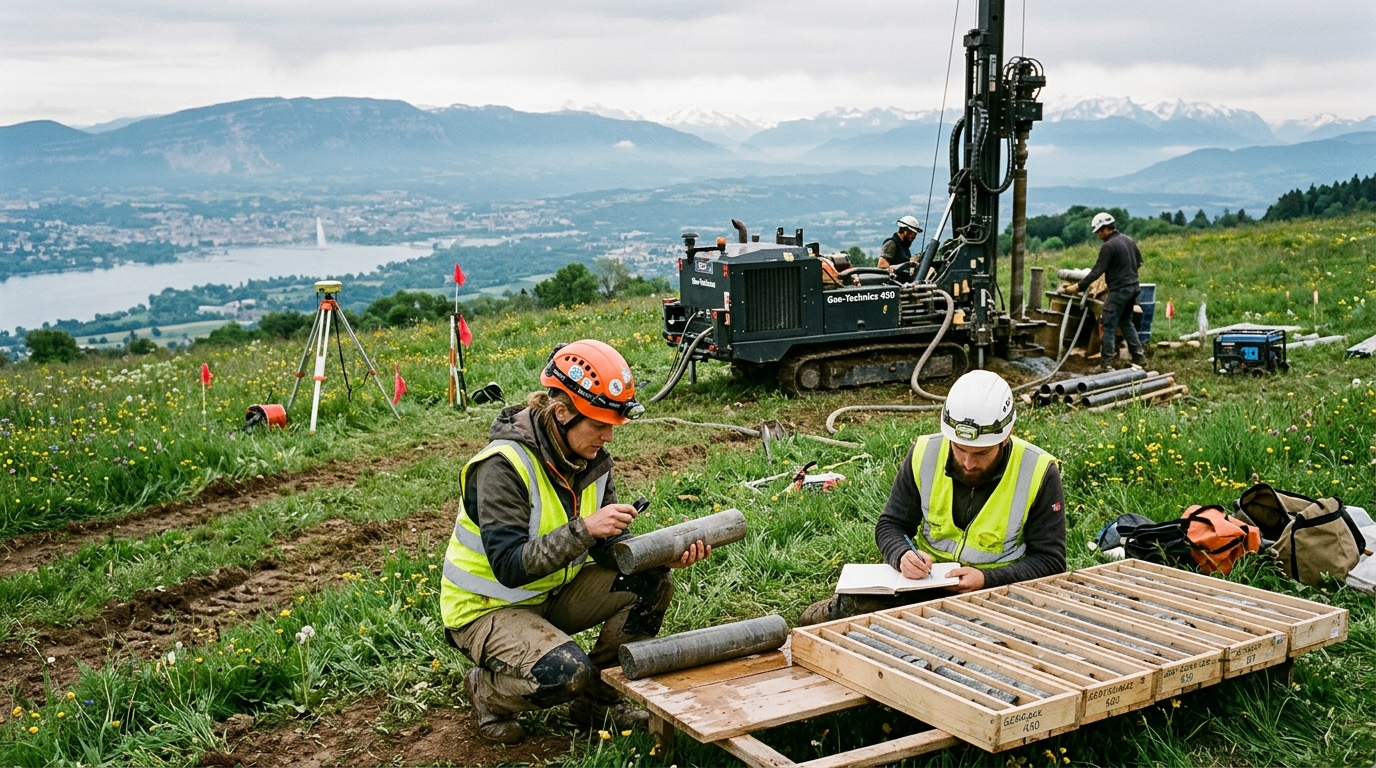
Environmental diagnostics played a central role in the scenario development, with subsurface modelling and field investigations covering approximately 600 hectares. These investigations informed the placement of surface sites to avoid sensitive areas such as protected agricultural fields, forests, nature protection zones, and high-pressure aquifers. The team also considered geological constraints, excluding areas with unstable ground, karst formations, or major fault lines. In France, the scenario was tested against ecological inventories and Natura 2000 zones, while in Switzerland, comparable protection zones at cantonal and federal levels were respected. This comprehensive environmental assessment serves as a prerequisite for the formal environmental impact assessment required for project authorisation.
Socio-economic performance was assessed using independent expert economics organisations following established EU and French national guidelines. The analysis integrated full costs, including quantifiable negative externalities such as greenhouse warming potential, noise, traffic, and loss of biodiversity. The study found that the net present value of the project is at least 3.9 billion Swiss francs, with a benefit–cost ratio of at least 1.2. Additionally, the residual asset value of the infrastructure was quantified to be in the order of 55% of the total FCC-ee investment costs. This residual value, estimated at 7.9 billion Swiss francs undiscounted, represents avoided costs for a subsequent hadron collider, although it was not included in the core benefit–cost calculations due to the lack of a formal decision to proceed with the second stage.
Stakeholder engagement has been a vital component of the feasibility study, involving municipalities, environmental experts, infrastructure operators, and civil society. Early dialogue with public authorities and local communities supported the identification of constraints, opportunities, and synergies. In France, the “Commission Nationale du Débat Public” was involved in 2025 to provide guidance for a nation-wide formal public consultation process scheduled for 2026. In Switzerland, a voluntary equivalent process is underway, reflecting the legal requirements of the Aarhus Convention on public participation in environmental decision-making. These consultations aim to establish a social licence based on transparency, openness to external requirements, and mutual trust between the project team and the local population.
Despite the high level of readiness achieved, the study identifies several challenges that must be addressed during the preparatory phase. Regulatory frameworks in both host states continue to evolve, with new land-use policies such as France’s zero net land artificialisation objective significantly constraining the conversion of agricultural or natural land. The reference scenario foresees the re-creation of protected agricultural zones through the transplantation of fertile topsoil to low-quality land, a process that requires extensive negotiations with landowners. Additionally, uncertainties remain regarding subsurface water conditions at some surface-site locations, which may affect authorisation timelines. Timely, site-specific investigations are required to rule out water presence or define technical mitigation measures.
The architectural design of the surface sites is intended to create societal added value through landscape integration and community benefits. A toolkit developed with architecture partners incorporates concepts such as the reuse of excavated soil, green roofs, and ecological construction materials. The design includes visitor centres, educational spaces, and recreational areas, some of which could be powered by residual heat from the particle collider cooling systems. This approach aims to foster local synergies and enhance regional vitality, demonstrating a commitment to sustainable territorial development. The costs for these innovative architectural approaches have been estimated to be compatible with the established project cost envelopes.
The feasibility study concludes that the FCC programme is ready to enter a preparatory phase leading towards construction authorisation within the coming decade. This phase will involve detailed subsurface investigations, the development of a detailed construction project plan, and the coordination of cross-border administrative frameworks. The European Strategy for Particle Physics Update 2026 has recommended the FCC-ee as the preferred option for the next flagship collider at CERN. The study provides a robust basis for this recommendation, demonstrating that the project can be conceived and implemented with sustainability as a feasibility enabler from the onset. The documented reference scenario serves as a model for how large-scale research infrastructures can be developed in complex transnational environments.
As the project moves forward, the focus will shift to securing legal rights on land plots and subsurface volumes, which may involve formal procedures such as public declarations of utility in France or sector plans in Switzerland. The study notes that while about 60% of land acquisitions can be resolved amicably, remaining cases may require lengthy expropriation processes. The cumulative effect of associated infrastructure projects, including high-voltage grid connections and road improvements, adds complexity to the approval process. However, the proactive engagement with stakeholders and the rigorous environmental and socio-economic assessments provide a strong foundation for navigating these challenges and securing the necessary authorisations for this ambitious scientific endeavour.
Subject of Research: Territorial implementation and feasibility of the Future Circular Collider at CERN
Article Title: Future Circular Collider Territorial Implementation
Article References: Gutleber, J., & Boillon, P. (2026). Future Circular Collider Territorial Implementation. EPJ Research Infrastructures, 10(1), Article 6. https://doi.org/10.1007/s41781-026-00159-6
Image Credits: AI Generated
DOI: 10.1007/s41781-026-00159-6
Keywords: Future Circular Collider, CERN, Particle Physics, Environmental Impact, Transnational Infrastructure, Socio-economic Assessment, Feasibility Study, France, Switzerland, Future, Circular, Collider
News Source: Katie Riggs. (November 8, 2026). CERN Maps 91-km Future Circular Collider Path. Scienmag.