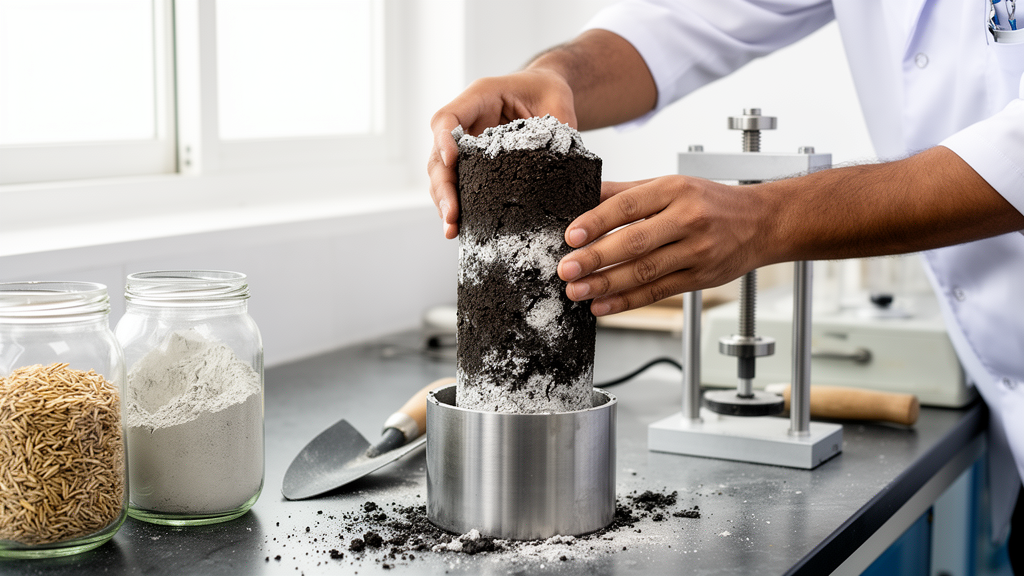
Peat is one of the most difficult soils on which to build. It is highly compressible, holds large amounts of water, and offers little shear strength, so structures founded on it can settle or fail without prior ground improvement. A new laboratory study has examined whether a locally available agricultural waste could help solve this problem for one particular Indian peat, and the results show a dramatic strengthening effect when rice husk ash is combined with ordinary Portland cement.
Researchers collected peat from Ziro Valley in Arunachal Pradesh, a region of India whose peat deposits had not previously been studied for stabilization. The soil was excavated from a depth of 0.5 to 1 metre, representing the highly organic OH layer identified in the profile, which was examined in a 2 metre by 2 metre pit dug to a depth of 4 metres in January, when the groundwater table stood at roughly 2 metres. The parent soil had a natural water content of 67.3%, a specific gravity of 1.33, and an organic matter content of 35.76%. Its optimum moisture content was 29.88% and its maximum dry density 13.47 kilonewtons per cubic metre, values that reflect the soil’s highly compressible character. Grain size analysis showed a largely fine-grained material, with 78.59% clay, 4.94% silt, and 16.47% sand, and about 100% of the soil passing the 4.75 millimetre sieve.
The team, led by Nabam Jumsi, Ajanta Kalita, and Ajay Bharti, treated the peat with Ordinary Portland Cement of grade 53 as the primary stabilizer and rice husk ash as a secondary one. The ash was produced by burning locally collected rice husks in a muffle furnace for one hour at 600 degrees Celsius, a temperature that previous studies have shown yields ash with high specific surface area and a substantial amorphous silica fraction. X-ray diffraction confirmed that the ash was rich in silica present in an amorphous state, visible as a broad diffuse region on the diffraction pattern. Cement dosages of 5%, 10%, and 15% by dry weight of soil were combined with rice husk ash contents of 6%, 8%, and 12%, with all percentages calculated on the dry weight of the parent peat.
Each mixture was characterized using the Standard Proctor compaction test following IS 2720 (Part 7):1992, and unconfined compressive strength specimens were compacted at each mix’s maximum dry density and optimum moisture content. Specimens were cured for 0, 7, 14, and 28 days in a sealed desiccator maintained at 27 plus or minus 2 degrees Celsius with relative humidity above 95%, wrapped in polyethylene film to minimize moisture loss. Three specimens were tested for each mix ratio and curing time, and specimens showing cracks, segregation, or improper molding were replaced. The strength testing followed IS 2720 (Part 10)-1991, with the reported value for each condition being the mean of three readings.
The compaction results showed a consistent pattern: adding rice husk ash raised the optimum moisture content and lowered the maximum dry density, an effect the authors attribute to the ash’s porous, lightweight particles, which absorb more water and reduce measured density. Importantly, the researchers caution that this reduction in compaction density is not a sign that stabilization has become less effective, because compaction density and the microstructure that develops during curing are separate properties. The fine ash particles can fill voids between soil grains, while the calcium from cement reacts with the reactive silica in the ash to form additional cementitious products such as calcium silicate hydrate, so mechanical behavior improved even where dry density fell.
Strength results told a clear story. The untreated peat reached an unconfined compressive strength of 189 kilopascals after 28 days of curing. With cement alone, 28-day strengths rose to 235 kilopascals at 5% cement, 432 kilopascals at 10%, and 528 kilopascals at 15%. Rice husk ash by itself produced only modest gains, with 6%, 8%, and 12% ash yielding 198, 212, and 238 kilopascals respectively at 28 days, indicating that on its own the ash has a weak stabilizing ability for this peat. The combination, however, was far more powerful: after 28 days, mixtures containing 12% ash with 5%, 10%, and 15% cement reached 586, 672, and 819 kilopascals respectively. The optimum mixture of 15% cement plus 12% rice husk ash delivered 819 kilopascals, an improvement of 333% over the untreated soil.
The strength gain was accompanied by a change in failure behavior. Treated specimens generally showed a more distinct and abrupt failure response than the untreated peat, indicating increased stiffness and a tendency toward more brittle behavior as cement content and curing duration increased. The authors link this transition to the development of cementitious bonds within the soil matrix: cement hydration produces calcium silicate hydrate and calcium hydroxide, which bond particles together and raise stiffness, while continued pozzolanic reactions between the ash’s amorphous silica and the calcium hydroxide generate further cementitious products. The authors also note a limitation of their interpretation: moisture content and matric suction were neither controlled nor measured, and for the untreated soil, whose strength varied somewhat with curing duration, the change could not be attributed solely to an aging effect because pore-water pressure, organic matter degradation, and microstructural changes were not directly measured.
Microstructural analysis provided physical evidence for the mechanical findings. Scanning electron microscopy of the untreated peat revealed a very porous structure with interconnected pores, loose particles, and partly decomposed organic fibers. In the stabilized optimum sample after 28 days of curing, the micrograph showed a dense, compact matrix in which particles were tightly bound by hydrates; calcium silicate hydrate gel and other cementitious products had filled pores, lowered the void ratio, and created a more homogeneous structure, with organic fibers encased in the cementitious matrix. X-ray diffraction of the ash identified quartz, cristobalite, calcite, hematite, and mullite, with the broad diffuse area indicating amorphous silica as the major constituent. In the stabilized mixture, the diffraction pattern showed more prominent quartz and calcite peaks along with calcium silicate hydrate, which the authors interpret as evidence of pozzolanic reaction between cement and the silica-rich ash, producing denser particle bonding.
The study’s authors frame the work as the first investigation of peat stabilization in Arunachal Pradesh, addressing a gap left by earlier research that focused on peats from Assam, Tripura, and Manipur. They emphasize that using rice husk ash, an agricultural and industrial by-product that India produces in large quantities, as a partial supplement to cement could reduce the environmental burden associated with high cement demand in ground improvement. The findings also come with caveats the authors themselves raise: oven drying at 105 degrees Celsius may alter the characteristics of highly organic soils by removing volatile organic constituents and inducing structural changes, so the results should be interpreted with that possible alteration in mind, and the extent of improvement in stabilized peats generally depends on organic content, initial water content, pH, fiber content, binder dosage, and curing conditions. Within those limits, the laboratory results demonstrate that combining cement with a locally sourced silica-rich ash can substantially strengthen a weak organic soil, at least under the controlled curing conditions of this experimental program.
Subject of Research: Laboratory stabilization of peat soil from Ziro Valley, India, using cement and rice husk ash
Article Title: Stabilization of peat soil using cement and Rice Husk Ash: strength and microstructural evaluation
Article References: Jumsi, N., Kalita, A., & Bharti, A. (2026). Stabilization of peat soil using cement and Rice Husk Ash: strength and microstructural evaluation. Discover Civil Engineering, 3(1), Article 263. https://doi.org/10.1007/s44290-026-00658-w
Image Credits: AI Generated
DOI: 10.1007/s44290-026-00658-w
Keywords: peat soil, soil stabilization, rice husk ash, cement, unconfined compressive strength, Ziro Valley, Arunachal Pradesh, geotechnical engineering, X-ray diffraction, scanning electron microscopy, pozzolanic reaction, construction materials
News Source: Alan Morgan. (October 28, 2026). Cement and Rice Husk Ash Transform Weak Indian Peat into a Stronger Construction Soil. Scienmag.