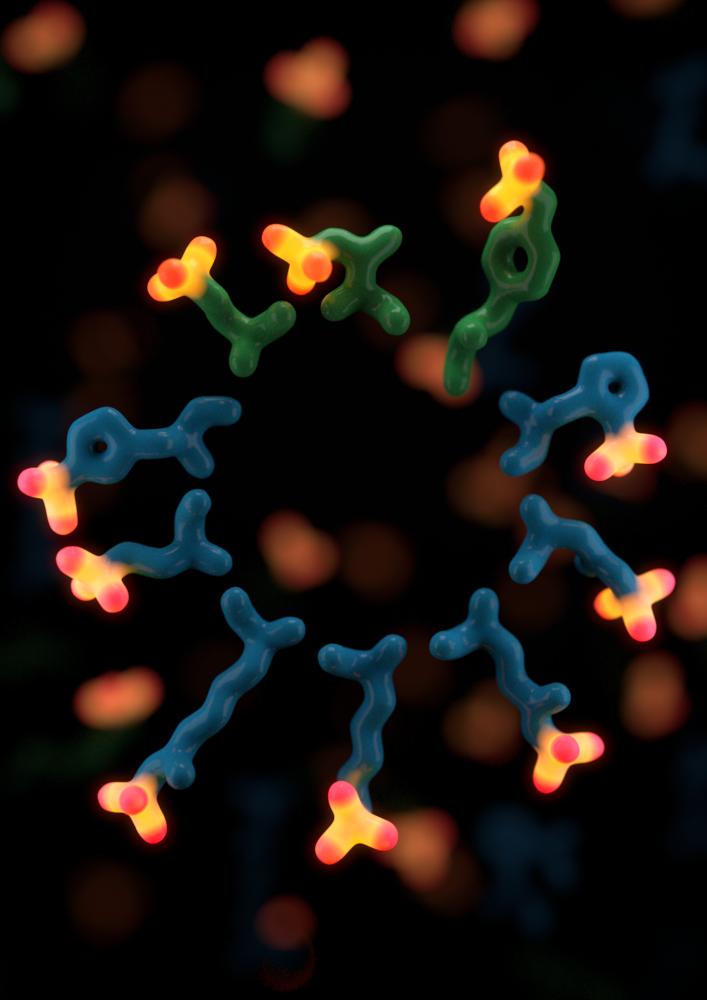
Credit: Claire E. Eyers, University of Liverpool; Jeroen Claus, Phospho Biomedical Animation
Researchers at the University of Liverpool have made a major breakthrough in the field of cell signalling.
In humans, signalling in cells normally regulates cell growth and repair. However, abnormal cell signalling contributes to many diseases, including cancer and neurodegeneration. Therefore, identifying specific proteins that control cell signalling in healthy and disease states could help accelerate the discovery of disease biomarkers and drug targets.
Using a new analytical workflow involving mass spectrometry, a team from the university’s Department of Biochemistry led by Professor Claire Eyers has shown that the phenomenon of protein modification (phosphorylation) in cell signalling is far more diverse and complex than previously thought. This study, published in The EMBO Journal, opens up a whole new area for bioscience and clinical researchers to explore.
Protein phosphorylation, which involves the addition of phosphate groups to proteins, is a key regulator of protein function, and defining site-specific phosphorylation is essential to understand basic and disease biology. In vertebrates, research has primarily focused on phosphorylation of the amino acids serine, threonine and tyrosine. However, mounting evidence suggests that phosphorylation of other ‘non-canonical’ amino acids also regulates critical aspects of cell biology.
Unfortunately, standard methods of characterisation of protein phosphorylation are largely unsuitable for the analysis of these novel types of non-canonical phosphorylation. Consequently, the complete landscape of human protein phosphorylation has, until now, remained unexplored.
This study reports on a new phosphopeptide enrichment strategy, which permits identification of histidine, arginine, lysine, aspartate, glutamate and cysteine phosphorylation sites on human proteins by mass spectrometry-based phosphoproteomics.
Remarkably, the researchers found that the number of unique ‘non-canonical’ phosphorylation sites is approximately one-third of the number of sites of phosphorylation observed on the more well-studied serine, threonine and tyrosine residues.
Lead researcher Professor Claire Eyers, Director of the Centre for Proteome Research in the Institute of Integrative Biology, said: “The novel non-canonical phosphorylation sites reported in this resource are likely to represent only the tip of the iceberg; identifying the diverse phosphorylation landscape likely to exist across vertebrate and non-vertebrate organisms is an important challenge for the future.
“The diversity and prevalence of multiple non-canonical phosphorylation sites raises the question of how they contribute to global cell biology, and whether they might represent biomarkers, drug targets or anti-targets in disease-associated signalling networks.
“The mass-spectrometry-based analytical workflow that we have developed will allow scientists from around the world to define and understand regulated changes in these novel types of protein modifications in a high throughput manner, which we have demonstrated are widespread in human cells.”
###
The research is featured on the front cover of the latest edition of The EMBO Journal.
The study was supported by funding from the Biotechnology and Biological Sciences Research Council (BBSRC) and North West Cancer Research.
Media Contact
Nicola Frost
[email protected]
Original Source
https:/
Related Journal Article
http://dx.