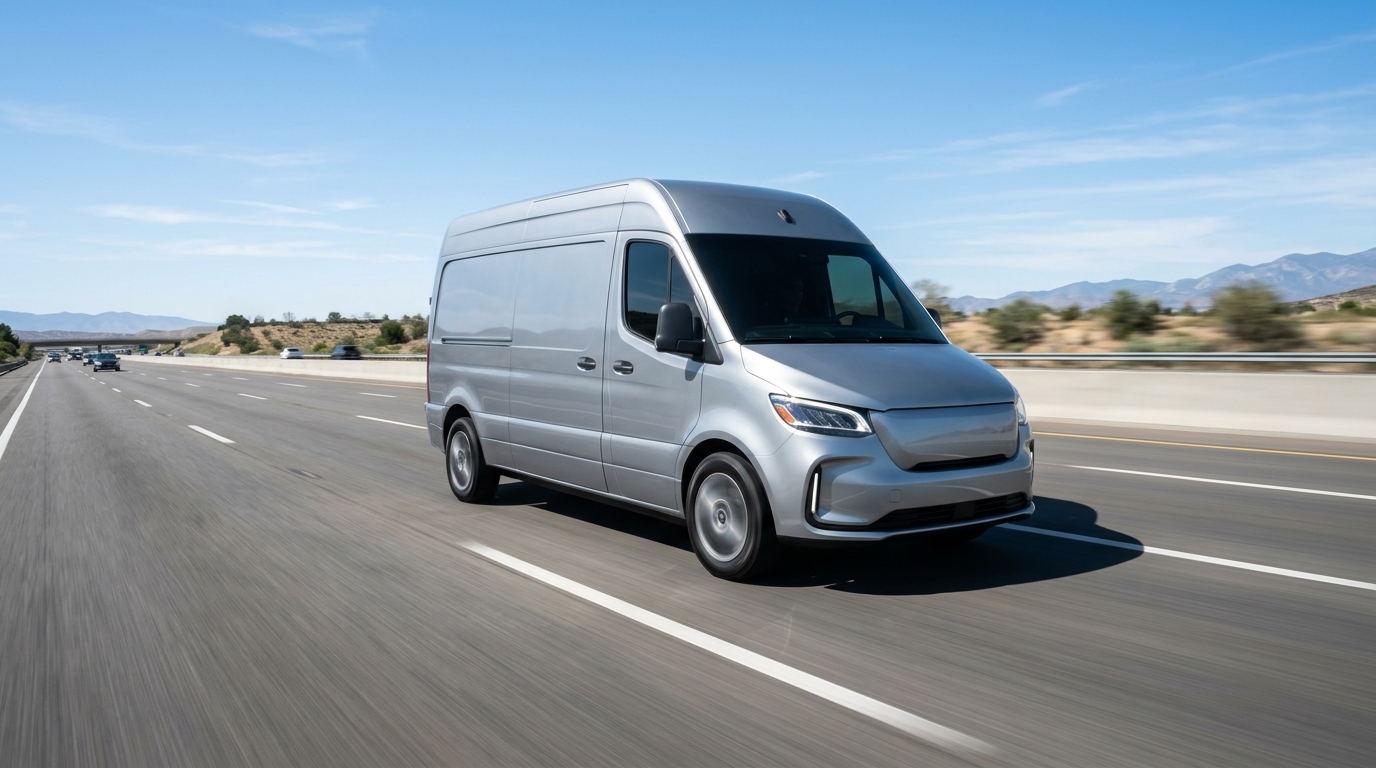
A newly published investigation introduces a causal machine learning framework to evaluate how vehicle speed directly influences energy consumption and driving range in electric cargo vehicles. Using telemetry from a Musoshi Pop-Up Mini electric commercial vehicle, the study shifts electric mobility analytics from observational correlations toward intervention-aware decision models. Existing range estimation tools correlate observed speeds with battery depletion, but they cannot determine whether altering velocity actively changes energy demand under shifting operational circumstances. To resolve this limitation, researchers constructed an analytical pipeline combining structural causal modeling with orthogonal Double Machine Learning, treating driving speed as an actionable intervention rather than a passive predictive variable. By deploying this causal framework, the authors quantified population-level average treatment effects alongside conditional heterogeneous responses across varying driving conditions. The resulting empirical insights demonstrate a statistically stable segment-level causal relationship between speed and energy use, providing a reliable foundation for range-aware control algorithms and smart energy management.
The authors formulated their methodology to overcome a major conceptual limitation in current electric vehicle analytics, where predictive accuracy has overshadowed decision-relevant understanding. Standard predictive systems based on regression, ensemble architectures, or deep learning effectively capture complex associations between telemetry parameters and energy use, but they remain fundamentally correlational. Because conventional pipelines treat vehicle speed merely as an explanatory feature, they cannot answer counterfactual questions regarding how active speed control alters energy efficiency in automated systems. In practical operational settings, including eco-driving assistance, adaptive cruise control, and energy-aware routing platforms, vehicle systems require interventional insights to determine the consequences of deliberate velocity changes. Confounding variables such as road topography, ambient temperature, and cargo mass simultaneously influence speed choices and power requirements. Without formal causal identification to untangle these intertwined factors, standard associational models risk providing biased guidance when applied to real-time control and energy optimization.
To evaluate the proposed framework on physical hardware, empirical testing was executed on a two-kilometer route located at Eskisehir Osmangazi University Campus in Turkey. The test vehicle was a Musoshi Pop-Up Mini electric cargo vehicle, a compact platform suited for short-distance logistics and commercial operations. The experimental dataset comprised thirty-five complete trips conducted under three predefined target speed regimes of fifteen, twenty-five, and thirty-five kilometers per hour. Testing spanned both summer and winter seasons, including twelve journeys recorded in summer and twenty-three trips gathered during winter. Furthermore, experiments evaluated two distinct payload conditions: an unloaded state at seven hundred kilograms and a loaded state at one thousand and fifty kilograms. Runs covered forward and return directions across campus terrain, introducing natural slope variability while preserving a structured setting that enabled precise causal identification without the extreme confounding noise encountered in uncontrolled urban transit.
Data preparation began with rigorous sensor synchronization and spatial discretization to guarantee consistency across vehicle telemetry subsystems. Diverse sensor streams recording temporal coordinates, battery cell dynamics, power electronics, motor parameters, and driving controls were synchronized to a uniform one-second sampling frequency, with missing observations handled through linear interpolation. To capture localized driving behavior, each two-kilometer trip was partitioned into discrete fifty-meter route segments. Segment energy consumption was calculated from battery state-of-charge changes relative to the vehicle’s fifteen point six kilowatt-hour battery capacity. This calculation yielded total energy used per fifty-meter segment in watt-hours, naturally incorporating energy recovered during regenerative braking. Segments from individual runs were then merged into an analytical dataset retaining trip and segment identifiers for downstream causal modeling.
A critical phase in the study was formulating a domain-informed Directed Acyclic Graph that mapped physical causal dependencies and identified potential confounding pathways. Drawing upon electric vehicle dynamics, the authors designated average road slope, vehicle mass, and outdoor temperature as upstream confounders simultaneously influencing vehicle speed and energy consumption. Crucially, factors like acceleration and battery state of charge were excluded from the conditioning adjustment set. Within the causal graph, acceleration and state of charge represent intermediate variables or dynamic system states affected by speed before influencing energy consumption. Adjusting for these post-treatment mediators would induce conditioning bias, distorting the estimated causal effect. By restricting the adjustment set strictly to upstream physical confounders, the authors satisfied standard identification criteria: conditional ignorability, positivity across observed speed regimes, consistency, and the stable unit treatment value assumption, ensuring the structural validity of subsequent causal effect estimation.
To execute causal estimation without imposing restrictive parametric constraints, the researchers integrated the DoWhy framework with EconML’s LinearDML estimator under an orthogonal Double Machine Learning structure. Double Machine Learning addresses regularization bias and model selection confounding by orthogonalizing the treatment and outcome variables via auxiliary nuisance models. The team evaluated multiple nuisance model configurations, including regularized Ridge Regression, radial basis function Support Vector Regression, Random Forest Regression, Gradient Boosting Regression, and hybrid pairings such as Support Vector Regression or Gradient Boosting combined with Ridge models. Hyperparameters were optimized via grid searches with five-fold grouped cross-validation based on trip identifiers, ensuring that segments from the same journey never appeared simultaneously in training and validation folds. Third-degree polynomial featurization was incorporated within the LinearDML estimator to model potential nonlinear treatment heterogeneity, while asymptotic inference procedures provided robust confidence intervals for the derived causal parameters.
Evaluating the population-level Average Treatment Effect revealed consistently negative values across all nuisance specifications, with point estimates ranging from minus zero point zero two five to minus zero point zero seven six watt-hours per unit increase in speed over a fifty-meter segment. While a negative coefficient might seem counterintuitive, the authors clarified that this outcome stems directly from segment-level spatial aggregation rather than genuine efficiency gains at higher velocities. Over a fixed fifty-meter segment, traversal duration decreases inversely with vehicle speed. Although vehicle power demand rises at higher speeds due to aerodynamic drag and motor loads, the sharp decrease in travel time dominates energy accumulation over that fixed distance, resulting in lower total energy consumption per segment. Expressed as energy per unit distance, the physical relationship conforms to expected principles. Ninety-five percent confidence intervals across all tested nuisance learners consistently excluded zero, verifying that the observed marginal speed effect is statistically significant and robust across diverse model architectures.
To confirm that the estimated causal signal was not an artifact of model specification or spurious correlation, the authors conducted comprehensive robustness diagnostics. A placebo refutation test replaced actual vehicle speeds with a randomly shuffled treatment variable; the resulting placebo effect distribution centered tightly around zero, demonstrating that the pipeline does not manufacture artificial effects in the absence of a genuine signal. Sampling stability analysis across repeated eighty percent random data subsamples demonstrated that the negative effect and its magnitude remained stable, indicating that specific trips did not drive the conclusions. Overlap and support diagnostics through treatment model residuals and observed-versus-predicted speed plots confirmed sufficient common support across the covariate space without severe extrapolation. Finally, sensitivity checks comparing Ridge nuisance specifications across different regularization penalties showed near-perfect one-to-one agreement along the diagonal line, proving that the causal conclusions are inherently supported by the underlying data rather than sensitive hyperparameter tuning.
Expanding the analysis to heterogeneity, Conditional Average Treatment Effects ranged from minus zero point four five five to zero point three five eight watt-hours per segment across differing operating conditions. Partial Dependence Plots and Individual Conditional Expectation curves identified road slope as the primary moderator of treatment effect heterogeneity. Uphill gradients substantially intensified the negative marginal segment effect due to increased traction power requirements, whereas downhill segments exhibited muted speed sensitivity. In contrast, outdoor temperature and vehicle mass showed secondary, weaker modulation; payload variations between seven hundred and one thousand and fifty kilograms affected baseline power demand but exerted minimal influence on marginal speed sensitivity. The authors translated these energy effects into remaining driving range via physics-based equations incorporating a five percent state-of-charge safety buffer. This conversion showed that the observed conditional variations equate to roughly plus or minus three point five meters of driving range per fifty-meter segment, offering directly interpretable operational metrics for range management.
While demonstrating the utility of intervention-aware modeling, the researchers noted several key experimental and methodological limitations. Data collection was restricted to a single two-kilometer campus track using one light electric cargo vehicle model, which limits immediate generalization to broader urban logistics and commercial highway networks. Furthermore, although the causal identification strategy accounted for road slope, vehicle mass, and ambient temperature, unobserved factors such as wind resistance, traffic density, and road surface roughness were not recorded in the telemetry. The study also relied on discretized seasonal temperature values and fixed payload states, while segment-level formulation did not explicitly capture longitudinal temporal dependencies across consecutive segments within a trip. Ultimately, this research demonstrates that integrating causal machine learning into vehicle telemetry provides actionable, interpretable insights essential for next-generation eco-driving systems and intelligent electric vehicle control.
Subject of Research: Causal machine learning analysis of vehicle speed on electric vehicle energy consumption and driving range
Article Title: Causal analysis of speed effects on energy consumption and driving range in electric cargo vehicles
Article References: Gandhi, M., Chaudhari, A. Y., & Mulla, R. (2026). Causal analysis of speed effects on energy consumption and driving range in electric cargo vehicles. Energy Informatics, 9(1), Article 62. https://doi.org/10.1186/s42162-026-00667-0
Image Credits: AI Generated
DOI: 10.1186/s42162-026-00667-0
Keywords: Electric Vehicles, Causal Machine Learning, Energy Consumption, Driving Range, Double Machine Learning, Vehicle Telemetry, Eco-Driving, DoWhy, Causal, analysis, speed, effects
News Source: Teresa Odom. (November 9, 2026). Causal Machine Learning Reveals How Speed Dictates Electric Cargo Vehicle Range. Scienmag.