• HOME
  • NEWS
  • EXPLORE
    • CAREER
      • Companies
      • Jobs
    • EVENTS
    • iGEM
      • News
      • Team
    • PHOTOS
    • VIDEO
    • WIKI
  • BLOG
  • COMMUNITY
    • FACEBOOK
    • INSTAGRAM
    • TWITTER
Saturday, April 11, 2026
BIOENGINEER.ORG
No Result
View All Result
  • Login
  • HOME
  • NEWS
  • EXPLORE
    • CAREER
      • Companies
      • Jobs
        • Lecturer
        • PhD Studentship
        • Postdoc
        • Research Assistant
    • EVENTS
    • iGEM
      • News
      • Team
    • PHOTOS
    • VIDEO
    • WIKI
  • BLOG
  • COMMUNITY
    • FACEBOOK
    • INSTAGRAM
    • TWITTER
  • HOME
  • NEWS
  • EXPLORE
    • CAREER
      • Companies
      • Jobs
        • Lecturer
        • PhD Studentship
        • Postdoc
        • Research Assistant
    • EVENTS
    • iGEM
      • News
      • Team
    • PHOTOS
    • VIDEO
    • WIKI
  • BLOG
  • COMMUNITY
    • FACEBOOK
    • INSTAGRAM
    • TWITTER
No Result
View All Result
Bioengineer.org
No Result
View All Result
Home NEWS Science News Chemistry

Catalytic methane removal to mitigate its environmental effect

Bioengineer by Bioengineer
April 11, 2023
in Chemistry
Reading Time: 2 mins read
0
Catalytic Methane Removal to Mitigate its Environmental Effect
Share on FacebookShare on TwitterShare on LinkedinShare on RedditShare on Telegram

This review is led by Prof. Junwang Tang (Department of Chemical Engineering, University College London; and Department of Chemical Engineering, Tsinghua University). The review summarised recent progresses in the oxidation of methane via both thermocatalysis and photocatalysis in the aspect of environmental remediation.
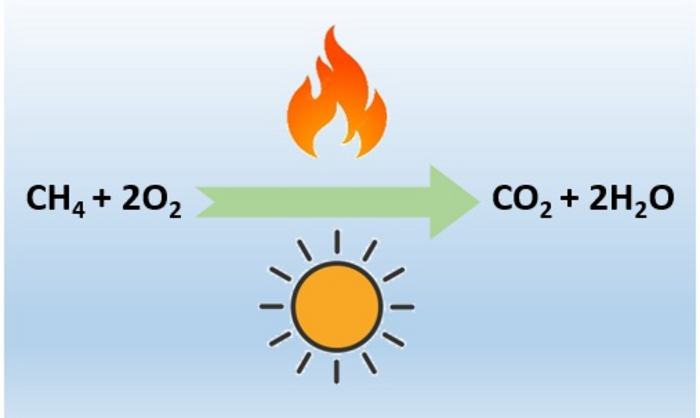
Catalytic Methane Removal to Mitigate its Environmental Effect

Credit: ©Science China Press

This review is led by Prof. Junwang Tang (Department of Chemical Engineering, University College London; and Department of Chemical Engineering, Tsinghua University). The review summarised recent progresses in the oxidation of methane via both thermocatalysis and photocatalysis in the aspect of environmental remediation.

“Methane, with its huge reserve and wide application, has caused a strong greenhouse effect due to its high global warming potential nearly 30 times that of CO2. Catalytic oxidation of methane directly to CO2 offers a potential pathway to mitigate the adverse impact caused by methane emission. Traditional thermocatalysis use noble metal or transition metal and their oxides as catalysts to convert methane into CO2 and H2O with O2 at high temperatures. Alternatively, photocatalysis opens a green pathway to drive this reaction at ambient conditions in the presence of a photocatalyst and under light irradiation. Development of methane removal process via both thermocatalysis and photocatalysis hold great importance in scientific research, and significant potential in large-scale applications as well.” Tang says.

The recent catalytic methane oxidation processes are thus reviewed as follows: 1) The development of thermocatalysts, especially Pd-based catalysts are summarised and compared; 2) The deactivation of thermocatalysts at high temperatures and in the presence of H2O, sulfur contents, etc., is discussed; 3) Fundamental studies on the evolution of catalysts and surface chemistry during the catalytic process by advanced spectroscopies and microscopies are reviewed; 4) The synthesis and performance of photocatalysts for methane oxidation are compared; 5) The underlying photophysics and surface chemistry processes in photocatalytic methane oxidation are discussed to guide future studies; 6) Future work should focus on the development of efficient thermocatalysts work at lower temperatures or photocatalysts response to visible light; Reactor design is another important aspect, however, overlooked in many studies, to improve the overall performance of the reaction.

See the article:

Catalytic Methane Removal to Mitigate its Environmental Effect

https://doi.org/10.1007/s11426-022-1487-8


Journal

Science China Chemistry

DOI

10.1007/s11426-022-1487-8

Share12Tweet8Share2ShareShareShare2

Related Posts

Local Universe Expansion Rate More Precise Than Ever — Yet Still Mysteriously Inconsistent

Local Universe Expansion Rate More Precise Than Ever — Yet Still Mysteriously Inconsistent

April 11, 2026
Breakthrough in Mainz: New Dual-Frequency Paul Trap Achieves Milestone Toward Antihydrogen Creation

Breakthrough in Mainz: New Dual-Frequency Paul Trap Achieves Milestone Toward Antihydrogen Creation

April 10, 2026

Ultra-Low Efficiency Roll-Off and Over 20% Efficiency Achieved in High Color Purity Blue Perovskite QLEDs

April 10, 2026

Bumblebee Bacterium Enables Vitamin B2 Production in Soya Drinks

April 10, 2026

POPULAR NEWS

  • Boosting Breast Cancer Risk Prediction with Genetics

    47 shares
    Share 19 Tweet 12
  • Popular Anti-Aging Compound Linked to Damage in Corpus Callosum, Study Finds

    44 shares
    Share 18 Tweet 11
  • Imagine a Social Media Feed That Challenges Your Views Instead of Reinforcing Them

    1012 shares
    Share 400 Tweet 250
  • Revolutionary Theory Transforms Quantum Perspective on the Big Bang

    41 shares
    Share 16 Tweet 10

About

We bring you the latest biotechnology news from best research centers and universities around the world. Check our website.

Follow us

Recent News

Butterfly-Inspired Heart Chip Unveils Cardiomyocyte Mechanics

China’s Flexible Path to Net-Zero Energy Transition

CRISPR-Engineered Stem Cells for Parkinson’s Therapy

Subscribe to Blog via Email

Enter your email address to subscribe to this blog and receive notifications of new posts by email.

Join 78 other subscribers
  • Contact Us

Bioengineer.org © Copyright 2023 All Rights Reserved.

Welcome Back!

Login to your account below

Forgotten Password?

Retrieve your password

Please enter your username or email address to reset your password.

Log In
No Result
View All Result
  • Homepages
    • Home Page 1
    • Home Page 2
  • News
  • National
  • Business
  • Health
  • Lifestyle
  • Science

Bioengineer.org © Copyright 2023 All Rights Reserved.