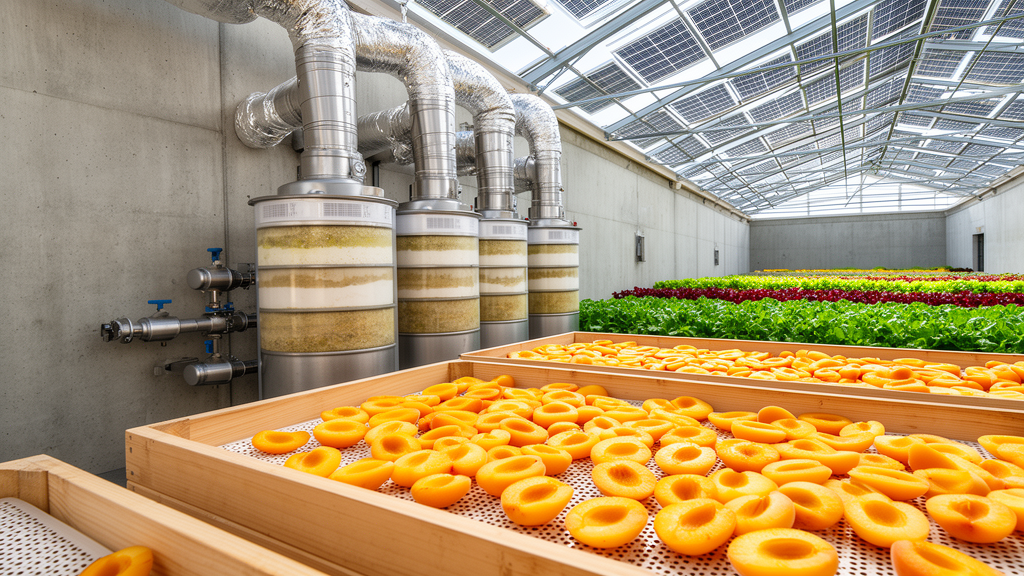
A numerical investigation of cascaded latent heat thermal energy storage systems indicates that allocating equal masses of phase change materials across cascade stages achieves the highest round-trip energy efficiency for solar crop drying operations. Conducted by researchers Mary Sally Kabasa, Saphina Biira, and Peter Tumutegyereize, the computational study evaluated how mass distribution and packed-bed porosity influence transient heat transfer, energy recovery, and exergy storage and recovery within a packed-bed thermal storage unit. Using finite element simulations in COMSOL Multiphysics 6.1, the investigation demonstrated that a uniform mass configuration attains a peak round-trip energy efficiency of 50.44 percent and sustains target drying temperatures for approximately 0.9 hours. In contrast, non-uniform configurations with larger fractions of high-temperature material achieved an overall exergy efficiency of 43.14 percent and exergy storage efficiency of 61.17 percent, underscoring that mass distribution must be aligned with specific drying performance objectives.
The research addresses post-harvest crop preservation in tropical agricultural communities, where open-sun drying remains the primary preservation method but suffers from weather intermittency and nocturnal delays. In rural farming systems, prolonged drying periods keep harvested produce at elevated water activity levels, accelerating microbial spoilage and driving substantial post-harvest losses. Agricultural standards require reducing crop moisture below 13 percent on a wet basis for safe storage, yet inadequate drying accounts for an estimated 37 percent loss of total crop value, representing approximately four billion dollars in annual grain losses across Sub-Saharan Africa. Integrating thermal energy storage into solar drying units bridges the gap between solar availability and demand by maintaining drying temperatures through night hours and overcast periods. Latent heat thermal energy storage provides an attractive solution, offering an energy storage density of approximately 100 kilowatt-hours per cubic meter compared to 50 kilowatt-hours per cubic meter for sensible storage systems, alongside relatively stable discharge temperatures.
Despite the high energy density of latent heat systems, practical deployment is constrained by the low thermal conductivity of organic phase change materials, which typically ranges from 0.1 to 0.6 watts per meter-kelvin. This low conductivity impedes heat transfer during charging and discharging, reducing overall system efficiency. To mitigate this limitation, the authors investigated a cascaded packed-bed arrangement using multiple materials with stepped melting temperatures arranged along the heat transfer fluid flow path. Cascading increases local temperature differences between the working fluid and storage media across consecutive stages, promoting synchronized phase change and maintaining more uniform heat transfer rates. To ground the technical design, the system was dimensioned around the thermal requirements of dehydrating at least 0.5 kilograms of high-moisture mushrooms from an initial moisture content of 90 percent down to 10 percent on a wet basis over a 12-hour overnight window spanning from six in the evening until six in the morning.
Meeting this drying requirement demanded delivering heated air within a target range between 40 and 50 degrees Celsius, anchored to a baseline drying temperature of 43.63 degrees Celsius. The modeled storage unit comprised a vertical, insulated stainless steel cylinder with an active height of 0.9 meters, an internal radius of 0.2 meters, a diameter of 0.4 meters, and 0.1-meter conical flow sections. These capsules accommodated approximately 33 kilograms of phase change materials, with each capsule holding roughly 0.0907 kilograms. Materials filled 80 percent of capsule volume to allow for phase volume expansion, while a 30 percent overload factor was incorporated into sizing calculations to account for inactive dead mass at capsule extremities that does not contribute to latent heat exchange.
The three commercial organic phase change materials selected from paraffin wax and organic acid classes were PCMCOOL-BIO48 (PCM1, melting at 48 degrees Celsius), PCMCOOL-BIO38 (PCM2, melting at 38 degrees Celsius), and PCMCOOL-NP28 (PCM3, melting at 28 degrees Celsius). Liquid water served as the heat transfer fluid due to its favorable thermal properties, low viscosity, non-toxicity, and material compatibility. Energy input was modeled on solar collection parameters in Uganda, where mean horizontal solar irradiance averages 5.1 kilowatt-hours per square meter per day, providing a representative operational irradiance of 406.3 watts per square meter. Coupled to a 2.1-square-meter flat-plate collector operating at an efficiency of 0.459, the simulated solar thermal power delivered to the storage vessel was 391.63 watts. Numerical simulations were executed using a two-dimensional axisymmetric domain in COMSOL Multiphysics 6.1 under local thermal non-equilibrium porous media physics, incorporating Ergun equation pressure losses and an apparent heat capacity phase-change formulation.
The study systematically evaluated four mass-loading configurations at a constant heat transfer fluid flow rate of 1.5 liters per minute, or 2.5 times ten to the negative fifth cubic meters per second. Configurations C(14:9:5), D(5:9:14), and F(5:14:9) distributed masses of 5.80, 10.98, and 16.24 kilograms across the three stages, while case G(1:1:1) maintained equal 11.0-kilogram loadings as a baseline. Because capsule loading density directly dictated bed voidage within each 0.3-meter section, local porosities varied inversely with phase change material mass, ranging between 0.30 and 0.75 across the configurations. Charging was simulated by introducing hot fluid at 60 degrees Celsius at the top of the tank over an eight-hour period from an initial ambient temperature of 22 degrees Celsius. Discharging reversed the flow, introducing cold fluid at 20 degrees Celsius from the bottom. Grid independence tests verified that an 8,704-element fine mesh limited output parameter deviation to below 2.2 percent.
Transient thermal tracking during charging revealed that PCM1 heated immediately upon contact with the 60-degree-Celsius fluid, whereas PCM2 and PCM3 experienced latency periods of approximately 0.25 and 0.5 hours due to attenuated thermal gradients at low flow rates. Low-temperature PCM3 melted fastest across all configurations, reaching nearly 100 percent liquid saturation within 1.0 hour because its 28-degree melting threshold sustained a wide heat transfer driving force. Consequently, case D(5:9:14), dominated by PCM3, exhibited shorter initial no-heating phases and rapid energy accumulation. However, liquid-phase saturation contours indicated that excessive bed porosity in the upper layers of cases D and F reduced fluid-capsule contact area, delaying PCM1 melting. Nocturnal discharging proceeded from the tank bottom upward, where growing solid layers imposed conduction-dominated thermal resistance that caused discharging durations to consistently exceed charging times. This resistance effect was most pronounced in case D, causing prolonged cooling at sub-target temperatures.
Energy analysis demonstrated that total energy stored did not correlate directly with useful heat delivery at target drying temperatures. Configuration D(5:9:14) stored the highest energy in the phase change materials at 10.007 megajoules and achieved the highest charging efficiency at 51.75 percent, owing to the high latent heat of PCM3 at 220,000 joules per kilogram. Case C(14:9:5) stored the least material energy at 9.854 megajoules, with a charging efficiency of 51.39 percent. However, during discharge, configuration D released the lowest total energy of 20.550 megajoules and exhibited the lowest discharge efficiency at 91.37 percent, with its exit fluid lingering near 24 degrees Celsius after 3.0 hours. In contrast, baseline configuration G(1:1:1) yielded the highest discharged energy of 21.632 megajoules, a discharge efficiency of 97.92 percent, and the highest round-trip efficiency of 50.44 percent, sustaining temperatures between 40 and 50 degrees Celsius for approximately 0.9 hours.
Exergy analysis highlighted the superior thermodynamic quality of high-temperature storage configurations over systems dominated by low-temperature media. Configuration C(14:9:5) achieved the highest stored exergy at 1,453,417.72 joules and recovered exergy of 1,025,043.34 joules, attaining an exergy storage efficiency of 61.17 percent and an overall exergy efficiency of 43.14 percent, representing a 17.2 percent improvement over case D(5:9:14). Baseline configuration G(1:1:1) followed closely, storing 1,419,978.11 joules and recovering 995,008.51 joules with an exergy storage efficiency of 59.76 percent. Because exergy measures available work relative to ambient surroundings, heat stored at 48 degrees Celsius possesses greater thermodynamic potential than heat stored near ambient in low-melting media. Configuration D delivered the lowest recovered exergy, demonstrating that high bulk energy storage provides minimal practical utility when delivered heat falls below the operational threshold required for crop dehydration.
Sensitivity analysis on configuration C(14:9:5) revealed that a 10 percent increase in thermal conductivity accelerated charging and discharging while significantly increasing recovered exergy, whereas flow rate and inlet temperature strongly influenced duration and thermal driving force. Multi-criteria decision analysis using weighted sensitivity indices assigned highest priority to recovered energy and exergy (29 percent each), followed by target temperature duration (21 percent), charging duration (14 percent), and discharge duration (7 percent). Configurations G(1:1:1) and C(14:9:5) tied with the highest suitability score of 0.97 for extended night drying. Flow rate evaluations on configuration G indicated that raising charging flow rates from 2.5 to 5.0 liters per minute reduced charging duration from 2.25 to 1.5 hours, though discharge duration similarly dropped from 2.5 to 1.5 hours. The authors noted that their two-dimensional numerical model neglected three-dimensional flow maldistributions and relied on coupled mass-porosity assumptions, underscoring the necessity of physical experimental validation.
Subject of Research: Thermal performance of cascaded phase change material mass ratios in packed-bed latent heat storage for solar crop drying
Article Title: Numerical investigation of cascaded phase-change material mass ratios for latent heat thermal energy storage in solar crop drying
Article References: Kabasa, M. S., Biira, S., & Tumutegyereize, P. (2026). Numerical investigation of cascaded phase-change material mass ratios for latent heat thermal energy storage in solar crop drying. Discover Energy, 6(1), Article 66. https://doi.org/10.1007/s43937-026-00167-y
Image Credits: AI Generated
DOI: 10.1007/s43937-026-00167-y
Keywords: latent heat thermal energy storage, cascaded phase change materials, solar crop drying, packed-bed storage, round-trip energy efficiency, exergy efficiency, bed porosity, COMSOL Multiphysics, heat transfer fluid, temperature control, mushroom drying, local thermal nonequilibrium, apparent heat capacity model, multi-criteria decision analysis, sensitivity analysis, paraffin wax PCMs, post-harvest losses, thermal energy storage
News Source: Alan Morgan. (November 12, 2026). Cascaded Phase Change Material Mass Balancing Optimizes Solar Crop Drying Heat Storage. Scienmag.