What do the flow of cars on a highway and the movement of bacteria towards a food source have in common? In both cases, annoying traffic jams can form. Especially for cars, we might want to understand how to avoid them, but perhaps we’ve never thought of turning to statistical physics, as Alexandre Solon, a physicist from Sorbonne Université, and Eric Bertin, from the University of Grenoble, both working for the Centre national de la recherche scientifique CNRS, have done. Their research, recently published in the Journal of Statistical Mechanics: Theory and Experiment (JSTAT), has developed a one-dimensional mathematical model that describes the movement of particles in situations similar to cars moving along a road or bacteria attracted to a nutrient source, which they then tested with computer simulations to observe what happened as parameters varied.
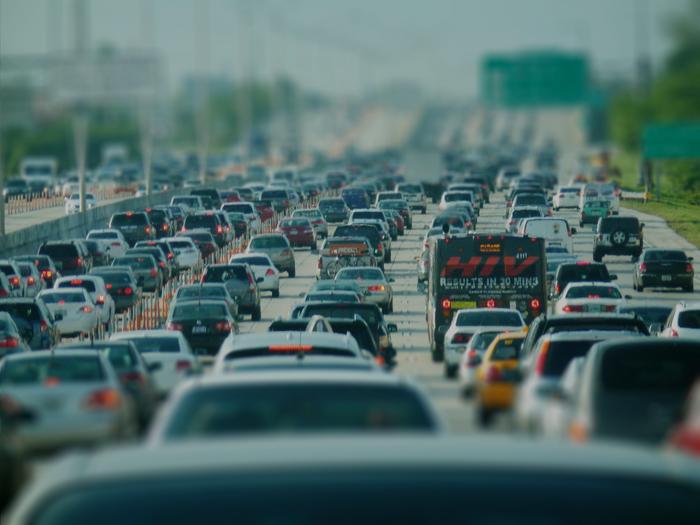
Credit: Public Domain
What do the flow of cars on a highway and the movement of bacteria towards a food source have in common? In both cases, annoying traffic jams can form. Especially for cars, we might want to understand how to avoid them, but perhaps we’ve never thought of turning to statistical physics, as Alexandre Solon, a physicist from Sorbonne Université, and Eric Bertin, from the University of Grenoble, both working for the Centre national de la recherche scientifique CNRS, have done. Their research, recently published in the Journal of Statistical Mechanics: Theory and Experiment (JSTAT), has developed a one-dimensional mathematical model that describes the movement of particles in situations similar to cars moving along a road or bacteria attracted to a nutrient source, which they then tested with computer simulations to observe what happened as parameters varied.
“The model is one-dimensional because the elements can only move in one direction, like on a one-lane one-way street,” explains Solon. It’s an idealized situation, but not so different from what happens on many roads where you can find yourself stuck in rush hour traffic. The models from which this research is derived historically come from studying the behavior of atoms and molecules, for example, those in a gas being heated or cooled. In the case of Bertin and Solon’s model, however, the behavior of the individual elements is a bit more sophisticated than that of an atom. “Among other things, a component of inertia has been inserted, which can be more or less pronounced, replicating for example the reactivity of a driver at the wheel. We can imagine a fresh and reactive driver, who brakes and accelerates at just the right moments, or another one at the end of the day, more tired and struggling to stay in sync with the rhythm of the flow of cars they are in,” Solon explains.
By conducting simulations with different values of certain parameters (the density of the elements, inertia, speed), Solon and Bertin were able to determine both situations in which traffic flowed smoothly or, on the contrary, became congested, as well as the type of jams that formed: large and centralized, or smaller and distributed along the route, akin to a “stop-and-go” pattern.
Borrowing language from statistical mechanics, Solon speaks of phase transitions: “just as when the temperature changes water becomes ice, when the values of some parameters change, a smooth flow of cars becomes a congestion, a knot where no movement is possible.” When the system reaches a critical density or when movement conditions favor accumulation rather than dispersion, the particles begin to form dense clusters, similar to traffic jams, while other areas may remain relatively empty. Traffic jams, therefore, can be seen as the dense phase in a system that has undergone a phase transition, characterized by low mobility and high localization of particles.
Solon and Bertin have thus identified conditions that can favor this congestion. Continuing with the metaphor of cars, contributing to the formation of traffic jams is the high density of vehicles, which reduces the space between one vehicle and another and increases the likelihood of interaction (and thus slowdown). Another condition is the frequent entries and exits from the flow: the addition of vehicles from the access ramp or attempts to change lanes in dense areas increase the risk of slowdowns, especially if vehicles try to merge without leaving sufficient space. A third factor is the already mentioned inertia in the behavior of drivers, who, when they react with some delay to changes in the speed of the vehicles ahead of them, create a chain reaction of braking that can lead to the formation of a traffic jam. In contrast the aggregation observed in bacterial colony happens in absence of any inertia and bacteria can move in any direction contrary to cars that need to follow the direction of traffic. As Éric Bertin says ” it is thus interesting and surprising to find that both types of behaviors are connected and can be continuously transformed into one another.”
Journal
Journal of Statistical Mechanics Theory and Experiment
Method of Research
Computational simulation/modeling
Subject of Research
Not applicable
Article Title
Biased motility-induced phase separation: from chemotaxis to traffic jams
Article Publication Date
30-Apr-2024