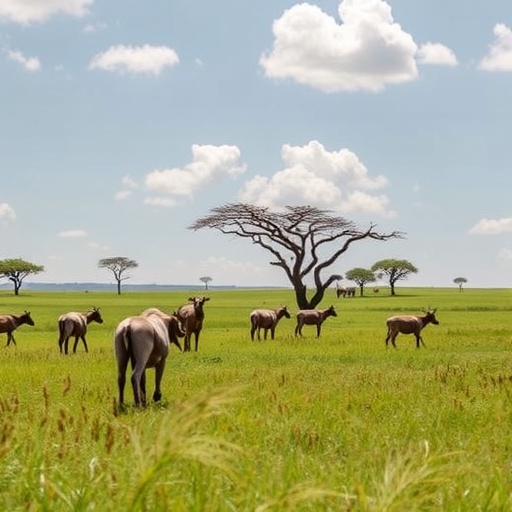
In an era marked by escalating environmental challenges and the urgent need for sustainable agricultural practices, a groundbreaking study has emerged from a collaborative team of researchers led by Yu, S., Zhang, X., and Liu, Y. Their innovative work presents a novel approach to assessing the sustainability of African grasslands in relation to livestock use. Published in Nature Communications in 2025, their study introduces the Carrying Capacity Alert Index (CCAI), a pioneering tool designed to quantify and predict the limits of grassland ecosystems in supporting livestock populations sustainably. This advancement is poised to reshape how stakeholders, from policymakers to pastoralists, manage these critical natural resources.
African grasslands constitute some of the most extensive and ecologically vital terrestrial ecosystems on the planet. These grasslands support a diverse array of wildlife and serve as the backbone for livestock-based livelihoods for millions of people. However, increasing pressures from expanding agricultural activities, climate variability, and socio-economic factors have heightened concerns about their long-term viability. The CCAI emerges against this backdrop, offering a scientifically rigorous yet practical method to monitor and manage grassland sustainability, potentially averting irreversible ecological degradation.
The developed Carrying Capacity Alert Index functions by integrating multiple environmental and anthropogenic parameters into a single evaluative framework. Key variables include vegetation productivity, soil quality, precipitation patterns, grazing intensity, and livestock density. By synthesizing these indicators, the CCAI provides real-time dynamic assessments of how close a given grassland system is to exceeding its ecological carrying capacity. Exceeding this capacity often triggers degradation processes, catalyzing a loss of biodiversity and a decline in forage quality, ultimately threatening the resilience of pastoral systems.
Technically, the construction of the CCAI involved extensive remote sensing data fusion with ground-based ecological surveys. High-resolution satellite imagery was employed to capture temporal variations in vegetation cover and biomass, while soil samples and precipitation data were collected through collaborative field studies across multiple transcontinental sites. The researchers utilized advanced algorithms to calibrate and validate the index, ensuring its sensitivity and specificity aligned closely with on-the-ground conditions.
One of the most remarkable features of the CCAI is its ability to serve as an early warning system. Through sophisticated trend analysis and predictive modeling, the index can forecast potential overshoot events—periods when livestock numbers exceed sustainable levels before ecological damage becomes evident. This predictive capacity empowers stakeholders to initiate timely management interventions, such as adjusting livestock stocking rates or implementing rotational grazing schemes, thereby mitigating environmental stress before irreversible degradation occurs.
The study also underscores the nuanced interplay between climatic fluctuations and grassland sustainability. The African continent experiences marked interannual variability in rainfall, which profoundly influences primary productivity. By incorporating climate data into the CCAI, the researchers have demonstrated how drought conditions and anomalous wet periods can alter carrying capacity thresholds, enabling a more adaptive and context-sensitive approach to resource management. This feature enhances the index’s utility under the realities of climate change.
Importantly, the CCAI is not merely an academic construct but is designed with practical applicability at its core. The researchers engaged extensively with local pastoral communities and land managers during the development phase to ensure that the index’s outputs translate into actionable insights. For example, accessible graphical dashboards and mobile-compatible platforms were developed to disseminate risk alerts and sustainability ratings, facilitating real-time decision-making at the grassroots level.
The implications of the CCAI extend beyond localized grassland management. From a broader ecological perspective, maintaining the integrity of African grasslands is essential for global carbon sequestration efforts and biodiversity conservation. Grasslands act as significant carbon sinks and habitat reservoirs, and their degradation can release vast stores of greenhouse gases while precipitating species loss. By providing a robust mechanism to curb overexploitation, the CCAI contributes meaningfully to international sustainability goals including those embedded in the United Nations Sustainable Development Goals framework.
Furthermore, given the economic centrality of livestock agriculture to numerous African economies, the index holds socio-economic significance. Livestock not only provides food and income but also plays an intrinsic cultural role in many pastoral societies. Sustainable management of grasslands ensures the longevity of these benefits while reducing the likelihood of land degradation-driven impoverishment and displacement. The study’s authors advocate for integrating the CCAI into national and regional agricultural policies as a standardized tool to harmonize development and conservation objectives.
The creation of the CCAI required the synthesis of interdisciplinary scientific domains including ecology, remote sensing, climatology, and data science. This integrative approach is emblematic of the contemporary shifts in environmental research toward holistic frameworks capable of addressing complex socio-ecological systems. The study highlights how cutting-edge computational methods coupled with empirical data collection can yield insights that are both profound and pragmatically valuable.
Critically, challenges remain in scaling the use of the CCAI across the diverse and heterogeneous landscapes of Africa. Variability in governance structures, data availability, and technological infrastructure between countries and regions necessitates tailored adaptation of the tool. The authors recognize these constraints and propose phased implementation strategies underpinned by capacity-building initiatives to foster local expertise and institutional ownership.
In terms of future directions, the researchers envision expanding the index to incorporate additional ecological components such as wildlife dynamics and invasive species pressures. Enhancements in machine learning algorithms for more refined predictive analytics are also anticipated. Moreover, establishing transboundary collaborations to share data and co-develop context-specific management guidelines will be critical to maximizing the CCAI’s impact across the continent.
The reception of this research within the scientific and environmental management communities has been enthusiastic. Experts commend the clarity and applicability of the CCAI as a transformative approach to grassland sustainability assessment. There is growing consensus that tools like the CCAI are indispensable for tackling the intricate challenges posed by environmental change in grassland systems worldwide.
In conclusion, Yu, Zhang, Liu, and their colleagues have delivered a seminal contribution to sustainable livestock and grassland management through the development of the Carrying Capacity Alert Index. This innovative tool encapsulates complex ecological realities into an accessible, predictive framework that promises to guide stewardship efforts, safeguard ecosystems, and sustain livelihoods across Africa’s vast grasslands. As environmental pressures mount globally, such visionary integrations of technology and ecology symbolize the hopeful pathways toward resilient and equitable agricultural futures.
Subject of Research: Assessment and management of African grassland sustainability for livestock use
Article Title: Assessment of African grassland sustainability for livestock use by constructing a carrying capacity alert index
Article References:
Yu, S., Zhang, X., Liu, Y. et al. Assessment of African grassland sustainability for livestock use by constructing a carrying capacity alert index. Nat Commun (2025). https://doi.org/10.1038/s41467-025-68084-7
Image Credits: AI Generated
Tags: African grassland sustainabilityCarrying Capacity Alert Indexclimate impact on grasslandsecological degradation preventionenvironmental monitoring in grasslandsgrassland ecosystem assessmentinnovative agricultural researchlivestock management toolsNature Communications 2025 studysocio-economic factors in livestocksustainable agriculture practiceswildlife conservation in Africa