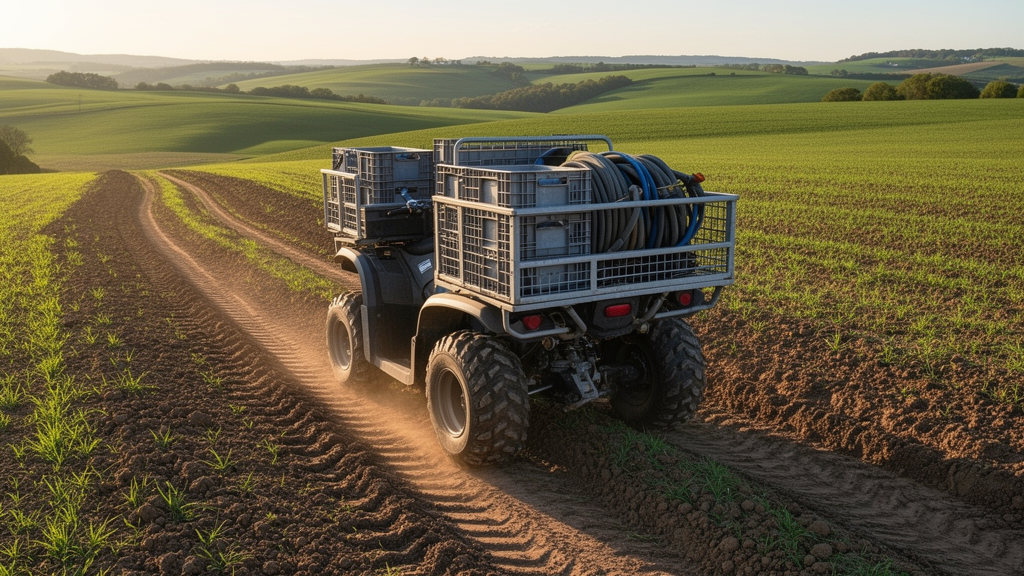
An experimental evaluation of dynamic stability across five agricultural all-terrain vehicle models reveals that cargo attachments significantly impair transient steering response times in smaller vehicles while leaving steady-state lateral acceleration limits largely unchanged. Conducted by researchers Fernando Ferreira Lima dos Santos and Farzaneh Khorsandi at the University of California Pavement Research Center at UC Davis, the investigation systematically examined how mounting solid and liquid payloads alters dynamic handling associated with farm rollover crashes. Agricultural environments present acute hazards for quad bikes, contributing to approximately 60 percent of all occupational all-terrain vehicle fatalities occurring on farms and ranches. Among those fatalities, 85 percent stem directly from vehicle rollover incidents, with stability serving as the primary factor determining rollover propensity during daily field tasks. In 75 percent of fatal farm accidents, workers had at least one attachment mounted, and sprayers were implicated in over 40 percent of cases. Testing five commercial machines under standardized dynamic maneuvers established empirical relationships between attachment placement, payload mass, and vehicle architecture.
Transporting cargo is routine in agricultural settings, yet adding equipment alters all-terrain vehicle dynamics by changing operating mass, elevating center of gravity height, and redistributing axle loads. Solid cargo alone can reduce static rollover stability by up to 20 percent and increase steering response times during cornering maneuvers by up to 64 percent. Liquid payloads, such as unbaffled chemical spray tanks, introduce dynamic complexity due to fluid sloshing during acceleration, braking, and steering. Sloshing fluid induces rapid, transient center of gravity displacements and generates lateral dynamic forces that increase roll moments, especially when fluid oscillation frequencies align with natural vehicle roll resonance. Although sloshing phenomena have been studied extensively in articulated road tankers and heavy tractors, those findings cannot be directly applied to all-terrain vehicles. Unlike trucks operating on highways or tractors moving slowly with low relative towing limits, quad bikes possess narrow track widths, short wheelbases, elevated centers of gravity, and towing capacities reaching up to 200 percent of vehicle mass.
To quantify dynamic stability across diverse vehicle configurations, the research team selected five commercially popular agricultural all-terrain vehicle models, designated Vehicles A through E, representing diverse weights, dimensions, and suspension systems. Vehicle mass ranged from 282 kilograms for Vehicle E up to 440 kilograms for Vehicle D, with wheelbases measuring between 1110.0 millimeters and 1320.8 millimeters and track widths spanning 802.6 millimeters to 1016.0 millimeters. Center of gravity heights varied between 696.0 millimeters and 776.0 millimeters when tested with a standard 95th-percentile adult male rescue manikin. While all five vehicles utilized independent double-wishbone front axle suspensions, their rear suspension designs differed fundamentally: Vehicles A and E incorporated solid rear axle suspensions, whereas Vehicles B, C, and D featured independent rear assemblies. The testing matrix comprised 420 experimental trials, evaluating unloaded baseline setups alongside configurations carrying solid metal plates or partially filled water tanks mounted on front racks, rear racks, or combined rack assemblies according to manufacturer specifications and safety-specialist loading recommendations.
Experimental data collection utilized an integrated prototype instrumentation package coordinated by a Raspberry Pi 4 single-board computer sampling inertial and steering data at 40 hertz. This sampling rate was selected based on the Nyquist-Shannon sampling theorem to capture steering, roll, and lateral acceleration frequencies below 10 hertz without aliasing or overburdening computational hardware, while global positioning system data logged speed at 1 hertz. An Xsens MTi-630 inertial measurement unit mounted under the seat near the center of gravity recorded vehicle attitude and lateral acceleration with a root-mean-square accuracy of 0.2 degrees in roll and pitch. Steering angle was recorded via a Grayhill rotary encoder linked to the handlebar steering shaft through a timing belt and 3D-printed pulley system with a 6.22-to-1 transmission ratio, providing an effective resolution of 0.226 degrees per count. To protect the test rider during severe wheel-lift maneuvers without providing mechanical support during normal turns, universal safety outriggers extending 890 millimeters outward with 370 millimeters of stationary ground clearance were installed on all vehicles.
Dynamic performance was evaluated using two established vehicular procedures adapted specifically for quad bikes and handlebar steering mechanics. The lateral transient response test, adapted from ISO 7401 passenger car test guidelines, measured vehicle response time during a rapid J-turn maneuver performed at a constant forward velocity of 20 kilometers per hour. Steering inputs were bounded using a physical mechanical stop on the handlebars to target a lateral acceleration of 0.4 g based on Ackerman steering geometry and vehicle wheelbase, with response time measured between the moment steering reached 50 percent of its final input and yaw rate reached 90 percent of steady state. Complementing transient testing, steady-state circular driving tests adapted from ANSI/ROHVA 1-2016 evaluated steering characteristics and lateral acceleration boundaries around a 7.6-meter radius circular path. Vehicles accelerated slowly from 2 kilometers per hour until wheel lift, outward rear tire slip, path departure, or speed limits were reached. Digital filtering using Butterworth low-pass filters, moving averages, and histogram-based steady-state extraction in Python preserved dynamic fidelity while eliminating noise.
Under baseline unloaded conditions, all five tested all-terrain vehicles demonstrated rapid transient responsiveness, exhibiting average response times between 0.17 and 0.32 seconds that remained safely below the 0.5-second safety threshold. However, adding cargo to rear carrying racks generated dramatic, vehicle-dependent variations. Smaller vehicles proved exceptionally vulnerable to payload alterations: Vehicle A experienced severe handling delays, jumping from a baseline of 0.31 seconds to 0.78 seconds with liquid payloads and reaching 0.92 seconds under safety-specialist solid loads, exceeding the safety threshold in three out of five rear-loading conditions. Factorial analysis of variance revealed that cargo weight significantly influenced Vehicle A, as rearward mass distribution increased vertical yaw moment of inertia and delayed steady-state yaw rate. For Vehicle E, response time was significantly affected by both payload type and turning direction, driven by a 26-millimeter lateral center-of-gravity offset. In contrast, larger models maintained rapid response times between 0.12 and 0.24 seconds, demonstrating substantial resistance to cargo-induced handling degradation.
In sharp contrast to transient handling metrics, steady-state circular driving trials demonstrated that cargo attachment type and payload mass exerted no statistically significant effect on the absolute limit of lateral acceleration. Across all five vehicle models and all evaluated rear loading configurations, dynamic lateral acceleration limits remained consistently confined within a narrow band of 0.4 to 0.5 g. Two-way analysis of variance confirmed that neither maximum loading recommendations nor cargo type produced significant alterations in steady-state rollover thresholds. Furthermore, comparisons with quasi-static tilt table ratios demonstrated that static metrics consistently overestimated dynamic lateral acceleration limits. The authors explained that dynamic cornering induces substantial lateral tire compliance and tread deflection in high-profile tires, effectively reducing track width and lowering dynamic rollover thresholds below quasi-static predictions. Two-wheel lift occurred in 75 percent of rear-rack trials, while vehicle path departure occurred in 20 percent and rear-end spin-out occurred in 5 percent, confirming that wheel lift governs steady-state stability.
Steering characteristic evaluations revealed a pervasive tendency toward oversteer behavior across the tested vehicle configurations. During steady-state circular maneuvers with rear rack attachments, oversteer accounted for 53 percent of trials, understeer appeared in 24 percent, transitions from understeer to oversteer occurred in 20 percent, and transitions from oversteer to understeer represented 3 percent. Binary logistic regression confirmed that neither load type nor load amount had a statistically significant influence on steering classifications, indicating that steering characteristics were dictated primarily by vehicle design rather than cargo parameters. The two models equipped with solid rear axle suspensions, Vehicles A and E, accounted for 68 percent of all observed oversteer cases, displaying consistently negative steering gradients. In contrast, models featuring independent rear suspensions displayed more diverse behaviors: Vehicle B maintained near-neutral handling with slight oversteer, Vehicle D consistently exhibited understeer, and Vehicle C exhibited variable oversteer gradients, demonstrating that suspension geometry strongly influences directional stability during cornering.
Evaluating load distribution across carrying racks demonstrated that dividing cargo mass between front and rear racks provides superior dynamic stability compared to rear-only loading. Under manufacturer-recommended loading using solid attachments, the combined front and rear rack configuration produced the most stable and uniform transient response times across the fleet, with four of the five models achieving response times of 0.25 seconds or less. Analysis of variance demonstrated that rack placement significantly affected steering response times in four of the five vehicle models. Concentrating cargo entirely on either the front or rear rack elevated roll and yaw moments of inertia, reducing angular acceleration for a given steering input and delaying transient stabilization. In contrast, balanced load distribution mitigated longitudinal inertial asymmetry, facilitating rapid yaw stabilization. While one-way analysis of variance indicated a statistically significant overall placement effect on lateral acceleration limits, post-hoc Tukey pairwise comparisons detected no significant differences between specific placement combinations, reinforcing that steady-state lateral boundaries remain governed by vehicle geometry.
Assessing vehicle performance against the ANSI/ROHVA 1-2016 criterion demonstrated notable limitations when applying generic off-road standards to agricultural all-terrain vehicles. Because two-wheel lift occurred before reaching 0.5 g in most trials, every tested model received negative normalized scores on the slope-lift safety index, indicating that standards grouping quad bikes with wider, more stable side-by-side vehicles fail to reflect quad-bike dynamics accurately. The authors emphasized that safety assessments must incorporate transient response times and steering gradients alongside steady-state thresholds. Several experimental limitations were noted, including conducting tests exclusively on smooth asphalt rather than irregular soil, maintaining factory tire inflation pressures, and omitting towed implements due to rider safety constraints. Future investigations must examine the coupled kinematics of tire pressure, suspension compliance, and variable surface topography. Nevertheless, the study demonstrates that agricultural all-terrain vehicle safety depends critically on avoiding heavy rear-rack loading and recognizing that smaller, solid-axle vehicles face heightened operational rollover hazards during routine farm operations.
Subject of Research: The effect of cargo attachments on agricultural ATV dynamic stability and handling
Article Title: Evaluating the impact of attachments on the dynamic stability of agricultural all-terrain vehicles
Article References: Ferreira Lima dos Santos, F., & Khorsandi, F. (2026). Evaluating the impact of attachments on the dynamic stability of agricultural all-terrain vehicles. Results in Engineering, 32, Article 114125. https://doi.org/10.1016/j.rineng.2026.114125
Image Credits: AI Generated
DOI: 10.1016/j.rineng.2026.114125
Keywords: all-terrain vehicles, agricultural safety, vehicle stability, dynamic handling, rollover prevention, liquid sloshing, center of gravity, transient response time, lateral acceleration, suspension architecture, solid rear axle, steady-state circular test, load distribution, two-wheel lift, static stability factor, sprayer tanks, off-road vehicle dynamics
News Source: Denise Maddox. (November 21, 2026). Cargo Attachments Delay ATV Steering Response in Smaller Agricultural Models. Scienmag.