Credit: Shawn Rocco, Duke Health
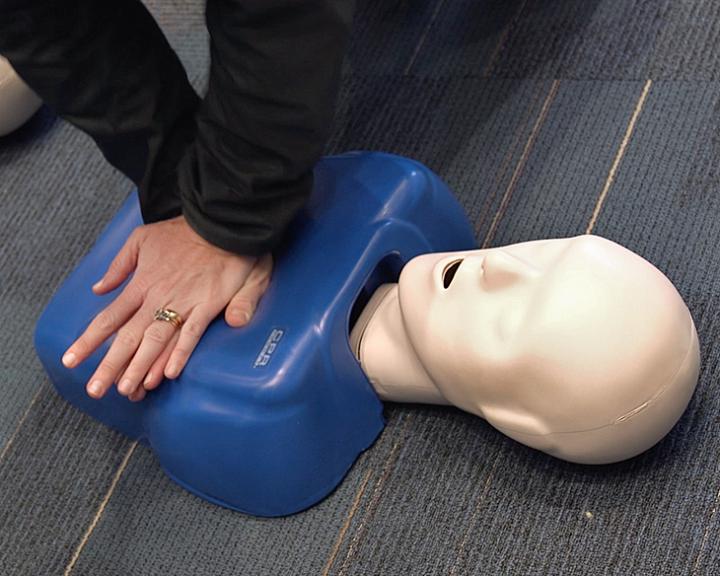
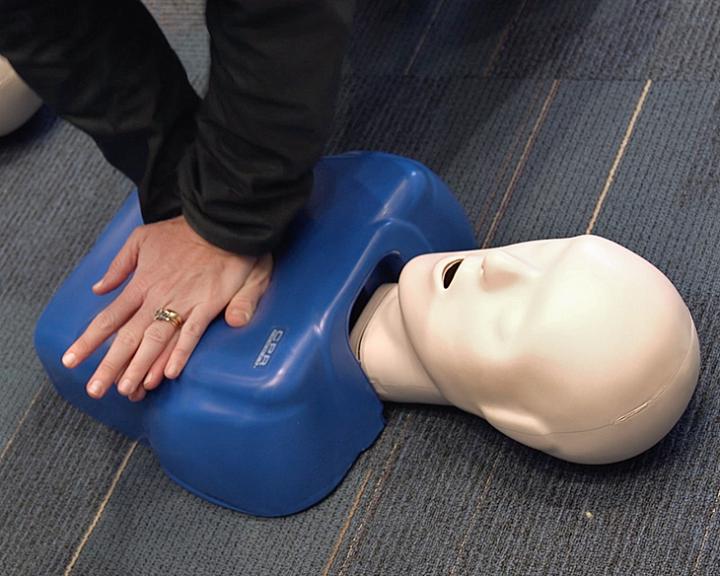
DURHAM, N.C. — Surviving cardiac arrest often seems like a matter of luck — whether a passerby knows CPR, or a defibrillator is close at hand or the ambulance arrives quickly.
But one surprising factor also plays a role: The racial makeup of your neighborhood.
Compared to people who live in predominantly white neighborhoods, those who live in predominantly black areas are much less likely to receive CPR or defibrillation from a bystander when their heart suddenly stops beating while they are at home or out in the community.
And that appears to translate into a worse chance of survival for people in black neighborhoods, according to a study published online Aug. 30 in JAMA Cardiology by researchers at the Duke Clinical Research Institute.
"We have known that there are differences in the rates of survival from cardiac arrest between blacks and whites, but it was surprising to see how the demographics of a neighborhood affected outcomes of residents who experience cardiac arrest," said lead author Monique Starks, M.D., a cardiologist and member of the Duke Clinical Research Institute. "This is absolutely a call to action to improve and expand CPR training and defibrillator access."
Starks and colleagues — including senior author Graham Nichol, M.D., director of the University of Washington-Harborview Center for Prehospital Emergency Care — analyzed cardiac arrest data from a registry that includes information from seven U.S. cities: Birmingham, Dallas-Fort Worth, Pittsburgh, Portland, Seattle, and Milwaukee. U.S. Census data were used to provide demographic information at the neighborhood level.
The researchers analyzed more than 22,000 cases in which cardiac arrest occurred in a non-hospital setting over a four-year period between 2008-11. Neighborhoods where out-of-hospital cardiac arrests occurred were classified by census tract, based on percentage of black residents, ranging from fewer than 25 percent, between 25-50 percent, between 51-75 percent, and more than 75 percent.
Compared with patients who experienced a cardiac arrest in mainly white neighborhoods, those in predominantly black neighborhoods were slightly younger, more frequently female, had lower rates of initial shockable rhythm, and less frequently experienced their heart event in a public location.
Overall, nearly 40 percent of people stricken with cardiac arrest outside of the hospital received bystander CPR. In primarily white neighborhoods, the rate was almost 47 percent, but in predominantly black neighborhoods, the rate was just 18 percent.
Use of an automated external defibrillator was similarly disproportionate by racial composition of the neighborhood. In mostly white neighborhoods, 4.5 percent of cardiac arrest victims received defibrillation from a bystander, compared to 0.9 percent in black neighborhoods.
Neighborhood make-up was also associated with survival. People with cardiac arrest in mixed- to majority- black neighborhoods had significantly lower adjusted survival rates at hospital discharge, the researchers found.
"We clearly see that treatments and outcomes for patients with cardiac arrest in black neighborhoods are worse than those in white neighborhoods. We then asked does it matter if you were black or white within those neighborhoods?" Nichol said. "Our observations were reassuring. It actually does not matter if you are black or white within the neighborhood, but the neighborhood matters."
That finding, the researchers noted, points to a lack of education about cardiac arrest and CPR in general among people living in black neighborhoods, along with a dearth of defibrillators in public spaces.
"This is something that can be addressed," Starks said. "Organizations such as the American Heart Association and the American Red Cross, along with medical centers and public health departments, have a unique opportunity to address this issue with dedicated education programs that are particularly tailored for black neighborhood. This is a relatively low-cost solution that could save lives."
###
In addition to Starks and Nichol, study authors include Robert H. Schmicker, Eric D. Peterson, Susanne May, Jason E. Buick, Peter J. Kudenchuk, Ian R. Drennan, Heather Herren, Jamie Jasti, Michael Sayre, Dion Stub, Gary M. Vilke, Shannon W. Stephens, Anna M. Chang and Jack Nuttall on behalf of the Resuscitation Outcomes Consortium investigators.
The study was supported by the Resuscitation Outcomes Consortium, which was funded by the National Institutes of Health and American Heart Association. Starks also receives grant support from the National Institutes of Health Common Fund to promote diversity in health-related research (3U54AT007748-02S1).
Media Contact
Sarah Avery
[email protected]
919-660-1306
@DukeHealth
http://www.dukehealthnews.org