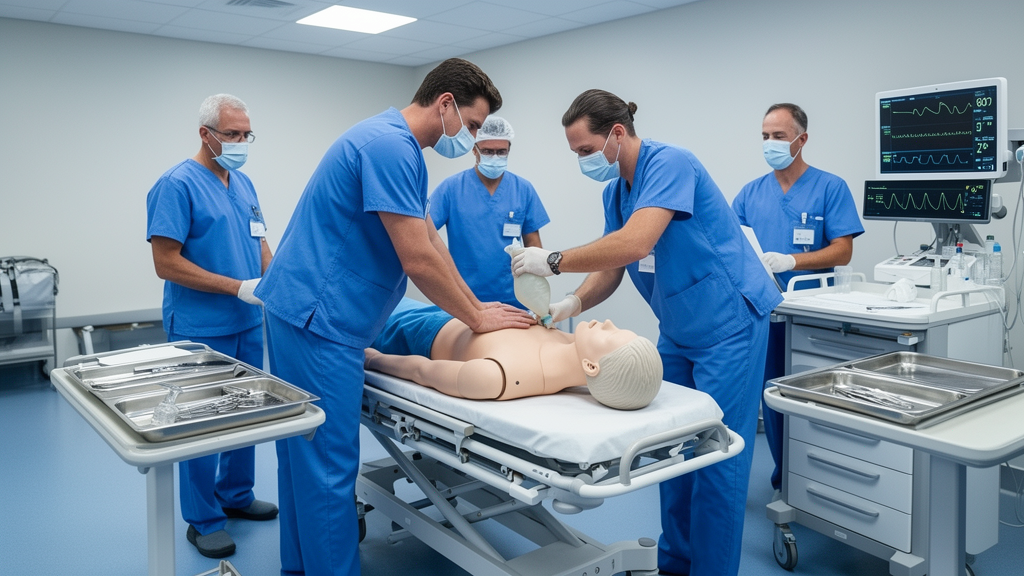
In an observational evaluation conducted across two Australian simulation centres, researchers examined how different simulation modalities support adult cardiac arrest training. The pragmatic mixed-methods study assessed whether learners and faculty perceived various training formats as offering sufficient realism for learning. Evaluating high-fidelity manikins, mobile applications, and virtual reality, the investigation evaluated how technological tools align with core educational goals during intensive medical resuscitation exercises.
Simulation-based education remains resource intensive across health professions training, creating continuous operational pressure to identify feasible and scalable delivery methods. To understand how expanding technologies can support essential educational objectives while preserving a beneficial participant experience, the investigators utilised functional task alignment as a sensitising conceptual lens. The inquiry examined adult cardiac arrest training events structured around three distinct implementation packages that shared broadly similar learning objectives.
The quantitative phase enrolled twenty-four simulation events representing one hundred eighty-eight total participation opportunities across the two facilities. Learners and faculty members completed post-event evaluation surveys assessing both perceived realism and whether the experienced realism was sufficient for learning. The evaluation prospectively designated perceived sufficiency of realism for learning as the principal quantitative survey outcome. In total, participants returned one hundred ten completed surveys, yielding an overall response rate of 58.5 percent.
Survey findings demonstrated comparable ratings for perceived sufficiency of realism across all three modalities. High-fidelity manikin-based simulation and app-based simulation each received a median rating of 8 out of 9, while virtual-reality simulation achieved a median rating of 7 out of 9. In ratings of patient responses and sounds, manikins received a median score of 7 out of 9, whereas app-based and virtual-reality modalities both received median ratings of 5 out of 9. Overall perceived fidelity medians reached 8 out of 9 for manikins, 6 out of 9 for applications, and 7 out of 9 for virtual reality.
The investigation also documented event-level implementation characteristics, observing that required faculty headcount varied across the three evaluated packages. Crucially, the authors emphasised that these quantitative observations remain descriptive and do not establish statistical differences, educational equivalence, or causal effects among the formats. The reported metrics instead capture operational experiences and participant perceptions within specific, pragmatic educational environments without testing comparative efficacy.
To explore contextual nuances, nine simulation educators and programme contributors participated in a semi-structured focus group analysed using codebook thematic analysis. The qualitative investigation identified three primary themes regarding realism and modality selection. First, participant realism was shaped through narrative structure, local context, personal engagement, and explicit alignment with defined learning objectives. Second, qualitative accounts revealed that technology could redistribute faculty implementation workload rather than simply reducing it. Third, educators noted that modality choices must directly reflect specific learning goals and local operating environments.
The authors concluded that selecting simulation modalities for cardiac arrest education requires careful functional task alignment rather than focusing on technological sophistication or perceived fidelity alone. Training decisions should balance specific learner needs, faculty capability, system reliability, and local implementation conditions. By tailoring simulation tools to pedagogical aims rather than novelty, educators can deliver feasible training packages that meet essential clinical learning objectives within real-world health education constraints.
Subject of Research: Evaluation of simulation modalities for adult cardiac arrest training
Article Title: Choosing simulation modalities for cardiac arrest training: a mixed-methods evaluation informed by functional task alignment
Article References: Coggins, A. R., Wu, T., Abednazari, M., & Warburton, S. (2026). Choosing simulation modalities for cardiac arrest training: a mixed-methods evaluation informed by functional task alignment. BMC Medical Education. https://doi.org/10.1186/s12909-026-10806-6
Image Credits: AI Generated
DOI: 10.1186/s12909-026-10806-6
Keywords: cardiac arrest training, simulation-based education, functional task alignment, high-fidelity manikins, virtual-reality simulation, app-based simulation, perceived realism, medical education, mixed-methods evaluation, codebook thematic analysis, faculty workload, resuscitation training, health professions education, educational fidelity, simulation centres, participant engagement, implementation context
News Source: Courtney Benton. (November 21, 2026). Cardiac Arrest Simulation Study Evaluates Realism and Workload Across Training Modalities. Scienmag.